
Travel Guide to Pembrokeshire

With 186 miles of breathtaking coastline and more blue flag beaches than any other county, Pembrokeshire is a national park like no other.
This beautiful stretch of crinkled coastline is the only UK national park to be situated completely on the coast and has a diverse landscape that houses rugged cliffs, hidden coves, and over 50 beaches to explore.
Whether you’re planning a weekend escape or a longer adventure, this guide brings together the very best things to do in Pembrokeshire.
From coastal walks and sunrise spots to iconic landmarks and local food, you’ll find everything you need to plan your trip, along with detailed guides to help you explore each location properly.
PEmbrokeshire Blogs
11 Of The Best Walks In Pembrokeshire
The Best Things To Do In Pembrokeshire
The Best Beaches In Pembrokeshire National Park
Five Of The Best Places To Watch The Sunrise In Pembrokeshire
The Best Photography Locations In Pembrokeshire
The Best Beaches In North Pembrokeshire
The 6 Best Places To Watch The Sunset In Pembrokeshire
Church Doors Cove And Skrinkle Haven
St Govan's Chapel
Green Bridge Of Wales And Stack Rocks
Bosherston Lily Ponds, Broadhaven South, & Barafundle Bay
Blue Lagoon, Abereiddi

Tips for visiting Pembrokeshire
-
Looking at a map, Pembrokeshire seems small, but the winding, rural roads mean getting from top to bottom takes much longer than you’d think.
It’s easy to try and fit too much into a short trip, but Pembrokeshire is best enjoyed at a slower pace rather than spending your whole trip in the car!
You are much better off picking one specific area, the North Coast (St Davids & the Blue Lagoon), the West Coast (Skomer & Marloes), or the South Coast (Tenby & Stackpole), and exploring it in detail.
-
Walking is by far the best way to experience Pembrokeshire. While the popular routes are incredible, don’t be afraid to explore lesser-known sections of the coast path. Almost all of the 186 miles offers something special, and the quieter stretches often feel even more rewarding. The further you get from the main hotspots, the more likely you are to have it almost entirely to yourself.
-
Do not rely on 4G to get you around! Phone service completely drops out on many of the beaches and coastal roads. Download your route on Google Maps for offline use or Wales on the app Maps.me before you leave your accommodation, and always keep a few physical coins in your car for the remote Pay & Display machines that can't connect to parking apps.
-
If you’re visiting popular locations, try to time your visit for early morning or late evening. The light is far better for photos, and you’ll avoid the crowds that build during the middle of the day.
A great way to structure your day is to visit your “must-see” location at sunrise or sunset, then spend the rest of your time relaxing on one of Pembrokeshire’s many beaches or exploring its small towns and villages at a slower pace.
-
A massive chunk of the Pembrokeshire coastline is managed by the National Trust. If you are doing a road trip, you will likely be parking at Martin’s Haven (for Skomer), Stackpole Quay (for Barafundle Bay), and Marloes Sands. The £5-£6 daily parking fees add up fast, so grabbing a National Trust membership before your trip usually pays for itself in just a few days. What’s more you can use it for the the year
-
To get to the best, most secluded spots, you will likely find yourself driving down narrow, single-track country lanes flanked by high hedgerows. Take it slow, keep an eye out for passing places, and be prepared to confidently reverse your car if you meet a tractor coming the other way!
-
Pembrokeshire gets incredibly busy in the summer, but it remains a deeply rural county. Many of the best pubs and seafood restaurants are small and get booked out weeks in advance. Also, kitchen hours can be strictly limited (often closing by 8:30 PM), so don't leave your evening meal up to chance.
-
Whether you are photographing the puffins on Skomer or hiking the coastline, please respect the National Park. Take all your litter home with you, stick to the footpaths, and give the local wildlife (especially the seals and their pups) plenty of space.
-
The sea here demands respect. If you are heading in for a dip, be aware of rip currents on the wilder west-facing beaches, and stick to RNLI-lifeguarded beaches if you aren't a confident swimmer. Crucially, always check the local tide times! Some coves and sections of the coastal path can get completely cut off at high tide.
-
Because it sits right on the edge of the Atlantic, Pembrokeshire has its own microclimate. You can easily experience bright sunshine, strong winds, and a sudden downpour all in the space of an hour. Even if you are visiting in August, pack layers and a good waterproof jacket.
-
Some of Pembrokeshire’s most dramatic sights, including the Green Bridge of Wales and St Govan’s Chapel, are located on the Castlemartin military firing range. If the red flags are flying, the roads are closed to the public. Always check before you drive down there to ensure the range is open to visitors that day.
https://www.gov.uk/government/publications/castlemartin-firing-notice--2

Getting to and around Pembrokeshire
Pembrokeshire is one of the most rewarding places to explore in the UK, but it’s also one of the least straightforward to get around. The coastline is spread out, many of the best spots sit at the end of narrow country lanes, and public transport can be limited in more rural areas.
Having a car gives you by far the most flexibility, allowing you to explore freely, reach hidden beaches, and move between different parts of the coast without relying on timetables.
That said, you’re not stuck if you don’t have one. With a bit of planning, it’s still possible to get around using trains and buses, especially during the summer months when services are more frequent. You just need to be a bit more selective with where you go and how you structure your days.
Below, I’ve broken down the best ways to get to Pembrokeshire and how to get around once you’re there.
-
By car - Driving is the easiest and most flexible option. From Swansea it takes around 1.5 to 2 hours, while from London it’s roughly 4 to 5 hours. Once you arrive, having a car makes it much easier to reach beaches, trailheads, and smaller villages.
By train - You can reach Pembrokeshire by rail with Transport for Wales, with main stations at Haverfordwest, Tenby, and Fishguard. Most journeys involve a change at Swansea or Carmarthen.
By coach - Long-distance coaches connect Pembrokeshire to major UK cities via National Express. This is often a cheaper alternative to trains.
By ferry - Fishguard has a ferry port with crossings to Ireland operated by Stena Line. View the ferry times here
-
Having a car is by far the easiest and most flexible way to explore Pembrokeshire, and realistically, it’s the only way to reach many of the best spots.
A huge number of beaches, viewpoints, and walk starting points are tucked away at the end of narrow country lanes, often several miles from the nearest town and completely unreachable by public transport. Places like Marloes Sands, Stackpole Quay, and the Blue Lagoon all require at least some driving.
The roads themselves are part of the experience, but they can be slow going. Expect winding routes, blind corners, and long stretches of single-track lanes with passing places. It’s not unusual to average far less than you would on normal roads, especially in summer when traffic builds up.
Parking is generally available at most major locations, but it’s rarely large. Popular spots can fill up early in the day, particularly during school holidays and weekends, so it’s always worth arriving early or later in the afternoon. Fuel stations are also relatively sparse in the more rural parts of the county, so it’s a good idea to top up when you pass through larger towns like Haverfordwest or Tenby.
-
If you don’t have a car, or you want to walk sections of the coast path without doubling back, public transport in Pembrokeshire is definitely usable, you just need to plan ahead. It’s not the kind of place where you can just turn up and hop on frequent services, but with a bit of organisation, you can link together some incredible days out.
Coastal buses (Puffin Shuttle and Coastal Cruiser) - Run by the Pembrokeshire Coast National Park Authority, these are by far the most useful services for visitors. They connect beaches, coastal villages, and key points along the coast path, making them perfect for one-way hikes without having to retrace your steps.
T5 (Haverfordwest to Cardigan) - Operated by TrawsCymru, this route runs along the north coast and links places like Fishguard and Newport. It’s one of the most useful routes for moving between towns without a car.
Local buses (Tenby, St Davids, Haverfordwest) - A network of local buses connects the main towns and some nearby beaches. These are useful for shorter journeys, but services can be limited, especially outside of summer, so it’s important to check times in advance. :
Trains- Rail travel is handled by Transport for Wales, with stations at Tenby, Haverfordwest, and Fishguard. Trains are great for getting into and out of Pembrokeshire, or for moving between larger towns, but they won’t get you to the more remote coastal spots.
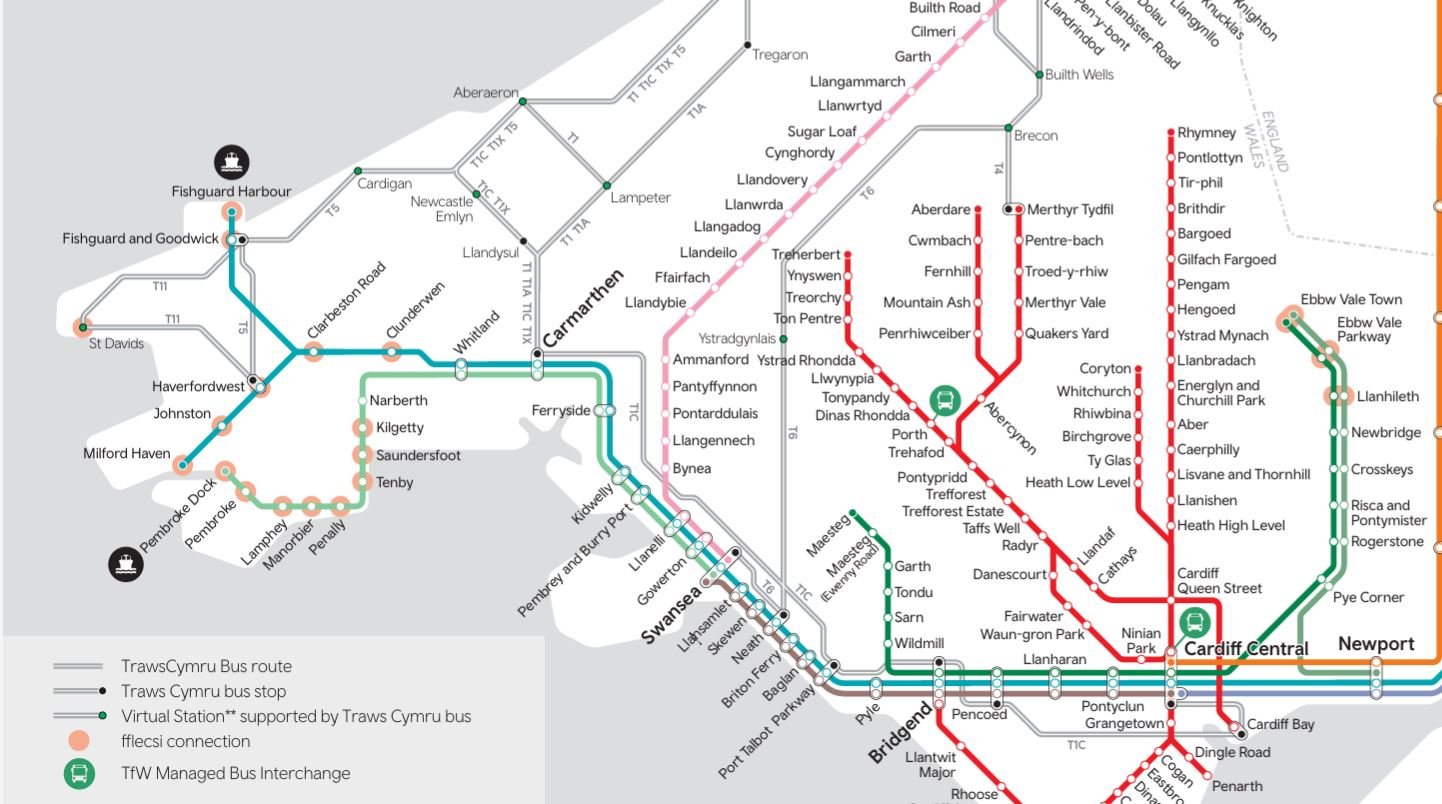
Transport For Wales South Wales Network
Where to stay in Pembrokeshire
Because Pembrokeshire is only an hour or so drive from my home city of Swansea, I usually just head west for a day trip. However, if you are travelling from further afield, you’ll want to base yourself strategically.
If you are only spending a weekend in Pembrokeshire, I highly recommend spending one day exploring the South Coast (from Tenby across to Freshwater West) and then a second day up on the North Coast (St Davids, Whitesands, and the Blue Lagoon). Because of this, it is well worth staying centrally so you can easily dart between the two without spending half your weekend in the car.
There is a huge range of accommodation available, including wild campsites, quirky Airbnbs, hostels, and luxury spa hotels. Here is a quick breakdown of the most convenient areas to base yourself:
Haverfordwest: The strategic choice. While it might not be the most impressive or scenic town in the county, it is the absolute centre point of Pembrokeshire. Base yourself here, and you have incredibly quick access to the north, south, and west coasts.
Tenby: Best for families. This town offers classic, colourful seaside charm, great restaurants, and direct access to massive, safe sandy beaches.
St Davids: Best for history and surfers. The UK's smallest city gives you quick access to the spectacular cathedral, boutique shops, and the incredible waves just down the road at Whitesands Bay.
Dale, Marloes & Angle: Best for wildlife and walking. Base yourself down here if you want to be close to the Skomer Island boats, the rugged southern beaches, and the wilder coastal hikes.
That being said, there are so many unique stays and beautiful campsites tucked away all across Pembrokeshire. During the peak summer months, accommodation books up incredibly fast, so it might just be a case of grabbing whatever you can find!.
If you’re looking for a dog friendly property on the North Coast of Pembrokeshire, then I would recommend Cae Cwsg Ideally located in Dinas Cross, which is in the centre of the North Pembrokeshire coastline, you are less than 1km from both Cwm yr Eglwys and Pwllgwaelod beaches.

Pembrokeshire FAQs
-
Pembrokeshire is world-renowned for its spectacular coastline, which is entirely protected as the UK's only coastal National Park. It’s famous for the 186-mile Pembrokeshire Coast Path, incredible wildlife (including puffins, seals, and dolphins), medieval castles, its world-class surfing beaches, and St Davids, which is the smallest city in the UK!
-
Late Spring (May to June): The absolute best time for wildlife. Skomer is packed with puffins, coastal flowers like bluebells are in full bloom, and the weather is generally dry and mild.
Peak Summer (July to August): Best for swimming, surfing, and family beach days, though this is when the region is at its busiest and most expensive.
Autumn (September to October): The hidden gem season. The sea is at its warmest for swimming, the summer crowds have gone, and September is peak season for spotting fluffy seal pups tucked away in hidden coves.
-
While having a car is highly recommended, Pembrokeshire is deeply rural, and having your own wheels makes reaching remote trailheads and secluded coves much easier, it’s not strictly necessary. During the summer, the county operates brilliant coastal bus services like the Puffin Shuttle and the Coastal Cruiser, which link major towns directly to popular beaches and hiking spots
-
If you want to hit the absolute heavy-hitters of the Pembrokeshire coast, these are the landmarks you need to build your itinerary around:
Church Doors Cove: A spectacular, slightly hidden rocky beach framed by two colossal, vertical sandstone cliffs that look exactly like a giant open doorway.
Bosherston Lily Ponds & Barafundle Bay: One of the best walks in Wales. You stroll across beautiful freshwater lakes covered in water lilies, which lead you straight out onto the golden sands of Barafundle Bay.
The Green Bridge of Wales & Elegug Stacks: A massive, dramatic limestone sea arch and towering rock pillars located on the Castlemartin military firing range.
St Govan's Chapel: A tiny, incredibly photogenic 13th-century church built directly into the side of a sheer, plunging cliff face just up the road from the Green Bridge.
St Davids, Whitesands & Carn Llidi: You can easily combine these three into one epic day. Explore St Davids (the UK's smallest city), hit the surf at Whitesands Bay, and hike up the craggy peak of Carn Llidi for mind-blowing panoramic views.
The Blue Lagoon (Abereiddy): A spectacular, vivid blue flooded slate quarry that has become famous for cliff diving.
Skomer Island: The ultimate wildlife sanctuary. An absolute must-do for getting up close and personal with thousands of wild puffins!
Tenby: The quintessential sea side town. Its quaint, colourful streets, castles and four beaches mean there’s something for everyone. Its also a major hub of Pembrokeshire and has loads of places to eat, drink, and stay
Check out my full guide - The Best Things To Do In Pembrokeshire
-
With over 50 beaches to choose from, you have to be selective. “Best” is always subjective, but these are some of my personal favourites depending on what you’re looking for
• For surfing and cinematic scenery: Freshwater West
One of the wildest and most dramatic beaches in Pembrokeshire. It holds the Welsh Surfing Championships and is widely considered one of the best surf spots in the country. Expect powerful waves, huge open views, and a properly rugged feel. It’s also famous as the filming location for Dobby’s Grave in Harry Potter.• For surfing and sunsets: Whitesands Bay
One of the most popular beaches near St Davids. Whitesands offers consistent surf along with a huge sandy bay, making it ideal for both beginners and more experienced surfers. It’s also one of the best sunset spots in Pembrokeshire.• For pristine beauty: Barafundle Bay and Broad Haven South
Barafundle is often ranked among the best beaches in the world, a secluded crescent of golden sand backed by dunes. Just around the corner, Broad Haven South offers a similarly stunning setting with wide sands and dramatic cliffs, often with fewer people. The walk between them via the Bosherston Lily Ponds is one of the best in Wales.• For wild scenery and wildlife: Marloes Sands
A vast, remote-feeling beach with towering cliffs and incredible views out towards offshore islands. One of the best places in Pembrokeshire for spotting seabirds and seals, and it feels far more untouched than many of the more famous beaches.• For escaping the crowds: Skrinkle Haven
A hidden gem only accessible around an hour either side of low tide via a natural arch from Church Doors Cove. While Church Doors is impressive but rocky, Skrinkle Haven feels far more secluded and often completely empty. Make sure to check tide times before visiting.• For family days out: Tenby and Whitesands
If you’re looking for safe swimming, facilities, and easy access, Tenby’s beaches (North, South, and Castle) are ideal. Whitesands is another great option, with lifeguards and plenty of space.Check out my blog on my favourite favourite beaches, and how to reach them - The Best Beaches In Pembrokeshire National Park
-
Absolutely. Pembrokeshire boasts more Blue Flag beaches than any other county in Wales. The waters at beaches like Tenby, Broad Haven, and Saundersfoot are fantastic and safe for swimming. However, always check tide times, be mindful of rip currents on the wilder west-facing beaches, and swim at RNLI-lifeguarded beaches if you aren't confident.
-
Most of the 186-mile coastal path is dog-friendly, and a huge number of local pubs and cafes welcome pets. However, during the peak summer months (May 1st to September 30th), there are partial or full dog bans on specific popular beaches (like Tenby North and Whitesands) to keep them clean for families. Always check local signage.
-
The official Pembrokeshire Coast Path is 186 miles (299km) long. If you want to tackle the whole thing in one go, it usually takes standard-fitness walkers between 12 to 15 days. Be warned: the total rise and fall of the path is over 35,000 feet, which is greater than climbing Mount Everest. Most visitors prefer to tackle it in bite-sized, circular day hikes.
-
Because Pembrokeshire is a peninsula surrounded by water on three sides, you can easily catch the sun rising and setting over the ocean on the exact same day.
You can check out my dedicated blogs for both sunrise and sunset below
-
Without a doubt, Skomer Island is the undisputed king of puffin spotting, there are over 45,000 of them. You can only access the island by boat, with 5 sailings a day. The season runs from the 1st April to the 30th of September; however, the puffins leave in mid-July. Tickets can only be bought online and booking in advance is essential.
Check out my specific blog post on Skomer below
-
The waters around Pembrokeshire are home to a massive resident population of bottlenose dolphins and Atlantic grey seals.
For Seals: You can spot them year-round, but head to the secluded coves around the Marloes Peninsula, Skomer Island, or Martin's Haven in September to see the newborn pups.
For Dolphins: You can frequently spot them from the coastal path (Strumble Head is a famous vantage point) or by booking a dedicated wildlife-watching boat tour out of St Davids.
-
Pembrokeshire is steeped in medieval history. Pembroke Castle is a massive, incredibly well-preserved fortress (and the birthplace of Henry VII) that is brilliant for families. Carew Castle sits beautifully on a tidal millpond and has a great history, while Cilgerran Castle offers dramatic ruins perched high above the Teifi Gorge.
-
You can't visit without trying Welsh Cakes (a sweet, flat bread filled with raisins and dusted with sugar). Pembrokeshire is also famous for its incredibly fresh seafood (local crab and lobster are staples), Cawl (a hearty traditional Welsh lamb and root vegetable stew perfect for warming up after a cold coastal hike), and the absolute classic: cockles and laverbread (a traditional Welsh delicacy made from seaweed, famously served as part of a cooked breakfast!).

Where to Eat in Pembrokeshire
Pembrokeshire has hundreds of places to eat, ranging from beachside cafés to high-quality seafood restaurants, and everyone’s taste (and budget) is different. You’ll have no problem finding something that suits you. Here are a few of my personal favourites:
Cafe Mor, Angle - A legendary beachside food shack serving fresh, locally sourced seafood right by the water.
The Shed Bistro, Porthgain - Amazing fish and chips, best enjoyed after walking to Blue lagoon and back.
Grain, St Davids - A relaxed spot for pizza and casual dining after a day exploring.
Golden Lion, Newport - A classic Welsh pub with a slightly more refined feel, perfect for a proper sit-down meal.
Wavecrest Café, Angle - Ideal for coffee, cake, or a quick bite with sea views.
The Rowan Tree Cafe - A cosy and reliable option, great for breakfast, brunch, or a relaxed lunch stop
Blas Restaurant, St Davids- One of the more refined dining options in Pembrokeshire. If you’re after something a bit more special, this is a great choice, with a strong reputation for quality Welsh produce.
Ultracomida, Narberth- A hugely popular deli, café, and tapas spot in Narberth. Slightly different to your other picks, but consistently rated highly and perfect for something more casual but memorable.
Runwayskiln, Marloes Peninsula - A really unique spot near Marloes Sands, set in a converted building with views over the coast. Great for brunch or lunch, with a focus on local, seasonal food.
The Stackpole Inn, Stackpole- A standout gastropub near Barafundle and Bosherston. Known for generous portions, local ingredients, and consistently excellent reviews. Perfect after a coastal walk.
During the day, it’s often easier to keep things simple and pick up a packed lunch or grab something quick, especially if you’re out exploring the coast. Many of the best beaches and walking routes are quite remote, so having food with you means you’re not stressing about finding somewhere to eat.
In the evenings, things are a bit different. During summer and busier times of year, restaurants can get booked up quickly, especially in smaller towns. It’s always worth planning ahead and booking dinner in advance where you can.
Help support what I do
I created and I run this website in order to help inform, amaze, inspire people (for free) to get outside and explore the adventurous side of the UK and beyond.
If you’d like to support this website, you can use the affiliate links below to book your accommodation or transport. These come at no extra cost to you, but help keep this site running.
Book your car using Discover Cars
Book your accommodation using Booking.com and Sykes Cottages
If you are feeling generous you can also buy me a coffee to say thank you, and give me a follow on social media.
Thank you, and if you have any questions, leave them in the comments below or drop me an email.
I hope you found this blog post useful, If you did (or didn’t) let me know in the comments below.
If you did find it helpful, I’d appreciate you giving it a share or giving me a follow on social media, every bit of support goes a long way.
For more travel, & photography inspiration around Wales check out my in-depth guides to each of my favourite regions below.