
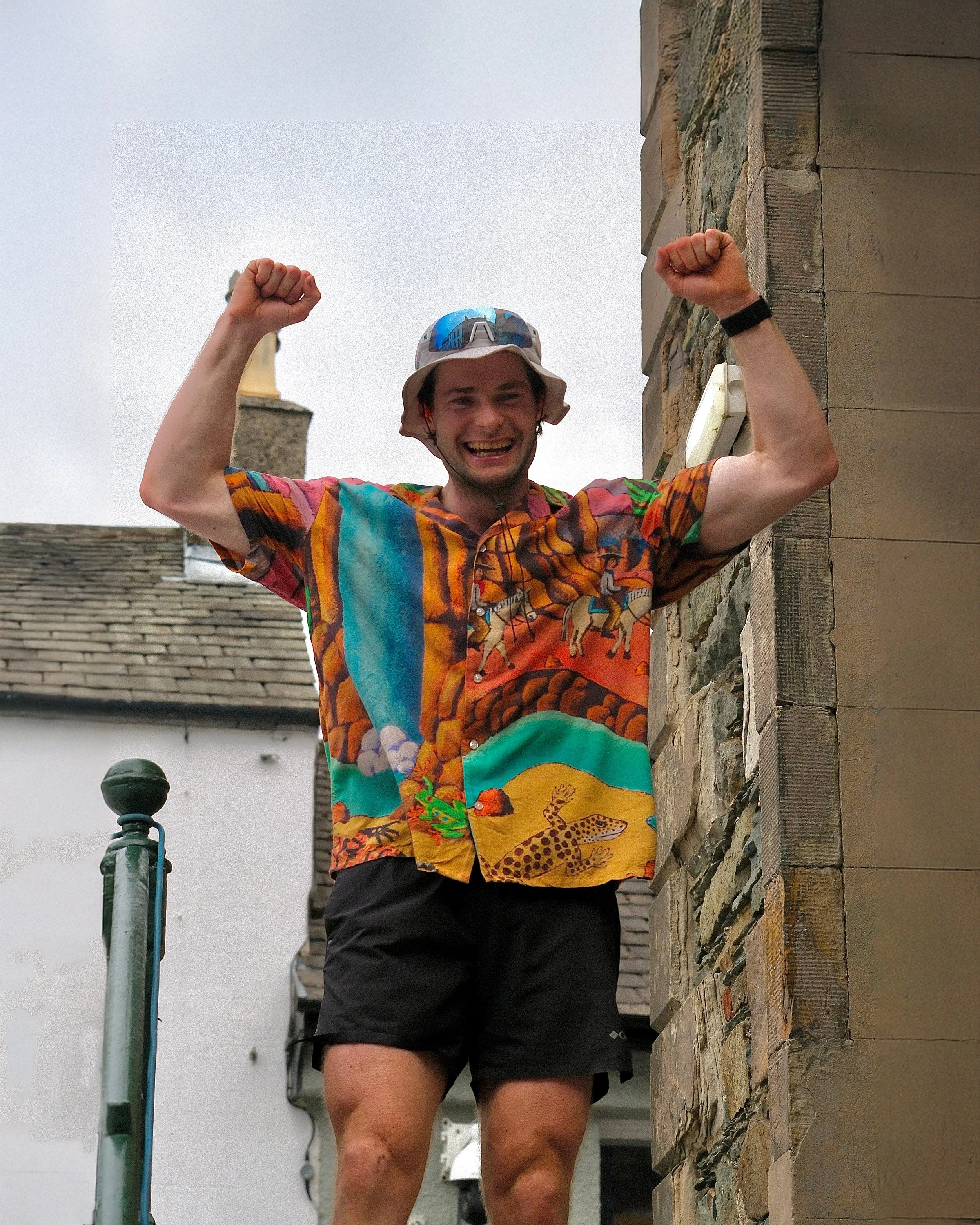
The Bob Graham Round is one of the most iconic challenges in British fell running.
Located in the Lake District National Park in North West England, the challenge takes its name from Bob Graham, who first completed the Round in 1932.
Starting and finishing at Moot Hall in the centre of Keswick, it involves summiting 42 Lake District fells over approximately 106km (66 miles), with around 8,200m (27,000ft) of ascent, all with the aim of returning to where you started in under 24 hours.
There is no fixed race date, mass start, or traditional entry fee. You simply choose your date, start time and direction, organise your own support, and give it a go.
After setting off at 7:14pm on Friday evening, I managed to get back to Moot Hall in Keswick at 5:00pm on Saturday, having covered 107km and climbed around 8,400m (almost the height of Mount Everest) in 21 hours and 46 minutes.
The Round was everything I hoped it would be and more, and easily one of the best days I have ever had in the mountains.
The weather was (mostly) incredible, the views were sensational and, despite a definite low point somewhere around Kirk Fell and Great Gable, I somehow managed to smile and laugh my way around almost all of it.
In this blog I am going to break down my entire experience of completing the Bob Graham Round, including my journey across each of the five leg, alongside the training, my kit, and nutrition. I will also explain why organising the thing was arguably harder than actually running it.
If you are looking for a dedicated guide to the Bob Graham round, you can find that below
The build-up to my Bob Graham Round
I had known about the Bob Graham Round for years, but despite being a very experienced hiker, I had never really considered it something I would attempt myself.
My closest experience of anything similar had been three successful completions of the Welsh 3000s, a hiking challenge in Snowdonia which is around 52km with 3,900m ascent.
The Bob however was a completely different beast, its over double the distance, has twice the eelevation, and the small inconvenience of potentially spending 24 hours moving through the mountains.
The idea started becoming more realistic after I signed up for UTS Snowdonia 56km, then watching Mark Wilson's documentary about his Bob Graham Round (a cracking watch). This planted the seed that with enough preparation maybe I could give it a crack myself.
Interestingly, most of my actual trail runs were relatively short, with the bulk of my ‘training’ coming from consecutive long days hiking.
My training at the start of 2026 was actually focused on Newport Marathon (End of April). Three weeks before the race I tweaked my calf on my last long run, and rather than jeopardise UTS Snowdonia which was four weeks later, i made the decision to pull out.
Instead I spent the marathon weekend hiking in Snowdonia National park ( 55 km with 4,300 m of ascent over four consecutive days) before heading to Madeira, where I hiked across the island, covering 130km with approximately 7,000m of ascent across six days.
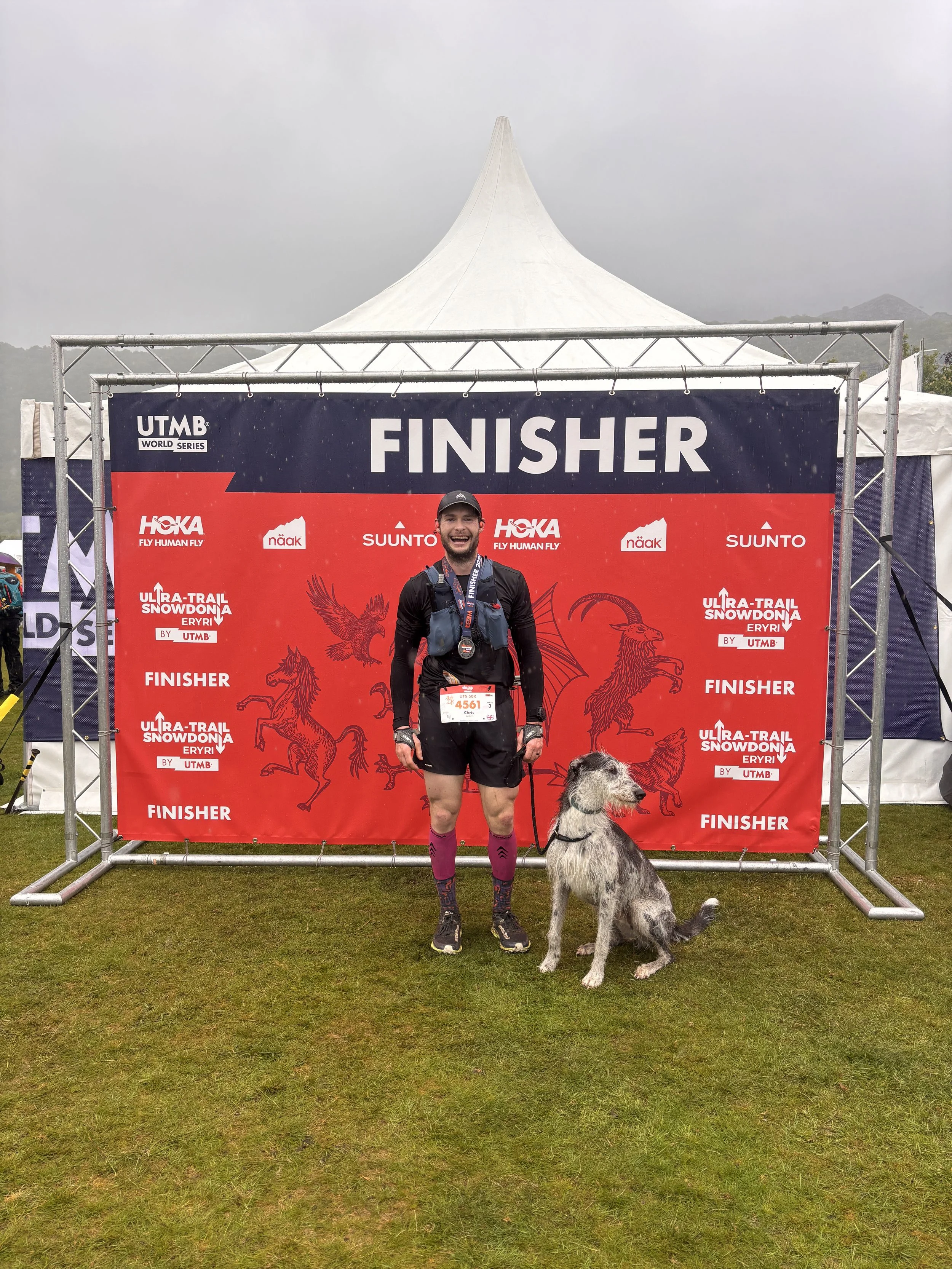
Then came UTS Snowdonia, where I covered the 56km route with 3,600m of ascent in 8 hours and 43 minutes, despite seven hours of rain and some of the most heinous mountain conditions I have ever experienced. Finishing underneath my nine-hour target gave me the first real confidence that the Bob might actually be achievable.
After UTS I headed to the Lake District to recce large sections of the Round. Unfortunately, I didn't manage to recce all of Leg 3, as I changed my plans to support a mate on Legs 1 and 2 of his successful Bob Graham attempt.
I completed Legs 1 and 2 (minus Fairfield) of the Round in around 7 hours 30 minutes, roughly 30 hours after completing a 25km loop from Wasdale with around 2,800m of ascent, which covered most of Leg 4 and the back end of Leg 3.
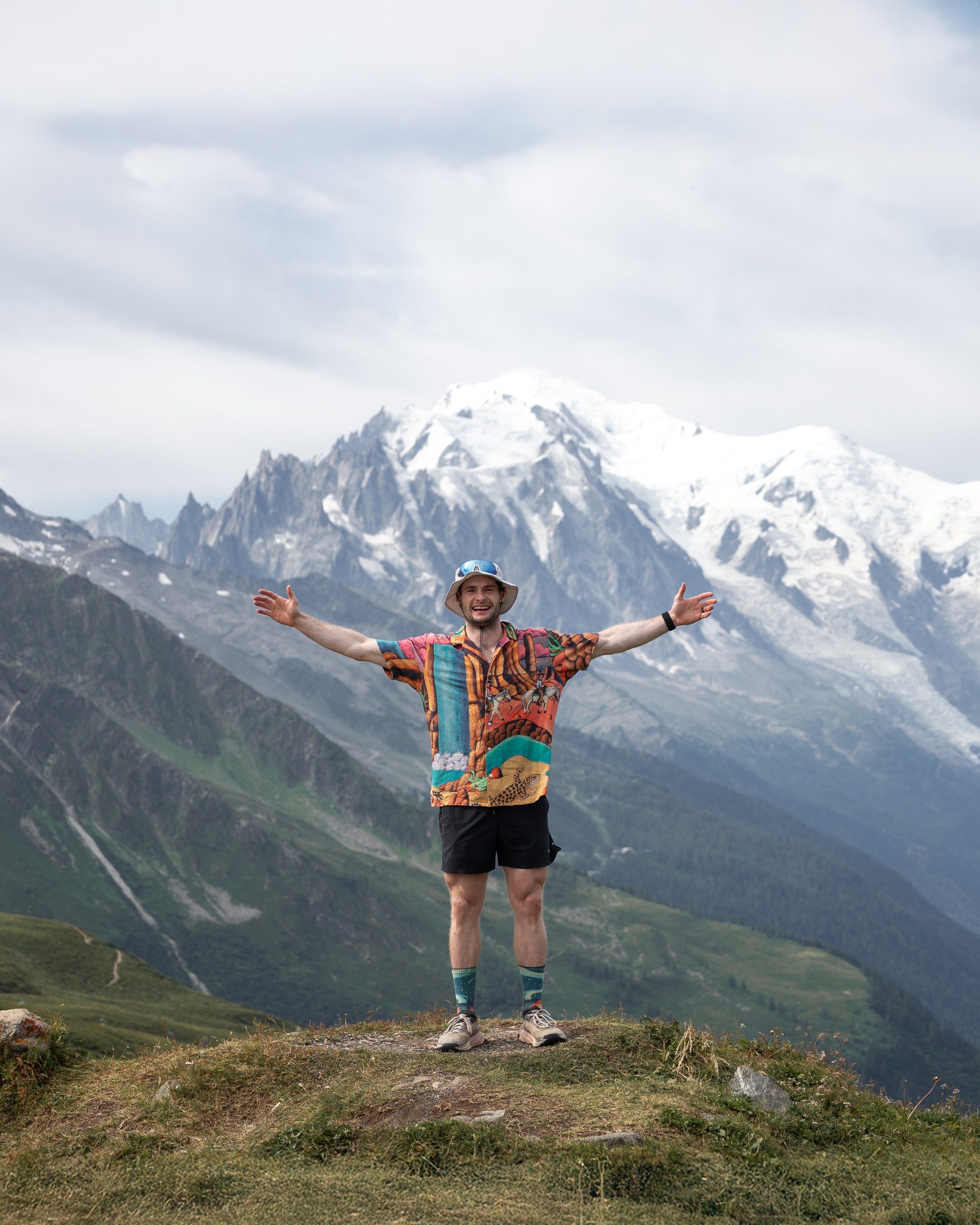
The final major block of preparation came three weeks before the Bob when I hiked and ran the Tour du Mont Blanc over 6 consecutive days, eventually covering around 172km with more than 10,000m of ascent.
More important than the numbers was how good my legs felt afterwards.
Especially considering 110km of the route was spent carrying a heavy hiking pack, Some of it was at altitude, and almost all of the 172km was done in silly temperatures.
I was ready for the Bob Graham Round, I just needed the right weather window.
Planning my Bob Graham Round
One thing nobody really prepares you for is just how much work goes into organising a Bob Graham Round, and how stressful the whole process can become.
I would genuinely argue that planning the bloody thing was harder than the Round itself, especially when you have to consider picking a date and start time, building a realistic schedule, finding hill support, organising road crew and transport, planning your nutrition and kit, and making sure everyone knows exactly where they need to be and when.
To keep things readable, I have broken the main parts of my planning down below.
-
One thing I was determined not to compromise on was the weather.
The Bob is difficult enough without deliberately making it harder, but for me the bigger reason was enjoyment. I take on these challenges because I love being in the mountains, and the views, scenery and experience are a huge part of what keeps me motivated when things start getting tough.
Without that, you're potentially signing yourself up for a 107km sufferfest in the clag (which I am not about).
Being based in South Wales also meant we had a six-hour drive to the Lake District, so we identified two Fridays in August that worked around our schedule, the 7th and the 14th.
We had also just spent six weeks waiting to complete on our first house, finally getting the keys at the end of July, so between moving house, a huge workload and a fairly uninspiring forecast, I ruled out the 7th.
As soon as the forecast for Friday 14 August started looking promising, I locked it in and set the increasingly complicated wheels of the Bob Graham machine in motion.
-
One of the few things you actually get to choose about the Bob is your date, start time and direction, and I had decided to go clockwise and start at 7:15pm.
Clockwise is by far the most popular direction and, for me, it made the most sense because you finish with the least difficult leg, which has the least elevation and eventually gives you several miles of road to get yourself back to Moot Hall.
The evening start was also very deliberate.
I am not a morning person, I tend to function pretty well late at night and, perhaps most importantly, it meant I didn't have an early alarm hanging over me. In fact, I somehow had my best night's sleep of the entire week the night before the Round.
Sunset was around 8:50pm, so starting at 7:15pm also gave me plenty of daylight heading towards Skiddaw and Great Calva, before putting most of Leg 2 into darkness, which is one of the less technical and more straightforward sections of the Round.
It worked brilliantly and I would happily choose a similar start time again, although there was one obvious downside. By the time I finished I had been awake for around 34 hours, and I'd be lying if I said that didn't affect me.
For my pacing, I chose a 22.5-hour schedule, which I felt was realistic based on my fitness and recces, while also giving me 90 minutes of contingency if something went wrong.
Going too close to 24 hours leaves very little margin for navigation mistakes, bad weather, longer road stops or an unexpected poo, but equally there is no point choosing an aggressive schedule that has you blowing your beans before you've even got over Skiddaw.
I used the Bob Graham Club schedule calculator to build my timings and added a 15% adjustment for rocky ground later in the Round, where I knew fatigue would start having more of an impact.
-
Most people who have attempted the Bob will tell you that organising it can be just as stressful as actually running it, and I can confirm that this is absolutely true.
I had a couple of bankers from the start. Mark Wilson had offered to support Legs 1 and 2 after I had previously supported his Paddy Buckley attempt, while another mate had offered to cover Legs 3 and 4 after I supported the first two legs of his successful Bob.
I then put a call out on social media and asked around, and although I had plenty of offers, actually getting everyone confirmed onto the right legs became increasingly complicated.
At one point I had at least two runners on every leg. Then came the inevitable dropouts.
My mate (who i supported for his round) who was meant to cover Legs 3 and 4 pulled out on the Wednesday after realising it was his anniversary ( a valid excuse but was still very last minute), leaving me frantically trying to find enough bodies and, more importantly, somebody confident with the navigation on Leg 3.
After a lot of messages and some incredibly flexible people, when I finally left Moot Hall my support looked like this:
Leg 1: Mark Wilson and Tom Bradley
Leg 2: Mark Wilson and Stephen Pearce
Leg 3: Brad Ingram and Ethan Pickavance
Leg 4: Rob Parsons
Leg 5: Heidi Rogers and Alex Staniforth
I was particularly happy to have two people on most legs, although I knew things could still change at the last minute.
(Spoiler alert: they did)
-
Hill support was complicated enough, but road support came with its own logistical headache.
My wife Becky was going to be my main road crew, but because of my evening start she was going to spend most of the night driving around the Lake District with very little sleep.
The biggest problem was Wasdale.
It can take around 90 minutes to drive there from Dunmail and then another long drive around to Honister, much of it along narrow Lake District roads, and I wasn't particularly comfortable with Becky doing all of that through the night while exhausted.
Thankfully, my friend Rob provided the solution.
He was driving down from Scotland to support and very kindly agreed to take responsibility for Wasdale, which meant he could also collect my Leg 4 runner from Keswick, get him around to Wasdale and then help shuttle the Leg 3 runners afterwards.
That took a massive amount of pressure off Becky, who could concentrate on Threlkeld, Dunmail and Honister without having to spend half the night conducting an endurance challenge of her own behind the wheel.
It did mean splitting my food, fluids and spare kit between two vehicles, which created another layer of organisation, but it was absolutely worth it.
By this point I was starting to understand why people said planning the Bob was harder than running it.
-
Compared with the nutrition and logistics, my kit was actually one of the simpler parts of planning the Round, mainly because almost everything I used had already been thoroughly tested during training, recces and previous mountain challenges.
My biggest rule was nothing new on the day. After spending months preparing for the Bob, the last thing I wanted was to discover 10km in that a new pair of shoes gave me blisters or that a piece of kit rubbed somewhere particularly unpleasant.
I also tried to keep what I personally carried relatively light and made full use of my support runners, who helped carry additional fluids, spare layers and emergency kit.
A few of the key pieces of kit I used were:
Columbia Montrail Trinity AG II shoes
Injinji toe socks
LEKI Ultratrail FX.One poles
Deuter Traick 9 running vest
Compressport waist belt
Shokz OpenRun Pro 2 headphones
Nitecore U27 Headtorch
Garmin Enduro 3 - Used this for navigation I preloaded the course with every peak and road crossings marked as a waypoints. I also set eat alerts for every 40 minutes and drink alerts for every 30 minutes. Th battery life was incredible and after finishing the round I had Only used up 35% battery
Garmin inReach Messenger Plus - Used this for tracking, It sent my location every two minutes and worked flawlessly. Also there in case of an emergency. Again battery life was great, and I only used 40% battery
The LEKI poles were probably the single most important piece of equipment I carried. I used them on virtually every significant climb and genuinely don't think I would want to attempt the Round without them, although I had also spent plenty of time training with them beforehand and knew how to use them efficiently.
I used both a running vest and waist belt because I wanted my food and important items immediately accessible rather than constantly taking my pack off and rummaging around every time my watch told me to eat.
I also had plenty of spare kit waiting at the road crossings, including additional layers, shoes and socks, even if I didn't necessarily expect to use all of it.
Foot care was something I took particularly seriously. I had spare socks, a towel, talc and foot cream ready with my road crew, and ended up changing my socks several times and my shoes twice during the Round.
My philosophy was basically to carry what I needed, let my support runners help with everything else, and have enough spare kit waiting at the road crossings to deal with problems before they became bigger ones.
-
My plan was simple: start steady and stick to the schedule.
I would use heart rate to monitor my efforts on the climbs and adjust effort to how I felt.
It is incredibly easy to get carried away at the beginning. You're rested, excited, full of carbohydrates and suddenly saving 15 minutes on the climb up Skiddaw feels like a brilliant idea.
Unfortunately, those minutes can become rather expensive 15 hours later. The Bob Graham isn't won on Leg 1, but it can certainly be lost there.
There were also seven registered attempts on the Friday I started, with six setting off between 7pm and 8pm, which created another temptation.
When you see headtorches ahead of you it is very easy to use them as a carrot, or when another group passes you, instinctively try to latch on.
Everyone is on a different schedule, has different strengths and is running their own Round, so unless I knew somebody was working to a similar pace, I wasn't interested in racing them around the Lake District.
Nutrition and hydration
Nutrition was another part of the Round that I planned pretty meticulously.
The Bob Graham is as much an eating challenge as it is an endurance one. So it doesn't matter how fit you are and how much training you have done, if you don’t fuel properly.
Thankfully consuming a heinous amount of carbohydrates while exercising is something I am very comfortable with. This is largely from my background in rugby and having previously completed an Ironman and three half Ironmans.
During UTS Snowdonia I had managed around 115g of carbohydrates per hour for almost nine hours, which was over 1000 grams of carbs in total.
I knew that number of carbs would be overkill for the Round, and wasn't something I wanted to try and sustain for 23 hours. So for my attempt I dropped my target to a much more manageable 80 to 90g per hour.
At around 81kg of Bodyweight, that worked out at roughly one gram of carbohydrate per kilogram of bodyweight each hour. I planned to get hit this target through a mixture of solid food, sweets, gels and carbohydrate drinks, which i will go into detail below.
-
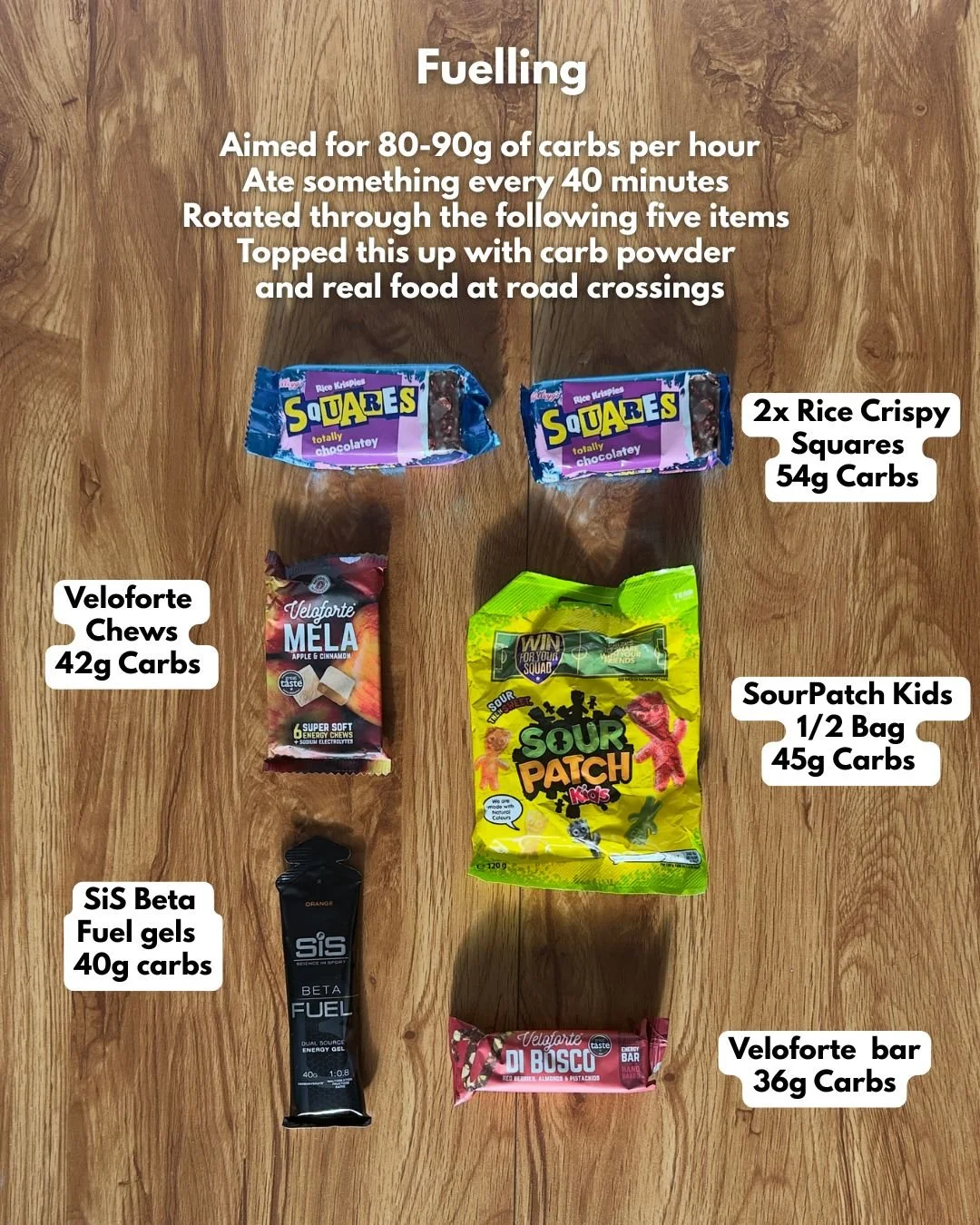
I set an alert on my Garmin to remind me to eat every 40 minutes, with most of my snacks providing around 40 to 50g of carbohydrates.
I started eating 40 minutes into the Round and planned to keep that rhythm going for as long as possible, because one of the easiest mistakes to make in an ultra is waiting until you are hungry or low on energy before you start fuelling.
My main on-hill foods were:
Rice Krispies Squares: 54g of carbohydrates for two
Veloforte Soft Chew: 42g
Veloforte bar: 36g
Half a bag of fizzy sweets: around 45g
SiS Beta Fuel gel: 40g
I deliberately planned to save more of the gels until later in the Round, when I knew there was a good chance I would become less interested in chewing solid food.
That part of the plan worked, although one mistake I did make was having too little variety. By Leg 4 I had been cycling essentially the same five sweet foods for hours and palette fatigue hit me hard, so if I did it again I would introduce considerably more savoury and salty food on the fells later in the Round.
-
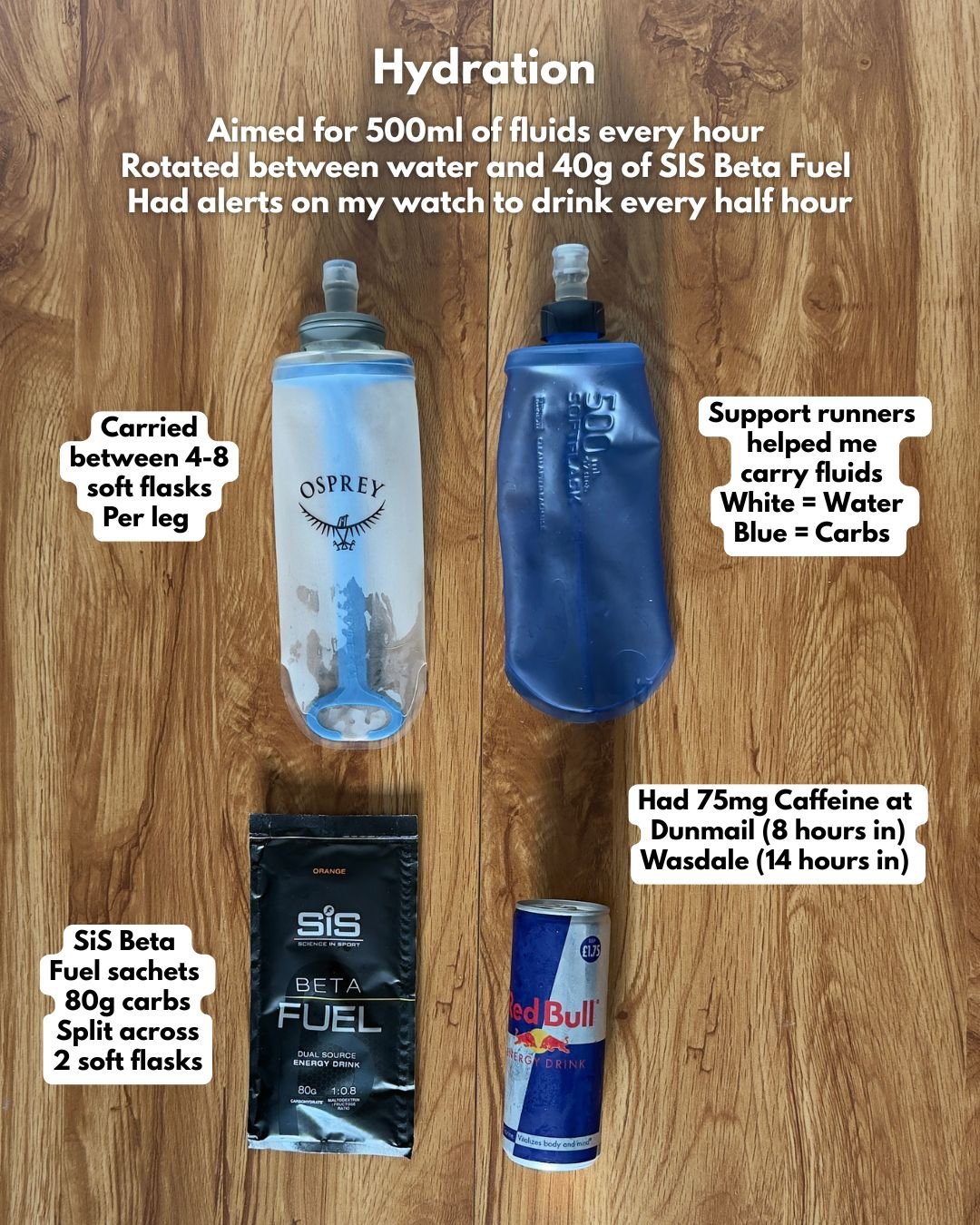
I aimed to drink at least 500ml per hour, alternating between plain water and carbohydrate drink rather than drinking liquid carbohydrates constantly.
My carb drink was SiS Beta Fuel, with an 80g sachet split between two 500ml soft flasks to give me roughly 40g of carbohydrates per bottle.
I also used different coloured bottles, with blue soft flasks for carbohydrate drink and clear ones for water, which sounds unnecessarily obsessive but made everyone's life considerably easier. Becky instantly knew what needed filling at each road crossing, while myself and my support runners could easily identify what we were carrying on the hills.
Because there had been an extended period of dry weather before my attempt, I decided to carry enough fluid for each leg rather than relying on streams and natural water sources (sorry Brad and Ethan).
That meant carrying more weight, but I preferred knowing the water was there rather than discovering 15 hours into the Round that the stream I had been relying on was dry.
-
At each road crossing I planned to eat something more substantial and, importantly, savoury, which gave me a break from the constant stream of sugar I was consuming on the fells.
My rough plan was:
Threlkeld: sandwich and sausage rolls
Dunmail: sandwich and sausage rolls
Wasdale: Pot Noodle or bacon sandwich
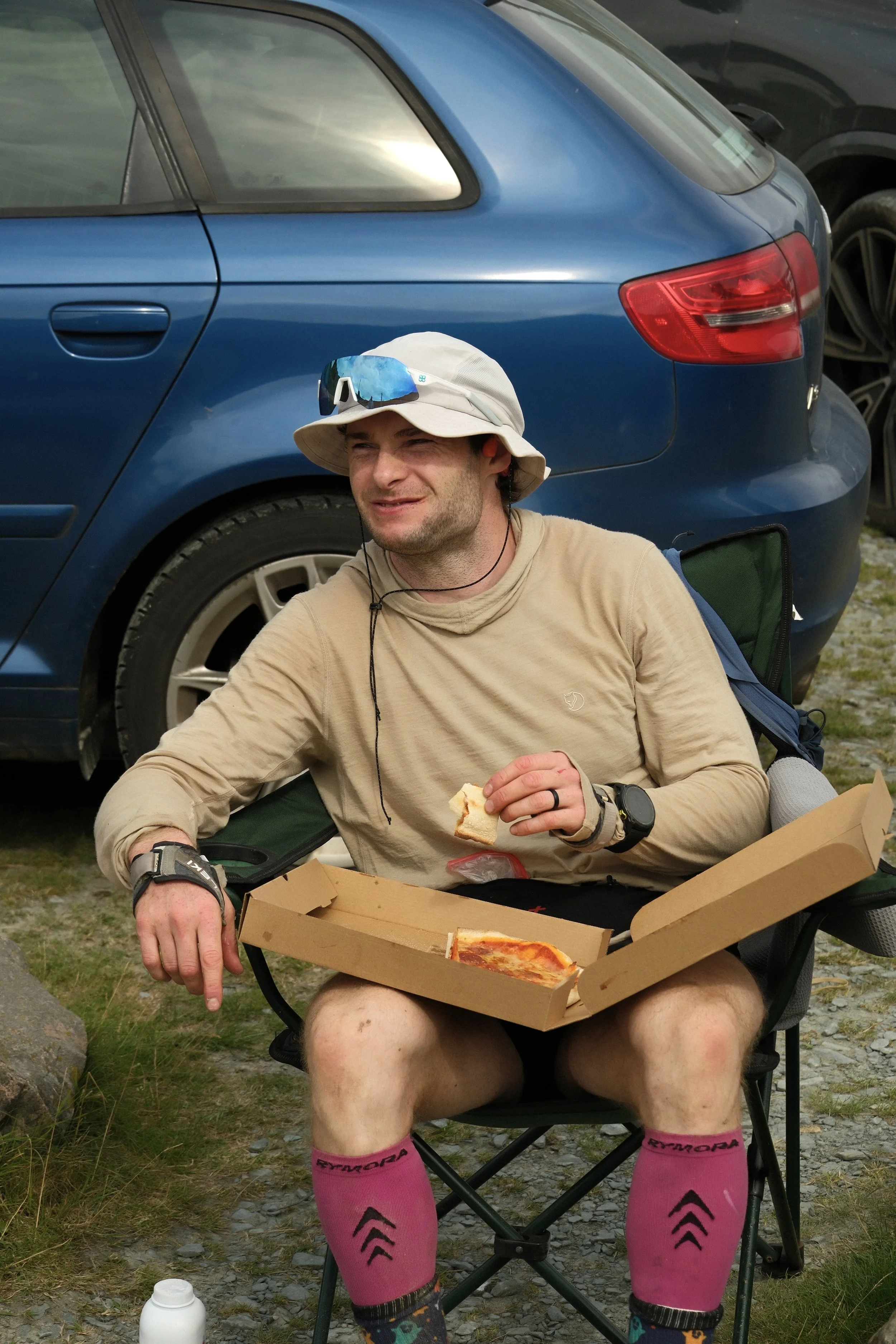
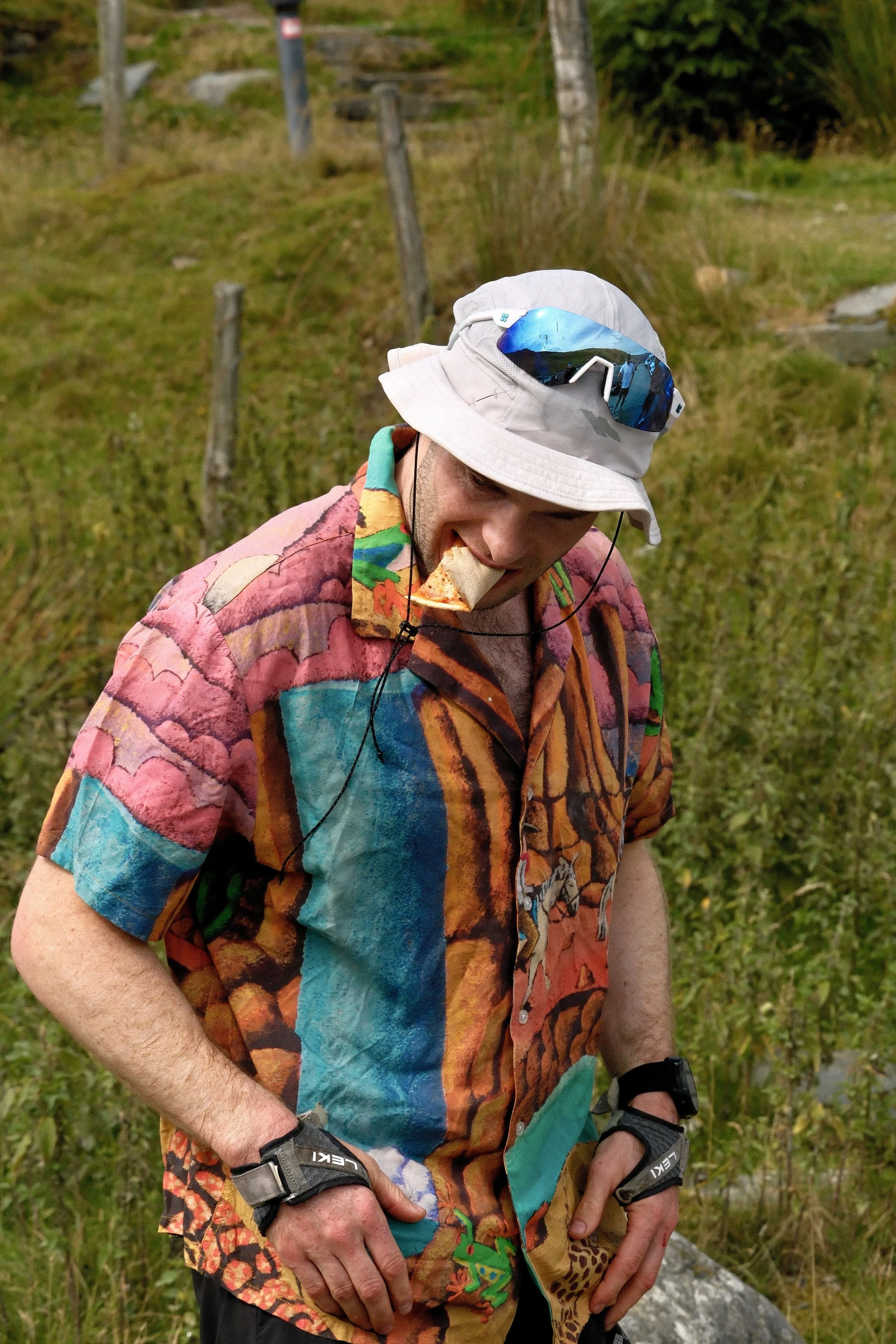
Honister: Pizza
I also aimed to drink at least another 500ml at each crossing, which helped me stay on top of hydration and reduced slightly how much fluid I needed to carry onto the next leg.
The bacon sandwich at Wasdale was excellent.
The pepperoni pizza at Honister was an absolulte dream
-
I deliberately chose not to have any caffeine before starting the Round.
My heart rate normally spikes at the beginning of big events before eventually settling down, and with the Bob starting with the enormous climb up Skiddaw, I didn't want to throw caffeine into the mix and send it even higher.
I also hoped the excitement, views and general buzz of finally starting the Bob would be enough to carry me through the opening few hours without needing any extra stimulation.
My plan was then to introduce caffeine gradually later in the Round, mainly through 330ml Red Bulls (75mg) at the road crossings, rather than having one enormous hit.
As it happened, I felt so good at Threlkeld that I skipped the caffeine completely and didn't have my first Red Bull until Dunmail.
-
Everything I ate and drank had been tested beforehand, particularly the gels, carbohydrate powder and the amount of carbohydrates I was trying to consume each hour.
A Bob Graham Round isn't the time to discover that the exciting new gel you bought on Thursday turns your digestive system into a cement mixer.
Everyone is different, and what works brilliantly for me might turn your stomach inside out after six hours.
My three biggest pieces of advice would therefore be:
Practise training with the food you plan to use. Experiment during training and find out what works and what doesn't. Once you find something that works and you like, stick with it.
Train your gut. Build up towards the amount of carbohydrate you plan to consume over a period of weeks or months. Don't suddenly jump from barely eating anything on your long runs to trying to consume 1 gram per kilo of bodyweight, build up
Start eating early and keep eating. Don't wait until you're hungry or your energy disappears. By that point you're already trying to recover a deficit while continuing to climb mountains. Start fuelling within the first hour and keep consistently topping yourself up.
The Round Itself
With a 7:15pm start and having driven up to the Lake District the night before, I had plenty of time on Friday to relax, finish prepping my kit and food, and finish increasingly desperate search for another Leg 4 support runner.
Rather than sitting around all day thinking about what was coming, Becky and I drove over to Crummock Water for a swim before heading back towards Keswick.
My stress levels were elevated slightly on the drive back over when we get stuck behind a broken-down car towards the bottom of the keswick side of Newlands Pass.
Thankfully we had plenty of time, and after doubling back to Buttermere and going up and over the Honister pass, we were set up in Bell Close car park in Keswick by 4:30pm.
After one final meal, I got my kit and nutrition ready, before meeting up with Mark and Tom (my support runners for leg 1), and making the short walk towards Moot Hall.
We arrived around 7:10pm and there was already another Bob Graham attempt (7:30pm start) sat outside moot hall.
Friday 14th August had tuned out to b a popular choice for attempting the round. There were seven registered attempts that evening, six of which were setting off between 7 and 8pm.
I would be the third of the six to set off, and this provided me with a bit of a boost, knowing there would be other people suffering their way around the fells with me, and Becky (my wife and road crew ) would have some company at the road crossings.
I was heading on a clockwise round, off a 22.5 hour schedule (reasons are listed in the planing section above).
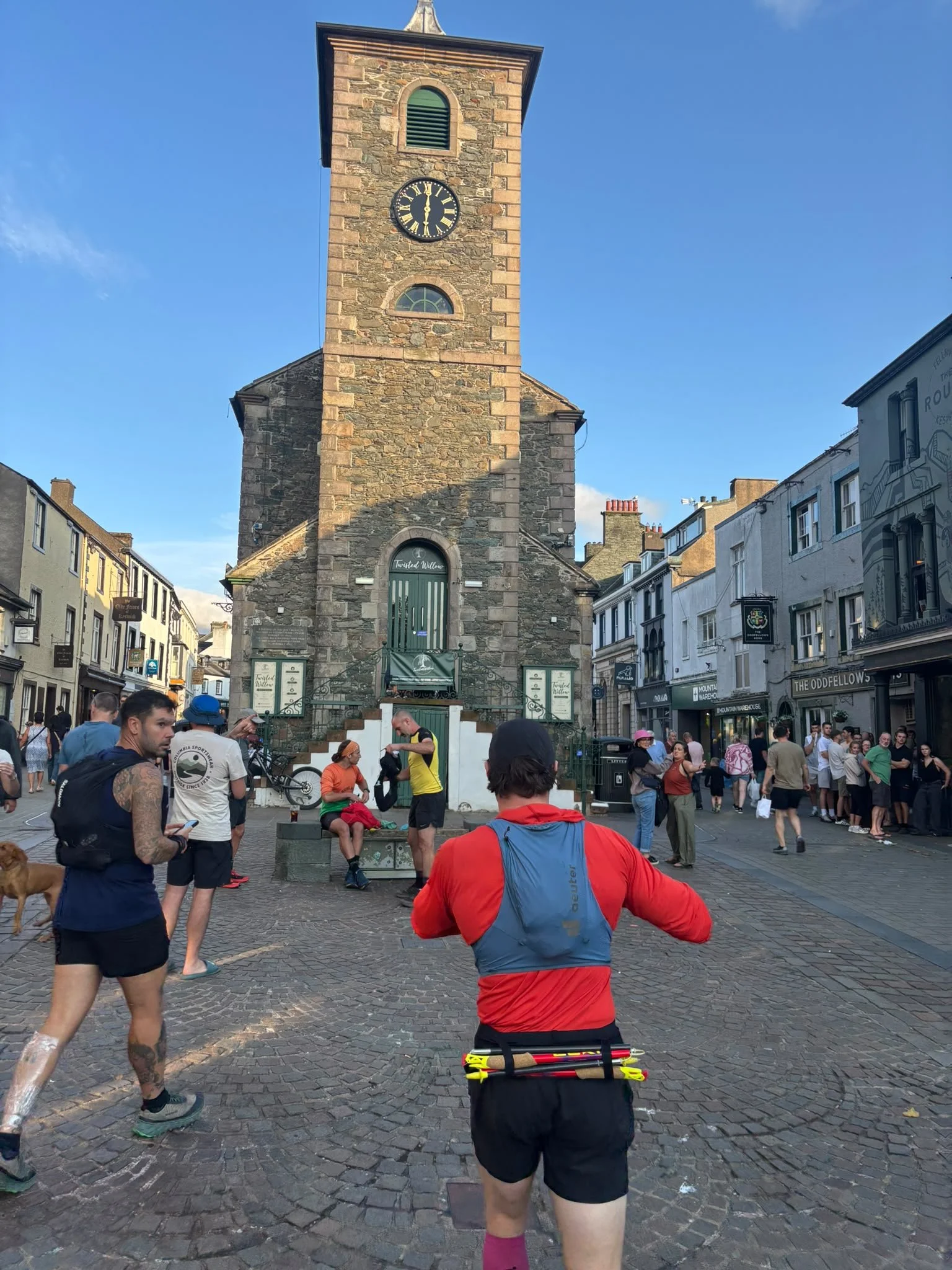
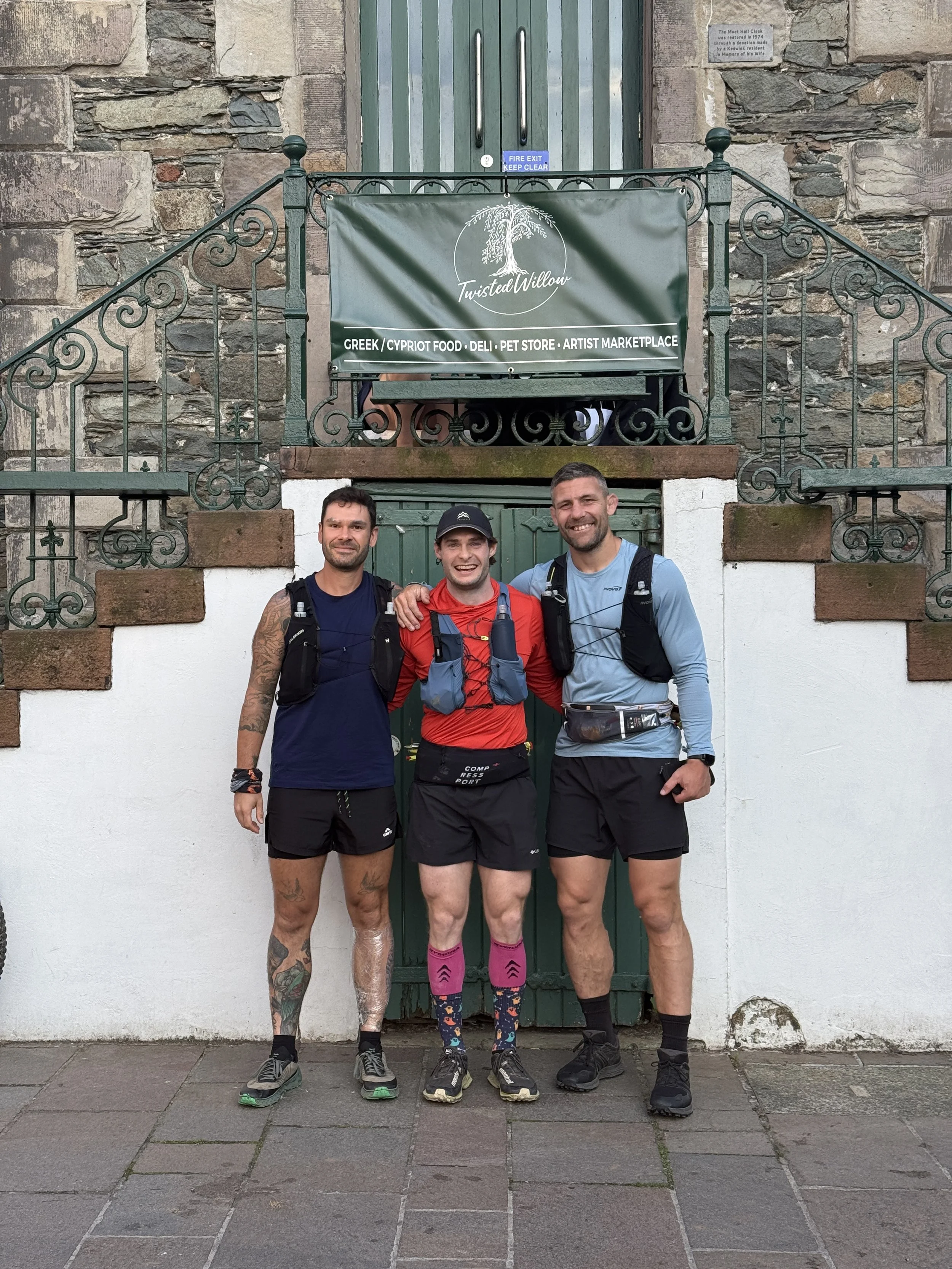
After getting the compulsory photo, loading the route onto my Garmin, and switching on my inReach tracker, I touched the door of Moot Hall and set off at 7:14pm to a few cheers and claps from the people outside.
Leg 1: Keswick to Threlkeld
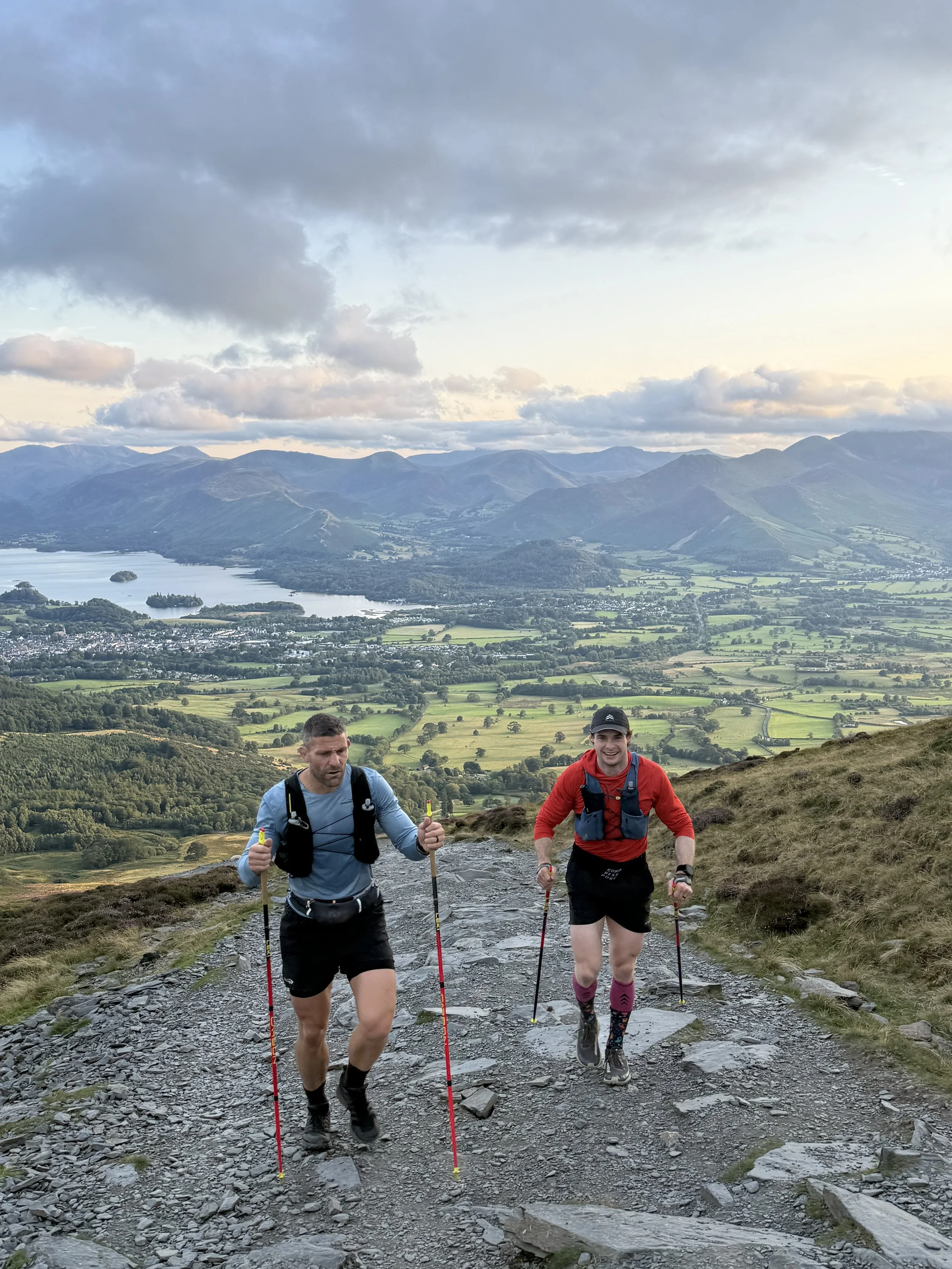
The opening pace was deliberately steady as we made our way through Fitz Park and towards Spooney Green Lane, where the poles came out, the running stopped, and the first of many climbs began.
As expected my heart rate was initially higher than I wanted, but Mark and Tom were both excellent at reminding me to ease off and reassuring me that we were comfortably on my 22.5 hour schedule.
Early on into on the climb, Mark's phone received a government emergency alerts, which I jokingly said were informing the country that I had officially started my Bob Graham Round.
I saw Becky again at Underskiddaw, where she had quickly driven up from Keswick to give Mark a couple of my soft flasks, before we continued towards Skiddaw.
The climb was everything I had hoped for, and exactly how I wanted the Round to begin.
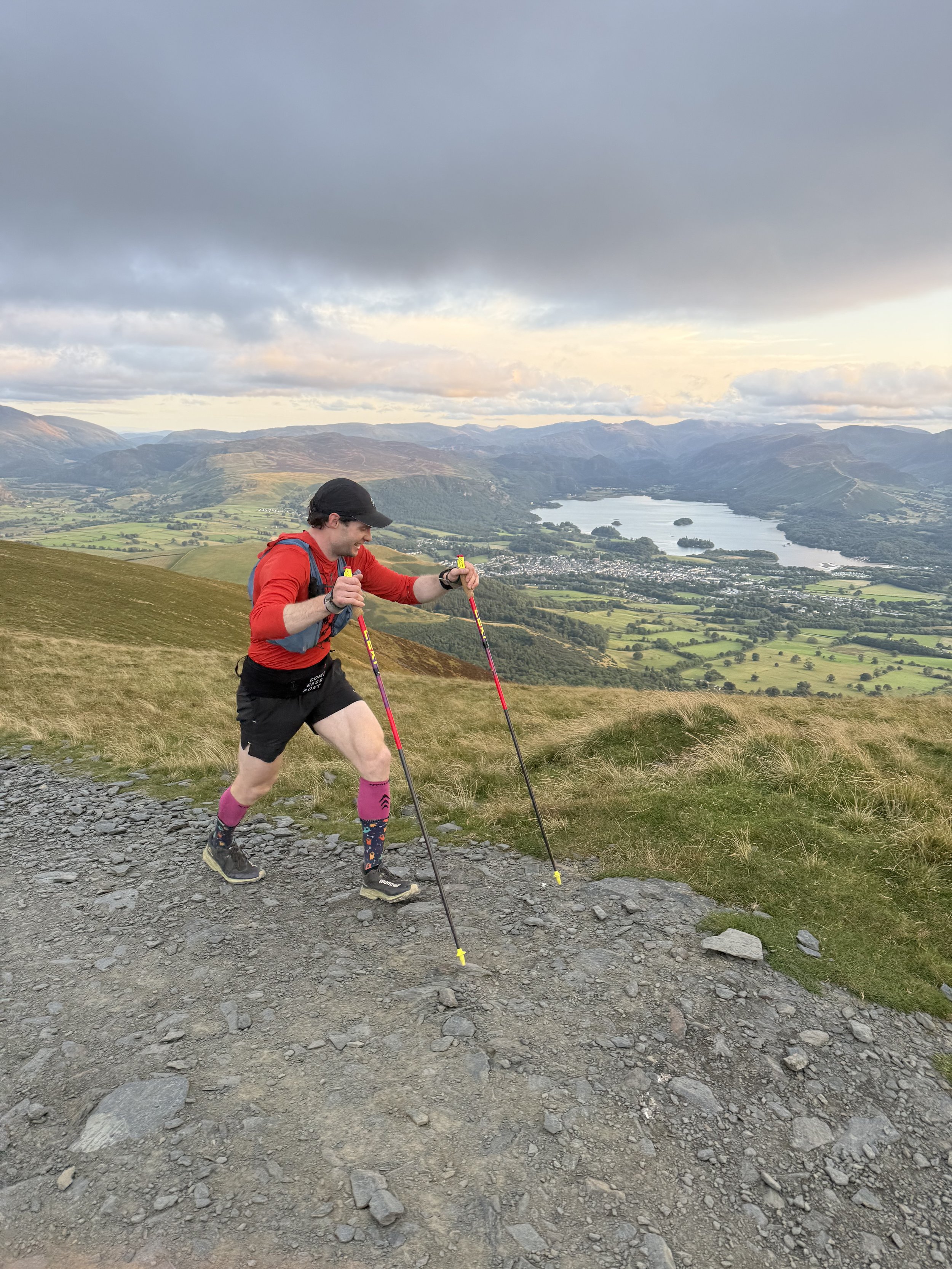
We were moving through golden-hour light, the views back towards Derwentwater and across the Lake District were sensational, while a cool breeze kept the temperature almost perfect.
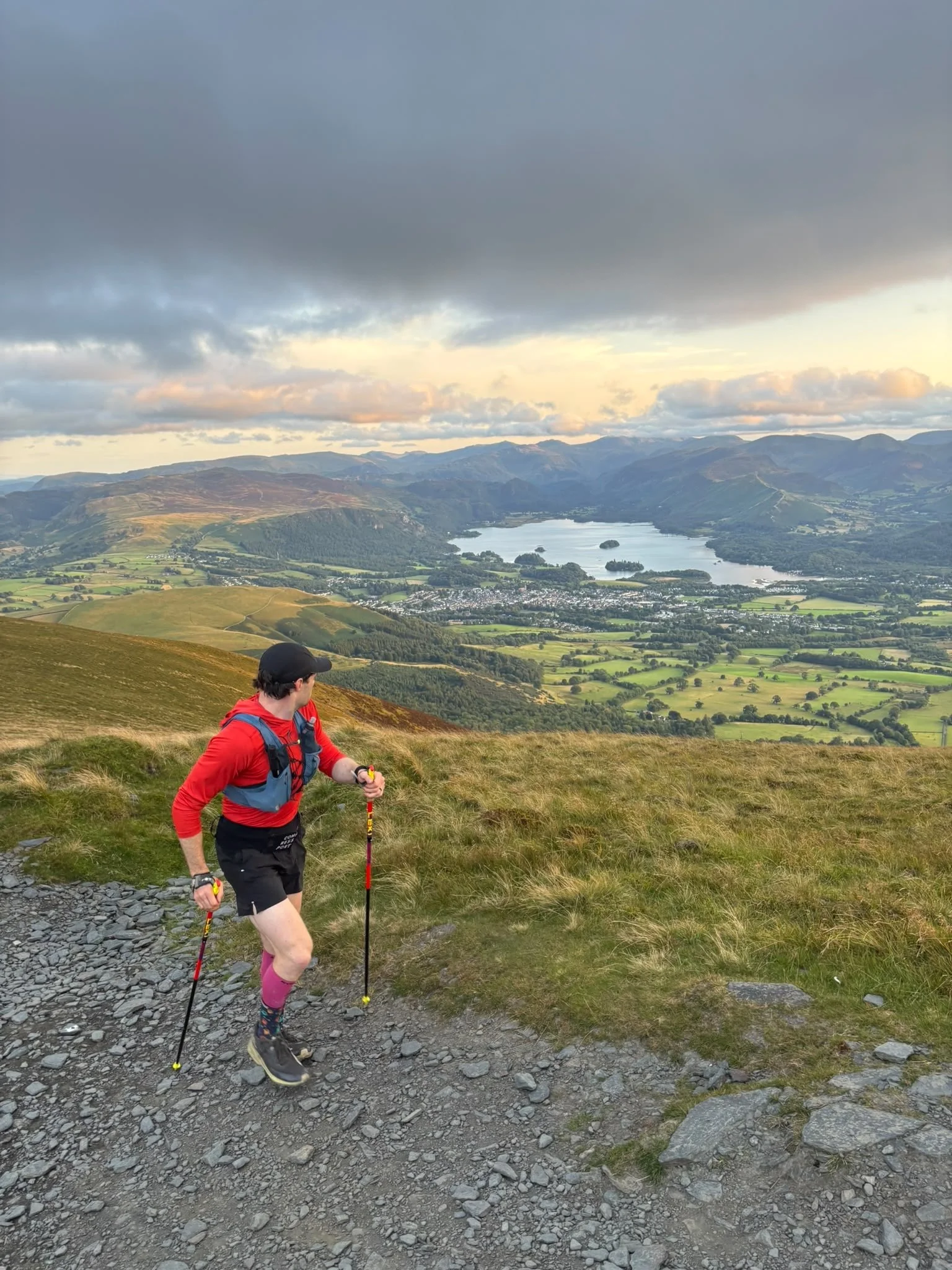
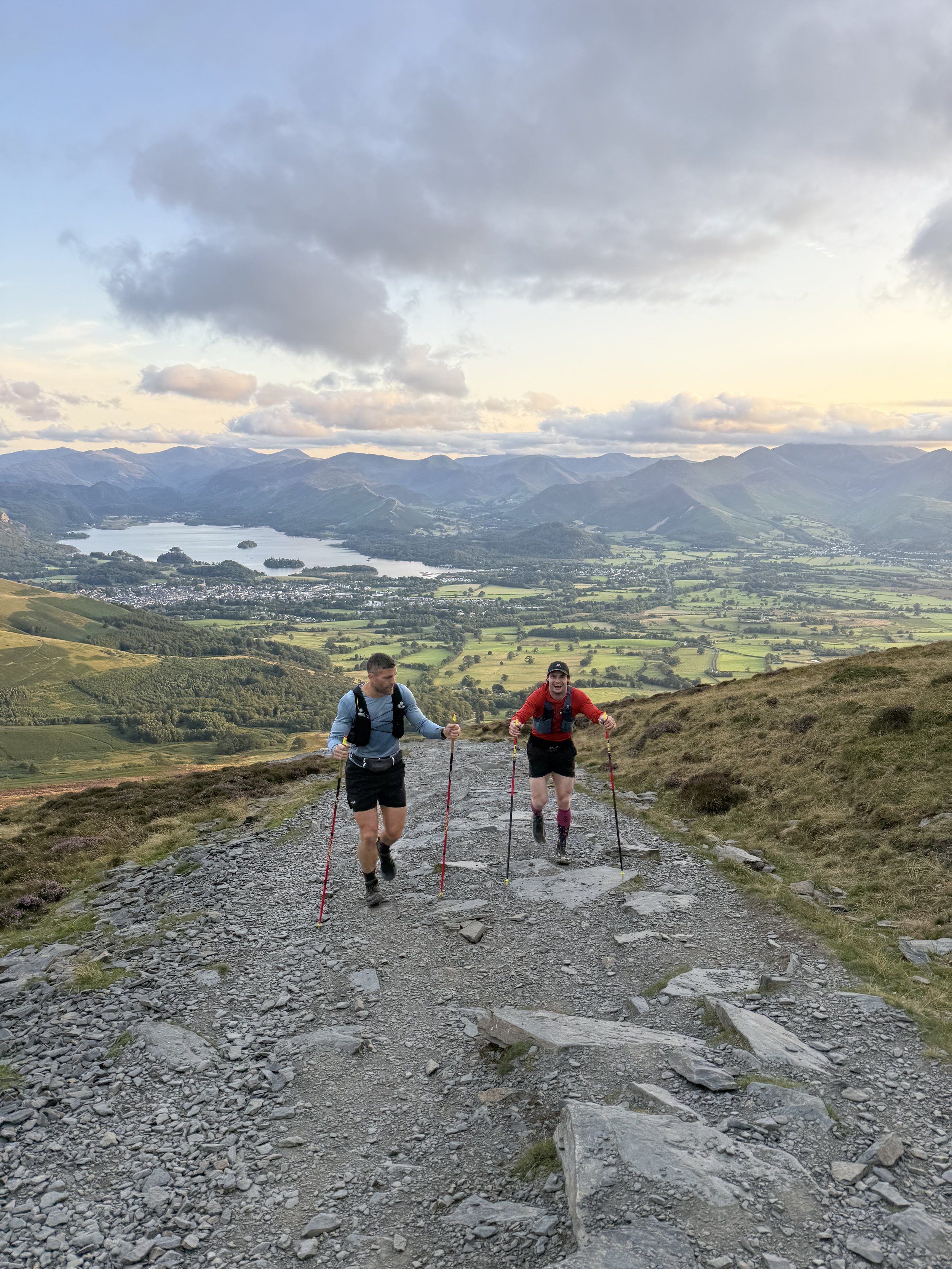
The cloud rolled in and the wind picked up near the summit, but I reached Skiddaw in around 1 hour 19 minutes, roughly six minutes ahead of my schedule, without feeling like I had pushed particularly hard.
From there we dropped back out of the cloud towards Skiddaw House before crossing towards Great Calva, where I had extended the advantage to around ten minutes.
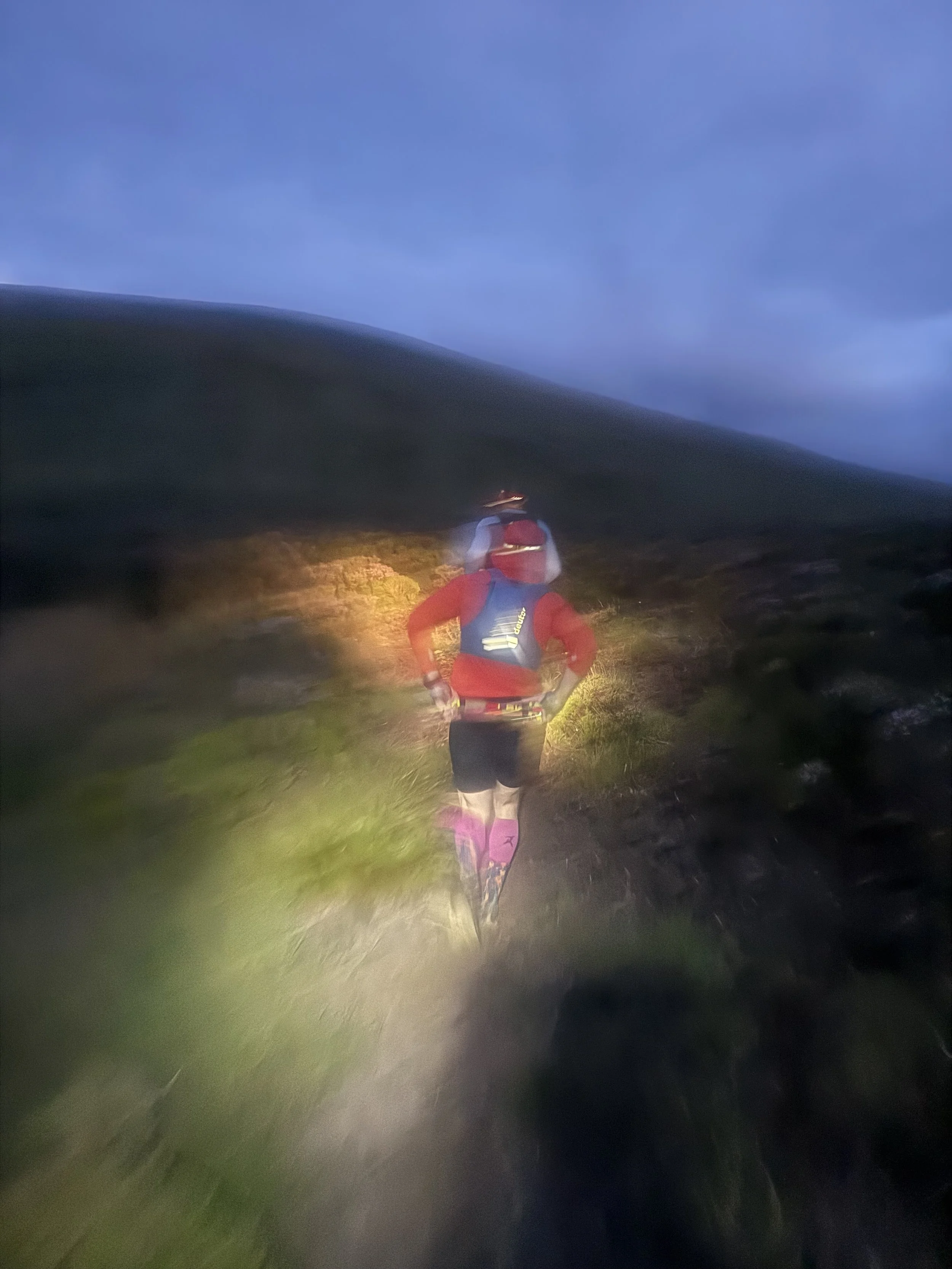
The headtorches came out on the descent, and after successfully keeping my feet dry through the river crossing, I promptly planted one of them into a patch of bog on the climb towards Mungrisdale Common
Looking back across the darkness, we could see several other sets of head torches moving across the fells from the other Bob Graham attempts, which was a special sight.
I was eating and drinking well, the pace felt comfortable and conversation was flowing, with Mark entertaining us with stories from his rugby career and his time around the England setup under Eddie Jones.
We reached Blencathra around 12 minutes ahead of schedule before starting the descent down Halls Fell. Once we had negotiated the trickier upper section, Tom shot off ahead carrying my empty soft flasks and a message for Becky that I wanted to change my socks after getting one foot wet.
I eventually arrived into Threlkeld in 3 hours 29 minutes, around 16 minutes ahead of my 22.5-hour schedule.
Considering the company, how comfortable the pace had felt, and how well I was eating and drinking, I came into the first road crossing on an enormous high.
Unfortunately there was some bad news.
My support runner for Leg 4 was flying back from Portugal and his flight had been delayed, meaning there was a chance he wouldn't make it to Wasdale in time…
That left me without anyone to support on leg 4, which is arguably the toughest leg of a clockwise round.
This meant I not only would have to carry all my kit and fluids, but would mean I wouldn’t have a witness at every summit, so couldn’t have my attempt ratified by the Bob Graham 24 hour club.
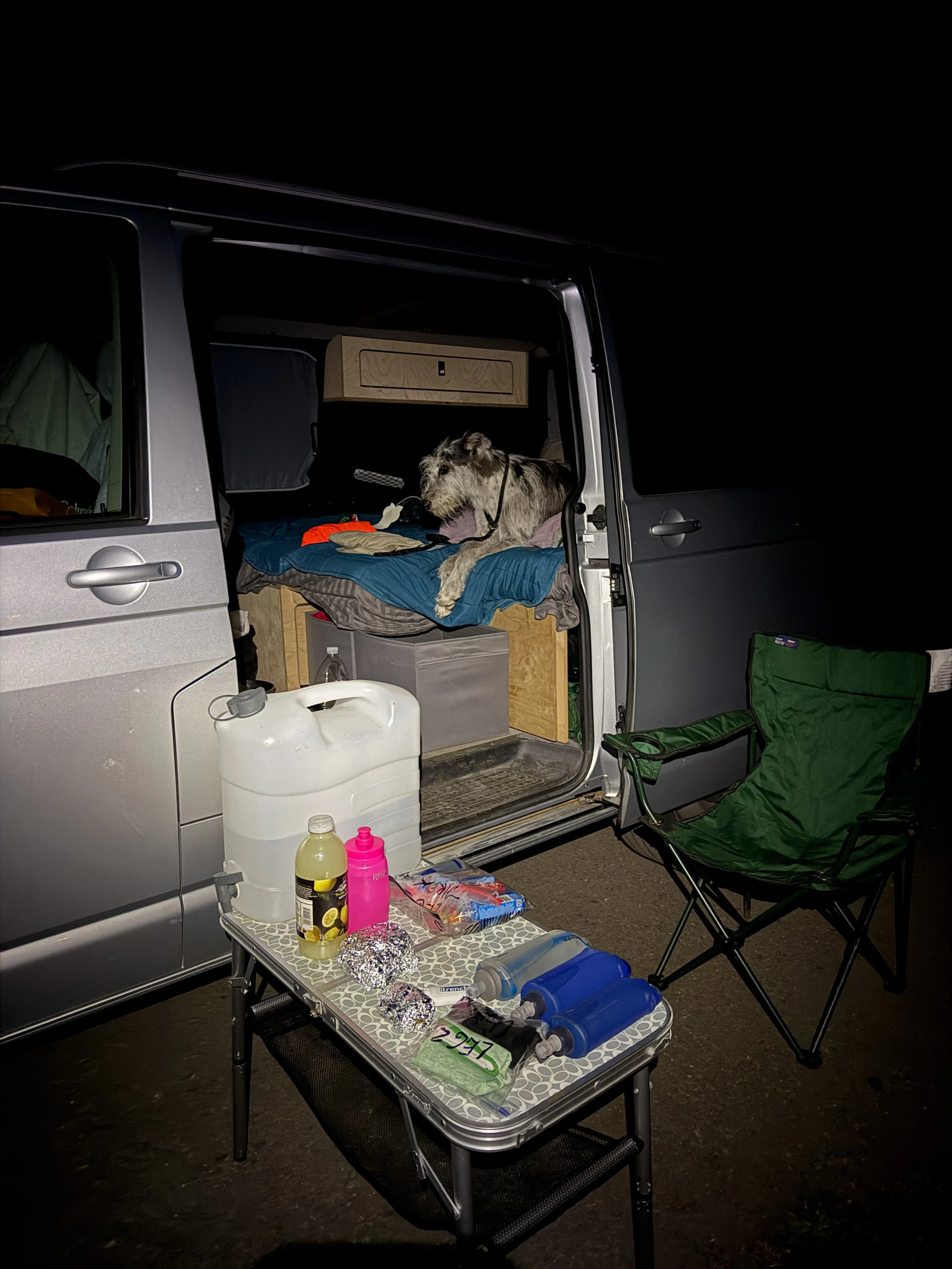
As there wasn't much I could do about it, I didn’t let it affect the mood. I changed my wet sock, ate a sausage roll, drank some fluids, thanked Tom and Becky, then headed off towards Leg 2 while eating my sandwich.
A 7 minute 45 second stop, which was just under he 8 minutes I had planned.
Leg 2: Threlkeld to Dunmail Raise
Leg 2 starts with a long section of road, so I used that to eat my sandwich whilst allowing Mark (who was changing his shoes for leg one) to catch back up.
The round is about being as efficient as possible and trying to keep moving, so you are better off walking and eating, rather than staying stationary. Also Mark came out with a belter of a quote which was “If we are moving, we are grooving” which became my mantra for the round.
With the problem of potentially having nobody to support me on Leg 4 still looming, I sent couple of voice notes on the early part of the climb to my support crew asking whether Ethan, who was currently down for Leg 3, would be willing to move across to Leg 4 instead.
Once the messages were sent, I put my phone away, left the problem with them and concentrated on the endless grind up Clough Head.
By the time we reached Great Dodd I was still around 15 minutes ahead of schedule, but the weather had started to change, with the wind picking up and thick clag rolling across the tops.
This is where Stephen came into his own.
He had supported and navigated Leg 2 numerous times (including Arthur Hill's winter Bob Graham record attempt), and said it was his speciallity. With visibility dropping to less than ten metres, I was able to relieve myself of the stress of navigating, follow his lines, and focus on eating, drinking and moving well.
The next couple of hours became a bit of a blur moving through the claggy darkness. Summits (and false summits) came and went, and it was hard to actually differentiate where I actually was on leg 2.
I do remember feeling incredible as we made the climb up to Lower man. I hadn't even had any caffeine at Threlkeld and was still riding the adrenaline of the Round.
Eventually we made it to Grizdale tarn and began the out and back to Fairfield. This is a horribly steep climb over loose scree (I had not reccied it) and with the wind and drizzle having picked up, it was a right slog
Mark had taken things easy on the climb, and whilst I was on my way back from the summit appeared out of the mist armed with Jelly Babies, which was a huge pick me up.
On the descent we also passed Pete, another Bob Graham contender who had started at 8pm on a 20 hour schedule.
Ironically, he had also struggled to find support for Leg 3 and had actually messaged me beforehand asking whether I could support his attempt. Because we were due into Dunmail (the second Road crossing) at fairly similar times, we had already discussed potentially joining forces across Leg 3.
With my own support situation changing by the hour, and Leg 3 being the section I knew least well, that possibility was suddenly looking increasingly likely…
We carried on over Seat Sandal before Stephen headed down ahead of me with my empty soft flasks and instructions for my wife.
I arrived into Dunmail Raise at around 3:00am, having completed Leg 2 in roughly 4 hours 10 minutes and was sitting around 20 minutes ahead of schedule.
Despite it being three in the morning, the lay-by was chock-a-block with road crews. More importantly only Brad was waiting to join me for Leg 3, which meant Ethan had agreed to move across and support Leg 4 and my problem with support was solved.
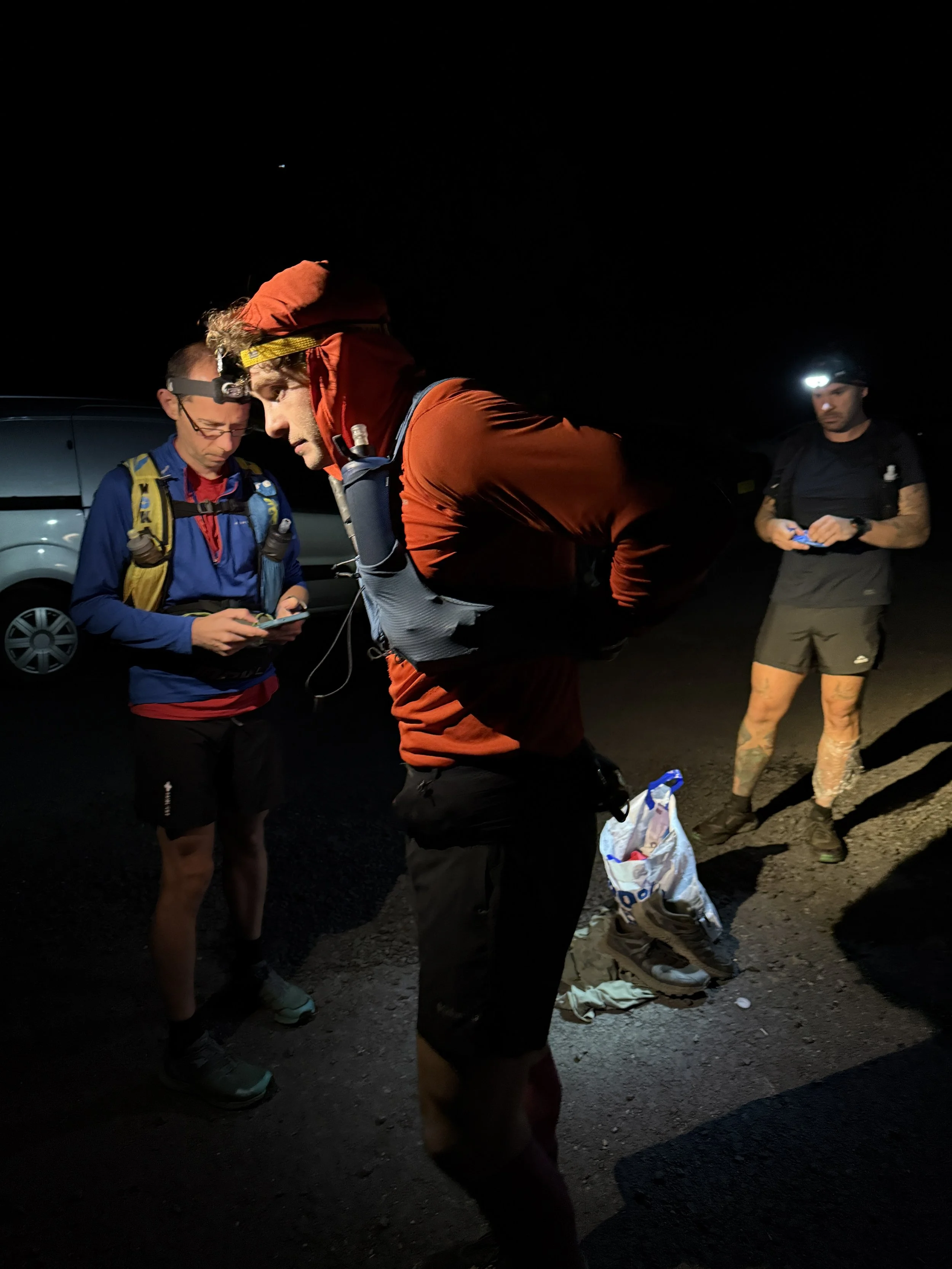
I changed both my shoes and socks, drank my first Red Bull of the Round, before a quick trip to the bushes for emergency poo.
After a 15 minute stop, I departed feeling considerably better (and slightly lighter) and me a Brad began the steep climb up Steel Fell.
Leg 3: Dunmail Raise to Wasdale
Leg 3 was the section I knew least well, which made it the one I was probably most nervous about from a navigation point of view.
Brad was my lone support runner and this was he first time we had met.
He was visiting the Lake District for the weekend to view potential wedding venues with his fiance. After seeing my social media post, he decided it would be a fun idea to meet me in a lay-by at 3am and spend six hours grafting through the fells. What an absolute trooper
After heinously steep climb up Steel Fell, we ticked off the first peak with relative confidence.
However with thick clag still covering the tops, multiple trods disappearing in different directions, and neither of us having done this section of the Round before, I found myself constantly second guessing and checking the route which was slowing us down considerably.
Thankfully, I eventually turned around to see two headtorches come bounding out of the mist.
It was Pete and his navigator Dave.
Because Pete and I had exchanged messages beforehand, he had no issue with us teaming up and moving together. Dave had completed the Round himself and knew Leg 3 well, so despite the occasional questionable line, had us moving with haste across the pitch-black, clag covered, fells.
I promised myself I would stick with them until at least sunrise, providing I wasn't jeopardising my own Round in the process.
One of the biggest mistakes you can make on a Bob Graham Round is trying to hold pace with a group on a faster schedule. You end up pushing too hard, burning too many matches, and leave yourself cooked for later in the round.
I was essentially going against my own advice.
Despite being head down and grinding away, conversation was still flowing, the mood was high, and most importantly, my heart rate was still sitting comfortably in Zone 2.
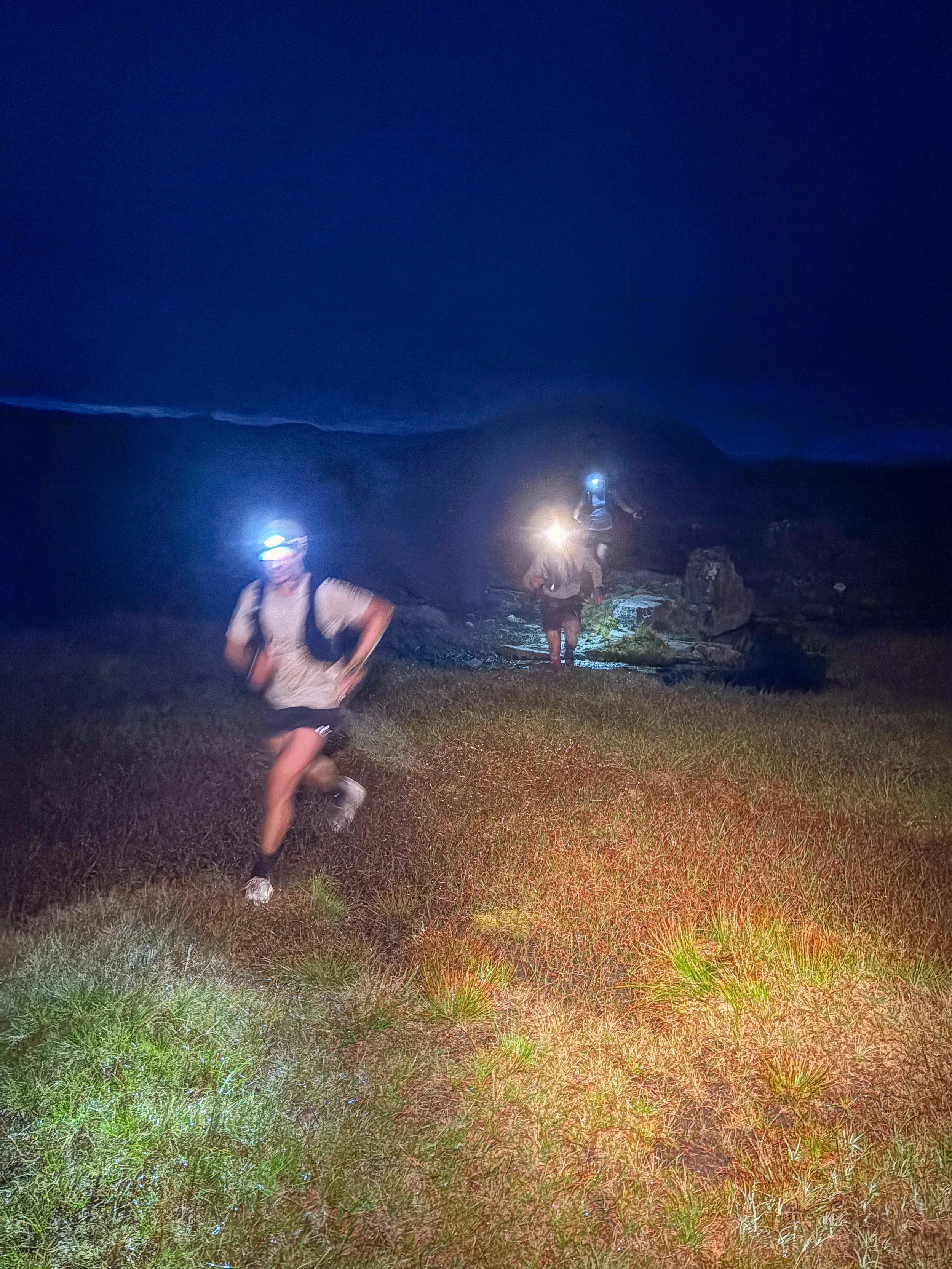
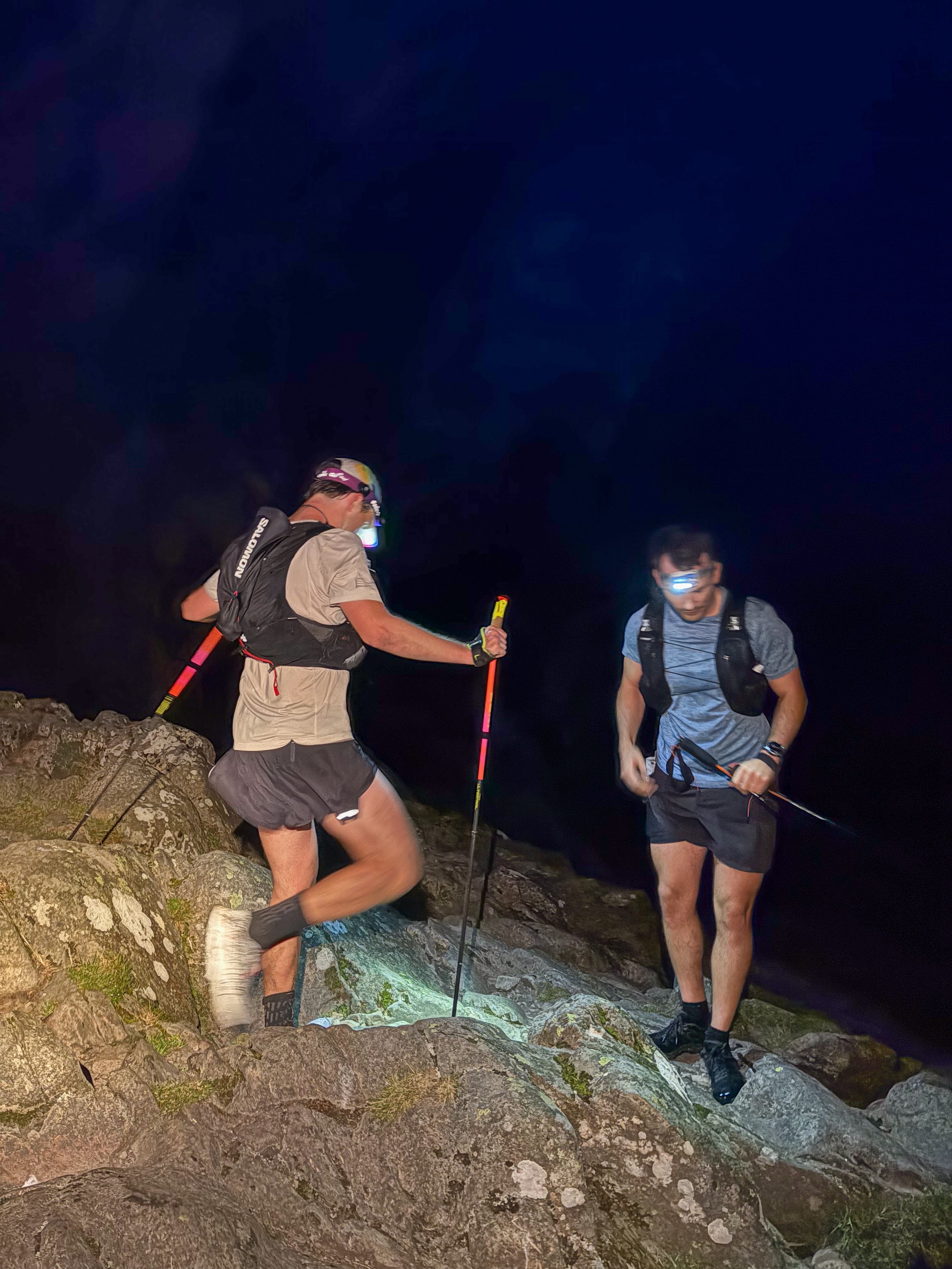
After traipsing through several hours of terrain that I now have zero recollection of, the darkness began to lift, daylight slowly returned and we were provided an enormous psychological boost.
Despite the slightly longer stop at Dunmail and some dilly-dallying during the opening stages of Leg 3, we were still ahead of my schedule when we reached Pike o' Stickle.
By this point I had repeated "Good one Dave, You’re a Legend Dave" (From the Flight of the Conchords song) half a dozen times.
The headtorches were now off, the cloud was beginning to clear properly, and for the first time since Great Calva I could actually see the mountains around me again.
The joy was short lived as we took a very direct and extremely soggy line across Musgrave Common , before beginning the first of two punchy climbs towards Bowfell.
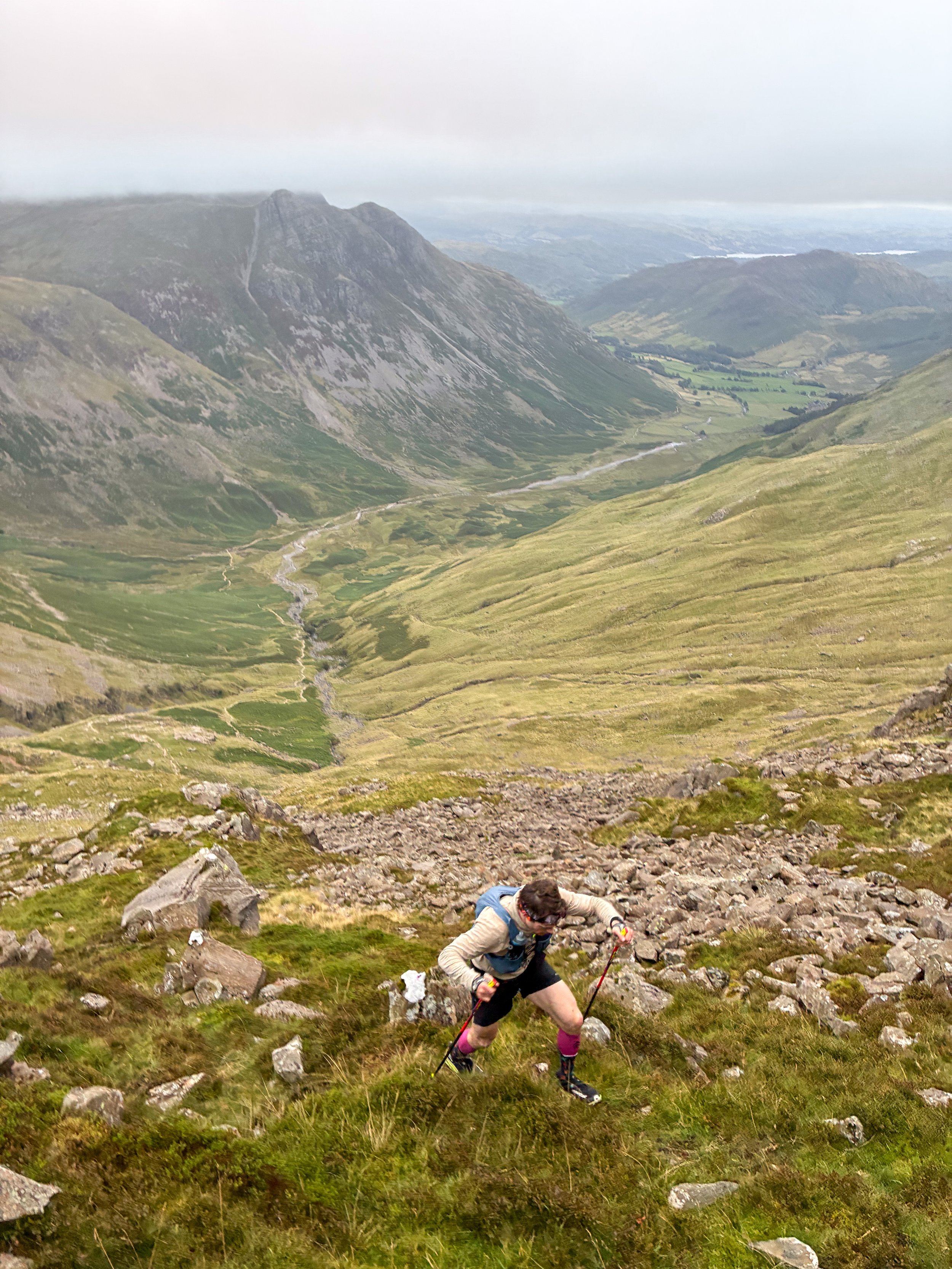
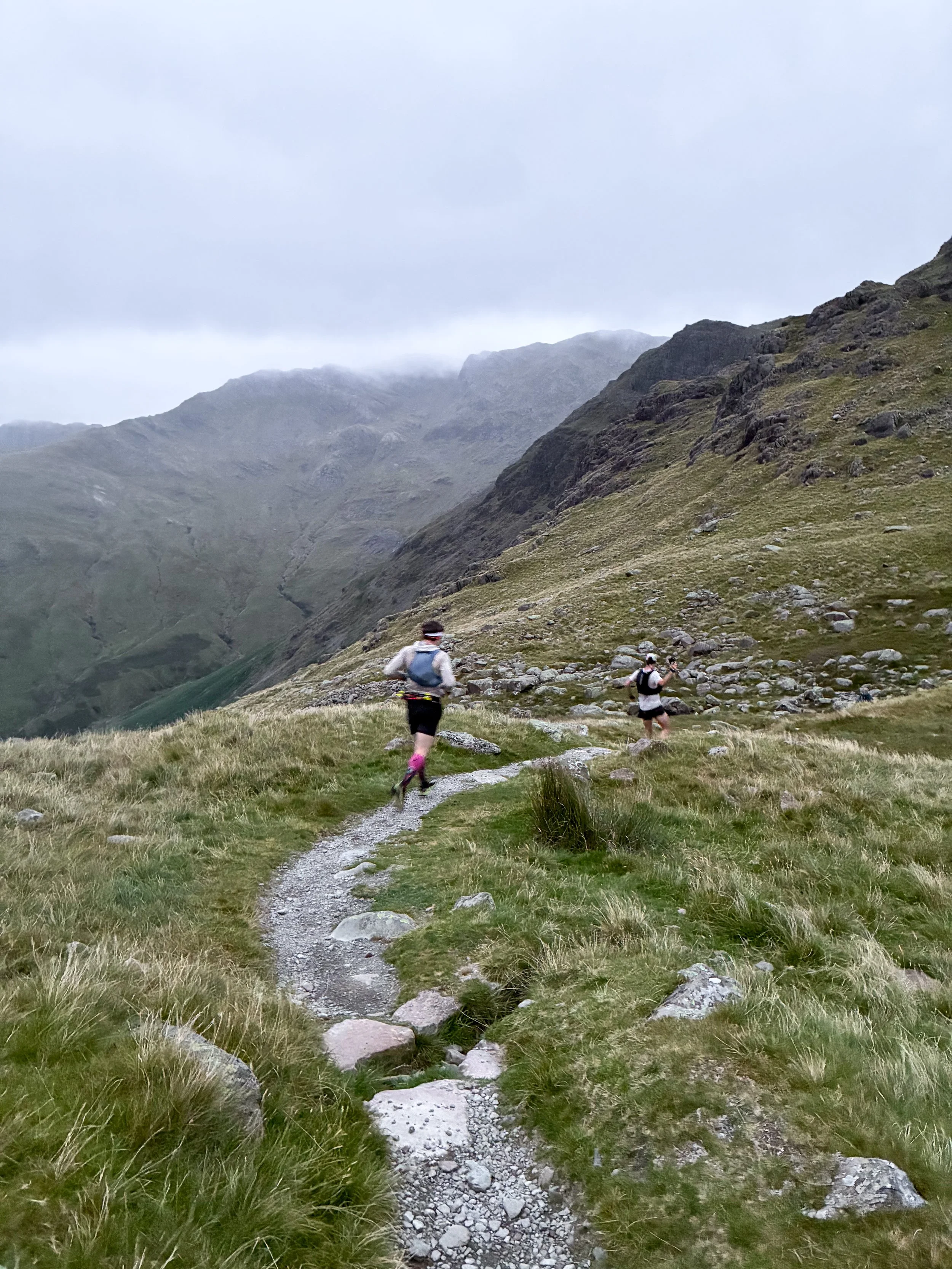
People talk about this section as one of the more unpleasant climbs of the Round because it is steep, rocky, and comes after a long section of awkward terrain, but I actually found it alright.
The views back towards the Langdales were incredible, and after spending around eight hours moving through darkness and clag, the stunning landscape of the Lake District stretching out around took my mind of the climb at hand.
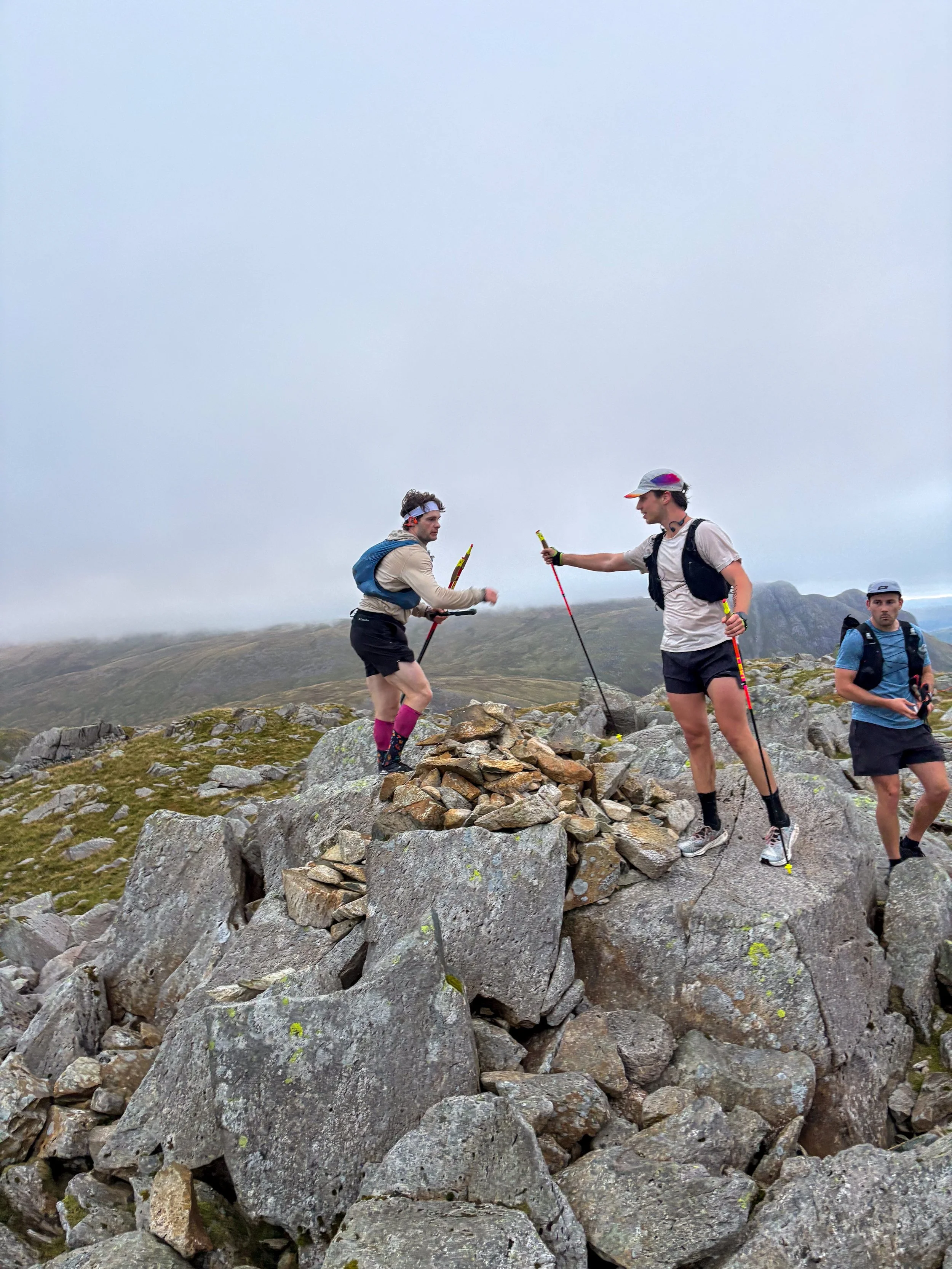
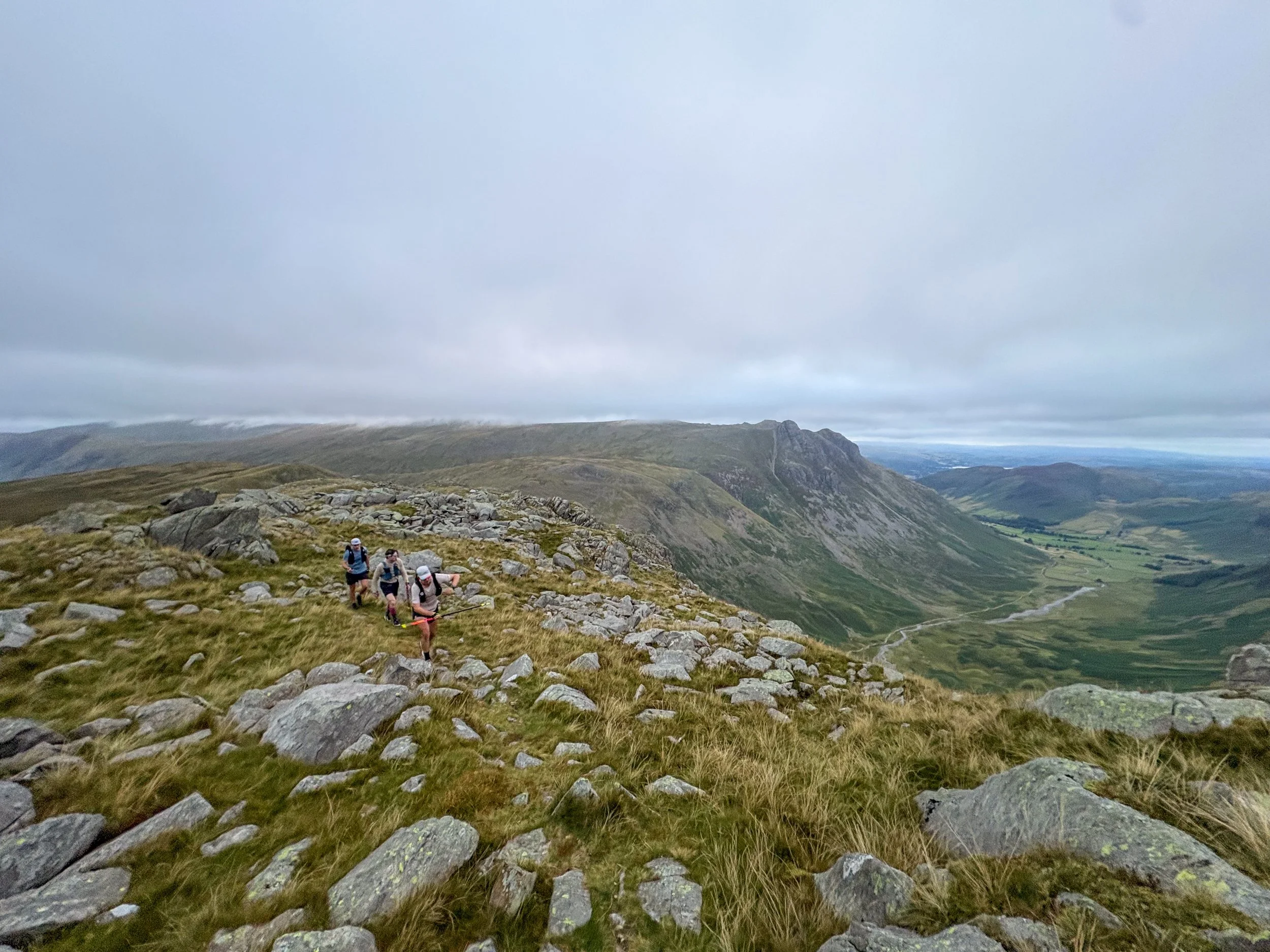
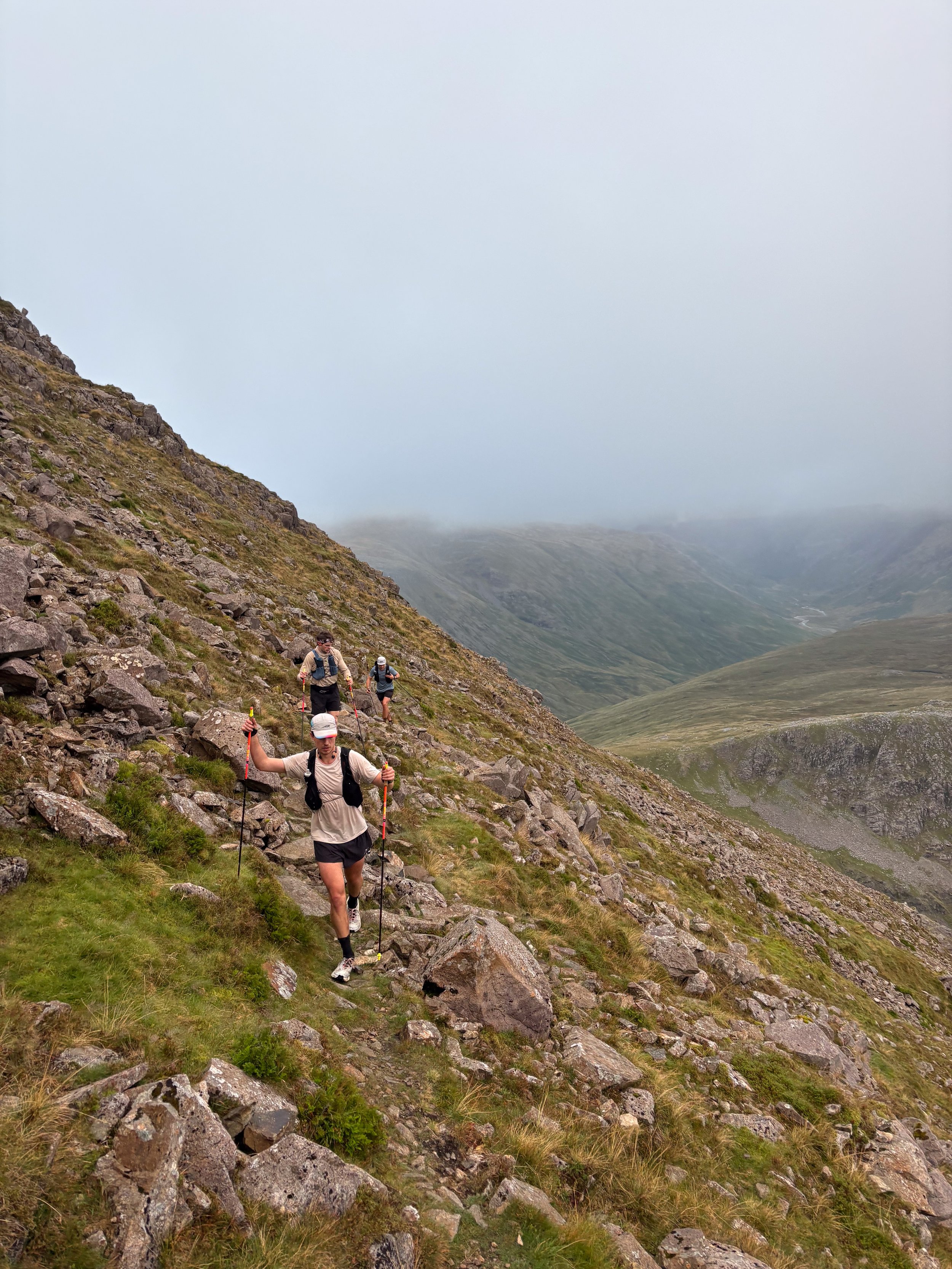
From Bowfell we made great time across some of the roughest terrain of the entire Round.
After ticking off Esk Pike, Great End, Ill Crag and Broad Crag, we reached Scafell Pike at around 7:55am, roughly 23 minutes ahead of my schedule.
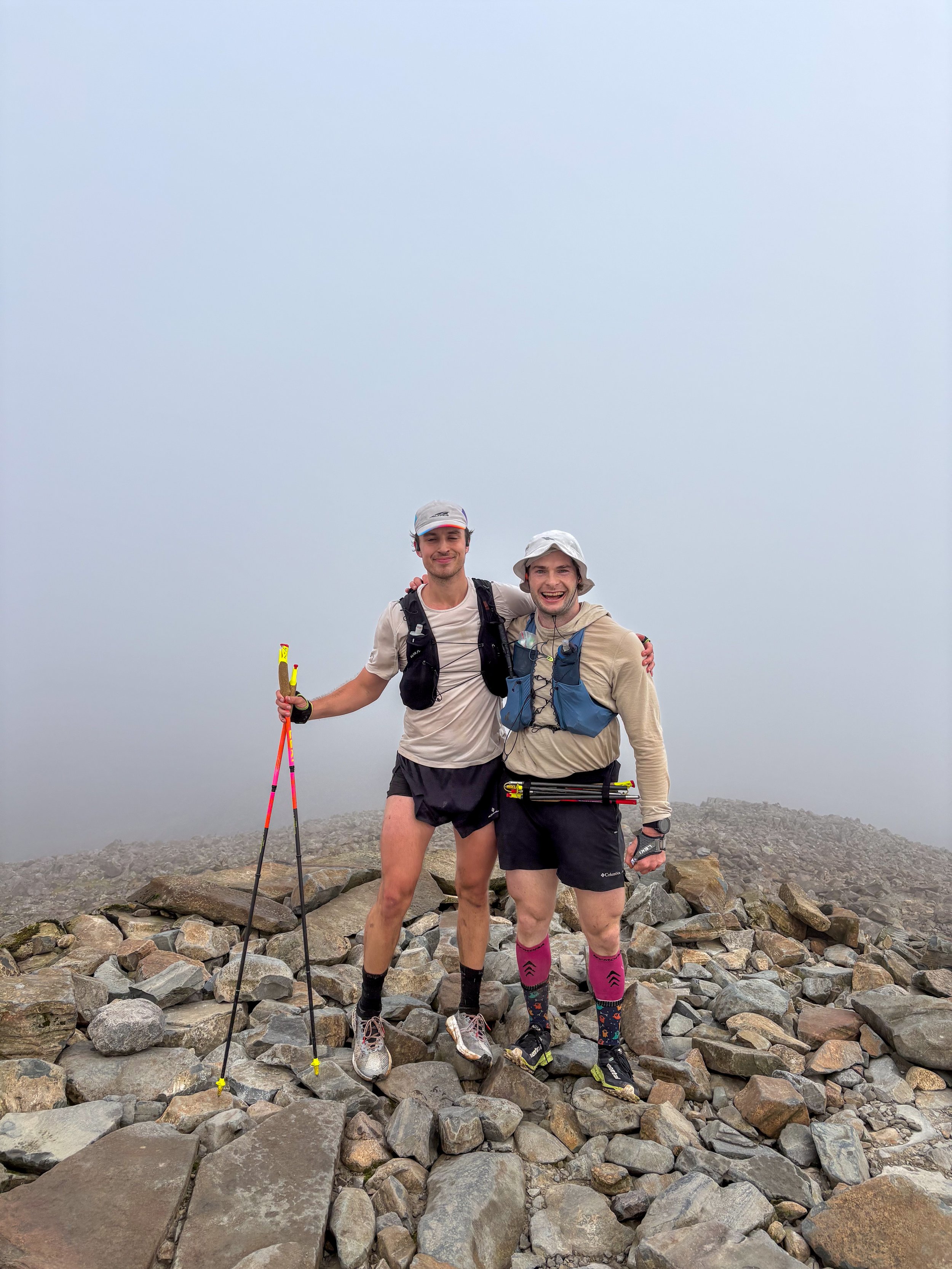
Standing on the highest mountain in England before 8am felt like a fairly decent way to start a Saturday, although unfortunately the mist had rolled back in and robbed us of any views.
From Scafell Pike we dropped towards Mickledore before taking Lord's Rake towards Scafell.
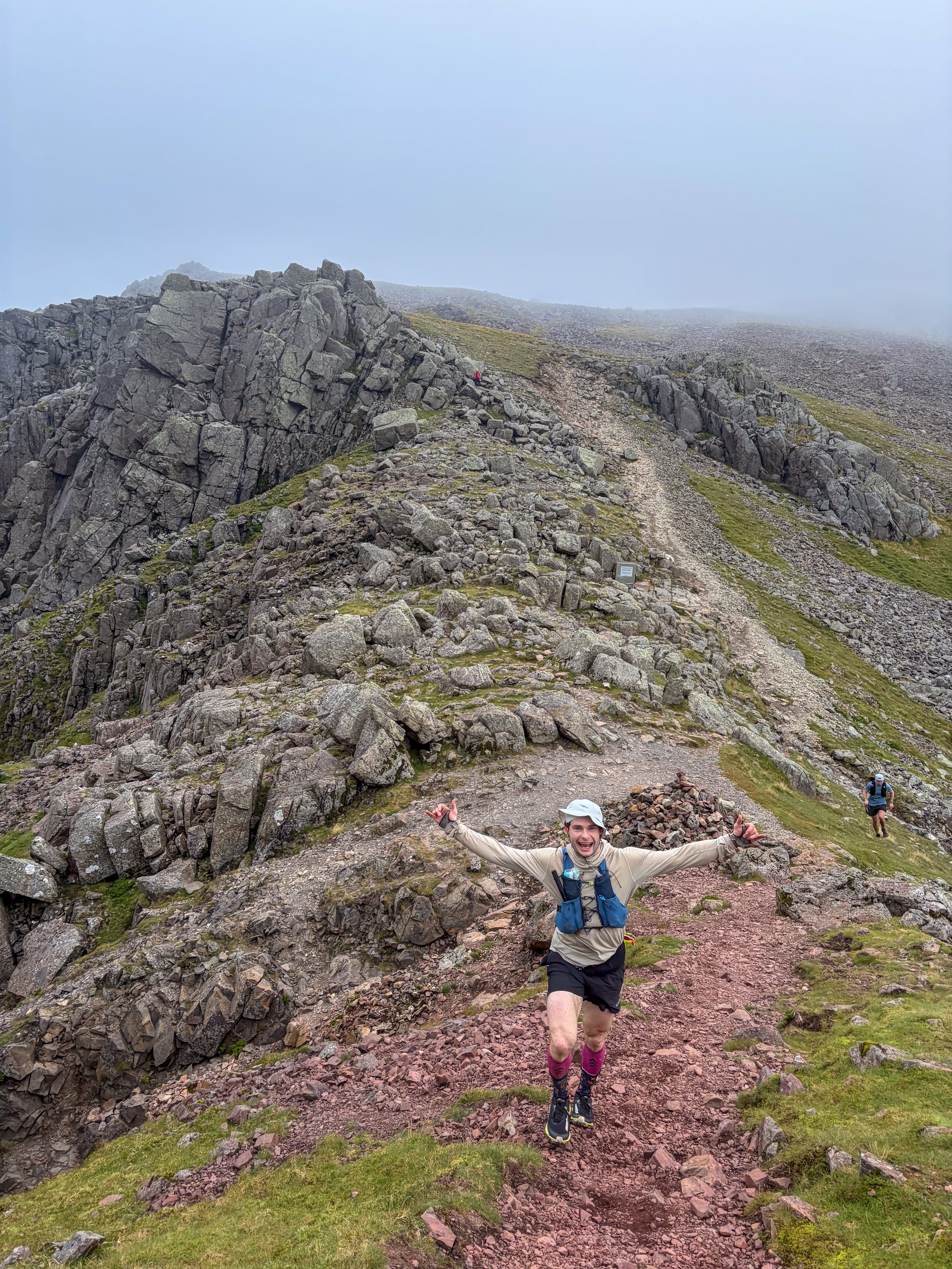
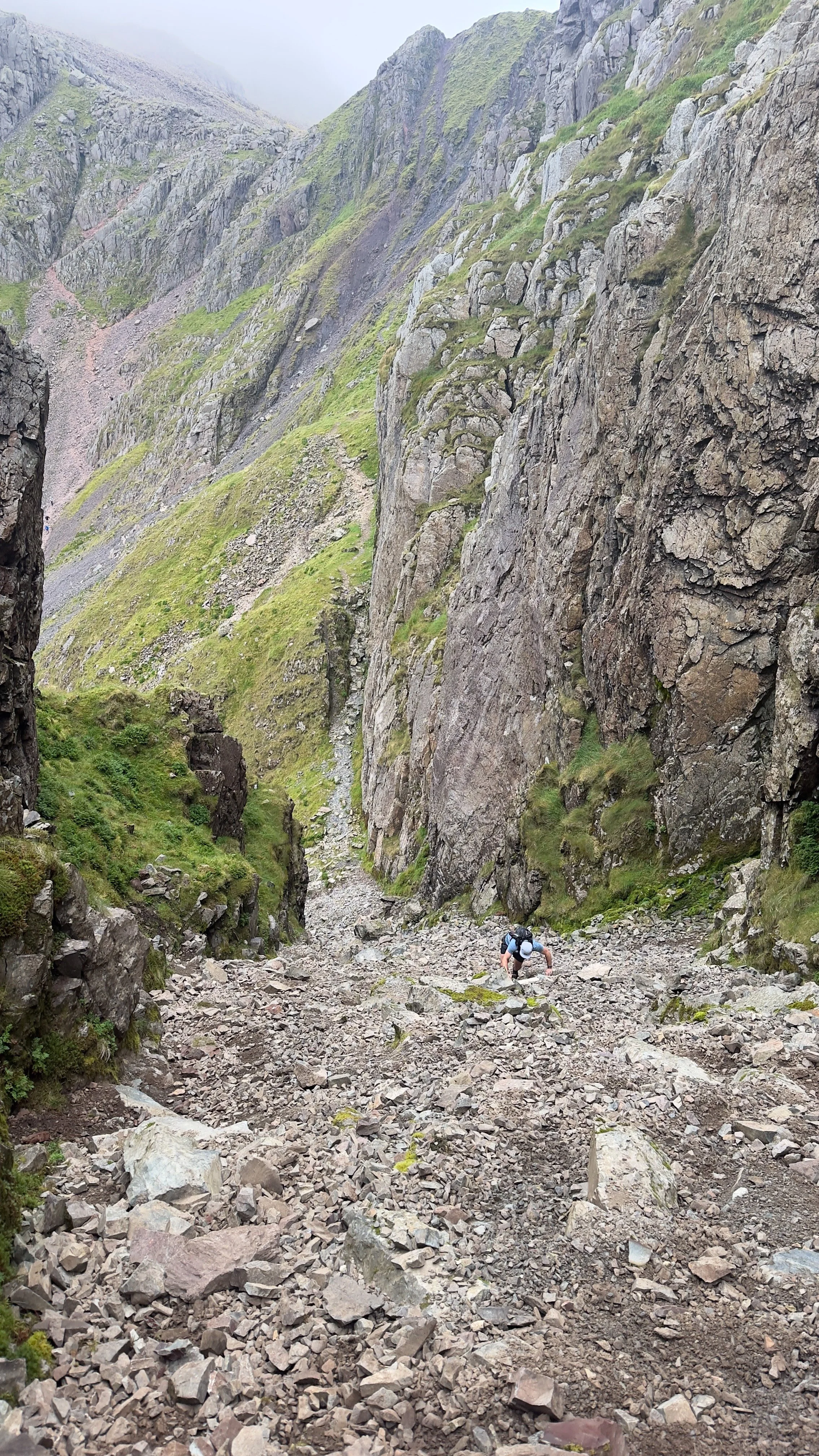
Having recced Lord's Rake after sunset beforehand, I had no issue with how technical it was. I loved it and found moving through it relatively straightforward, particularly if you stick to the more solid sections around the edges rather than charging straight through the loose scree.
Brad had a been brilliant throughout the leg, checking in, taking photos, alongside constantly reminding me to eat and drink. What he hadn’t mentioned was that he had started struggling slightly with the pace, and when we reached the steep scree of Lord's Rake he began to fall a little behind.
Near the Western Traverse he then took a wrong line and disappeared out of sight.
Not wanting to stand around getting cold, and knowing I would effectively be doubling back on myself after Scafell, I continued with Pete and Dave to bag the final peak of Leg 3 , before heading back through the mist to find Brad
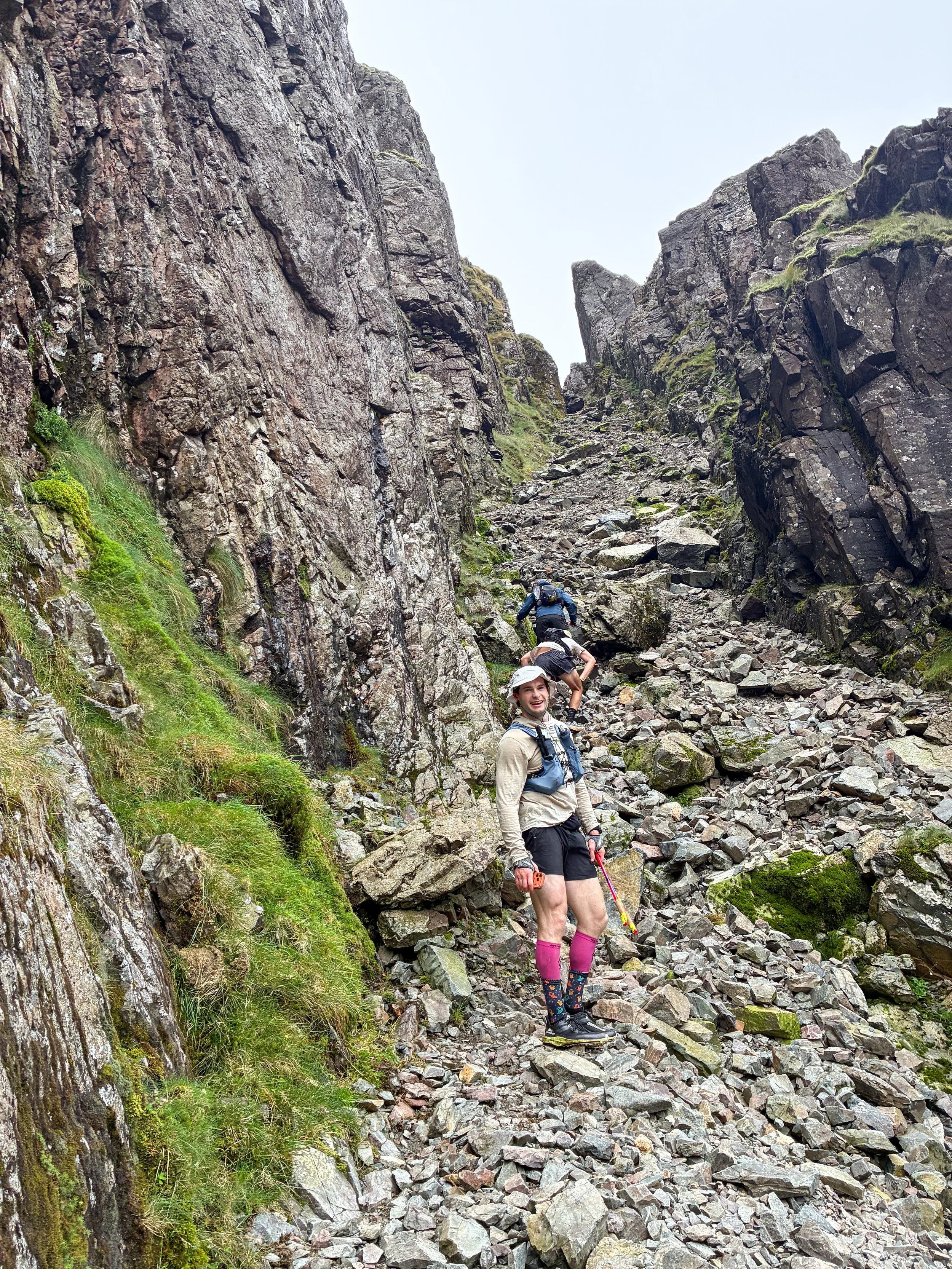
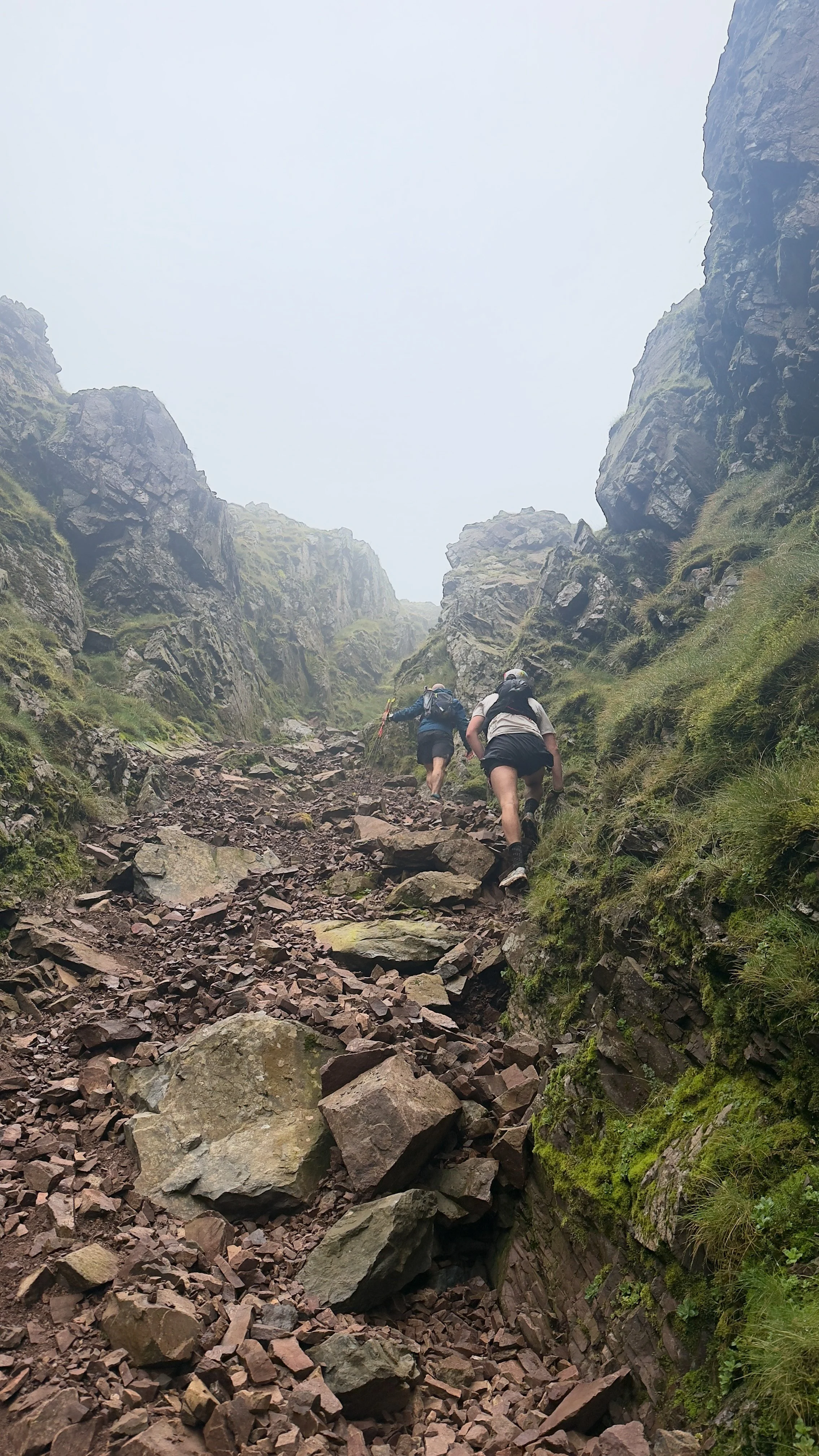
Western Traverse
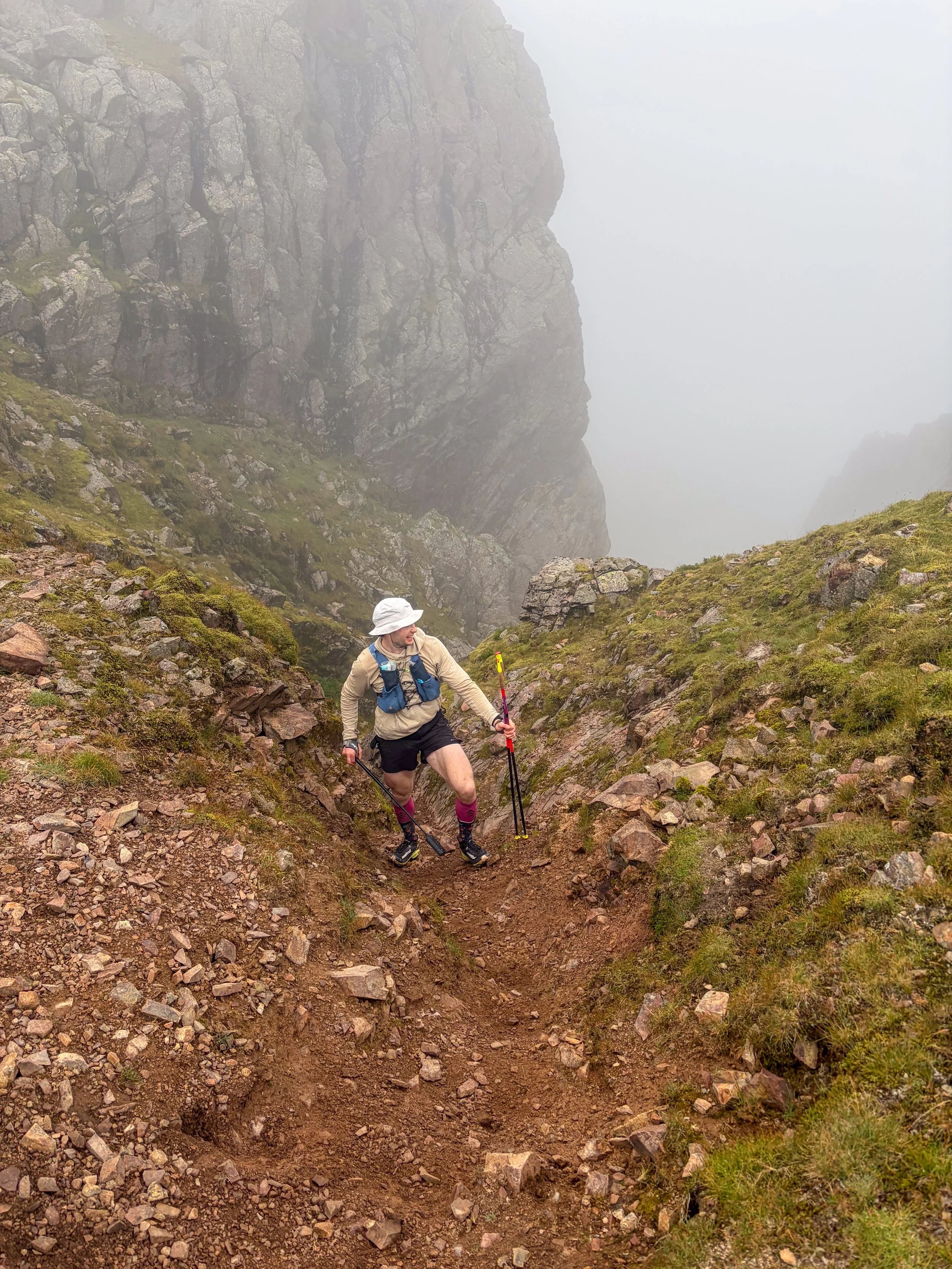
top of the Western Traverse
Fortunately we were quickly and rather conveniently reunited directly above the descent off Scafell.
knowing I was a quicker descender, Brad handed me all my empty bottles, and told me he would see me at the campsite.
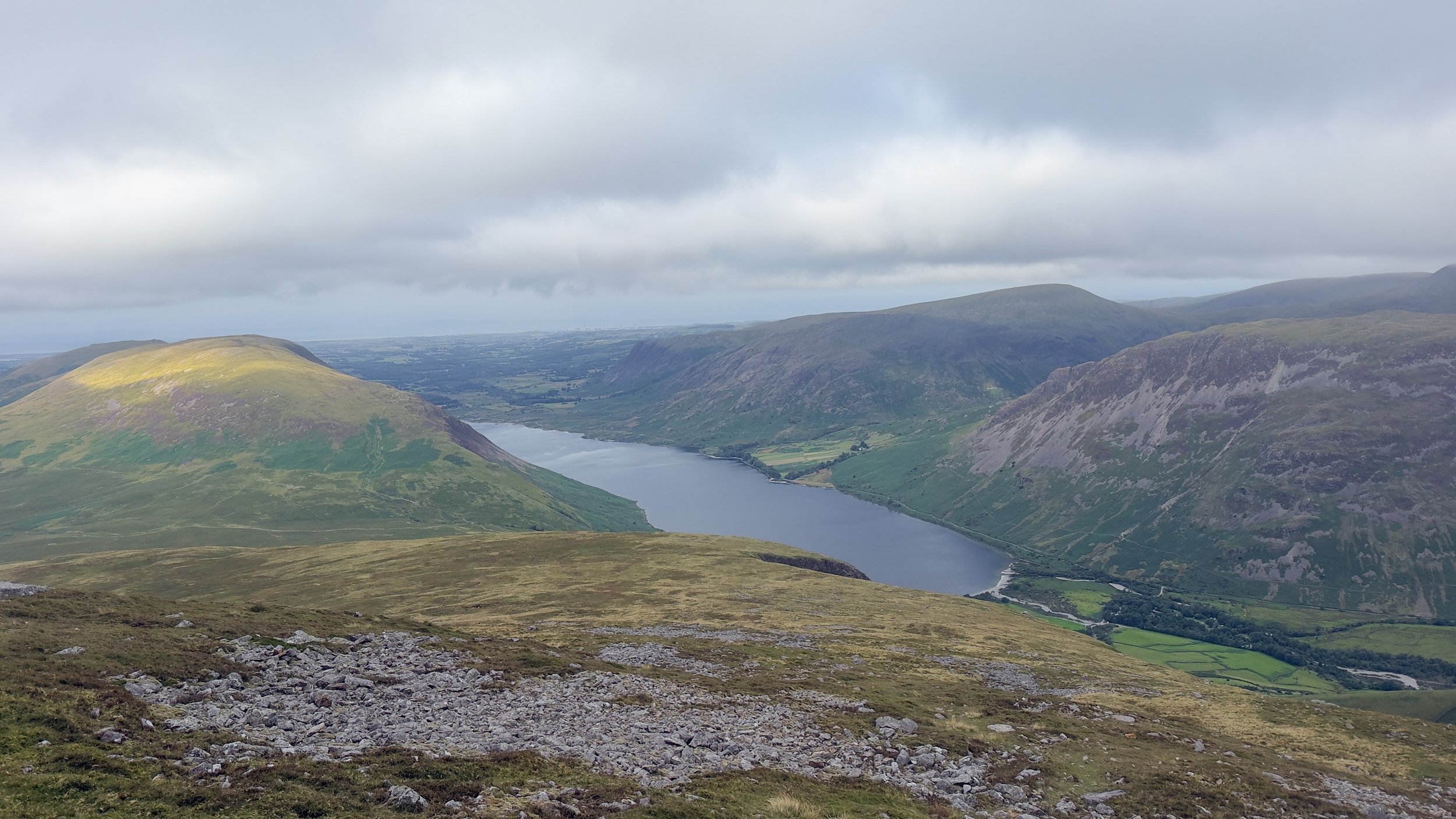
The final descent into Wasdale was steep, loose and fast, but I loved it.
After being called a lunatic by a couple of hikers making their way up Scafell Pike, I eventually arrived into Wasdale at around 9:04am, having completed Leg 3 in 5 hours 48 minutes.
It had been the longest leg of the Round, and the section I was worried about the most, yet I had come through it 27 minutes ahead of schedule and still feeling remarkably good.
Being a sunny Saturday morning in August, the car park in Wasdale was absolutely rammed. Thankfully a helpful parking attendant cleared some cones for Rab's van after he explained that they were supporting a Bob Graham attempt.
Being ahead of schedule meant they had only just arrived and nothing was quite ready. However as I was comfortably ahead of schedule, still riding high from the round, and extremely grateful to see a familiar face, I wasn't particularly concerned about slower road crossing.
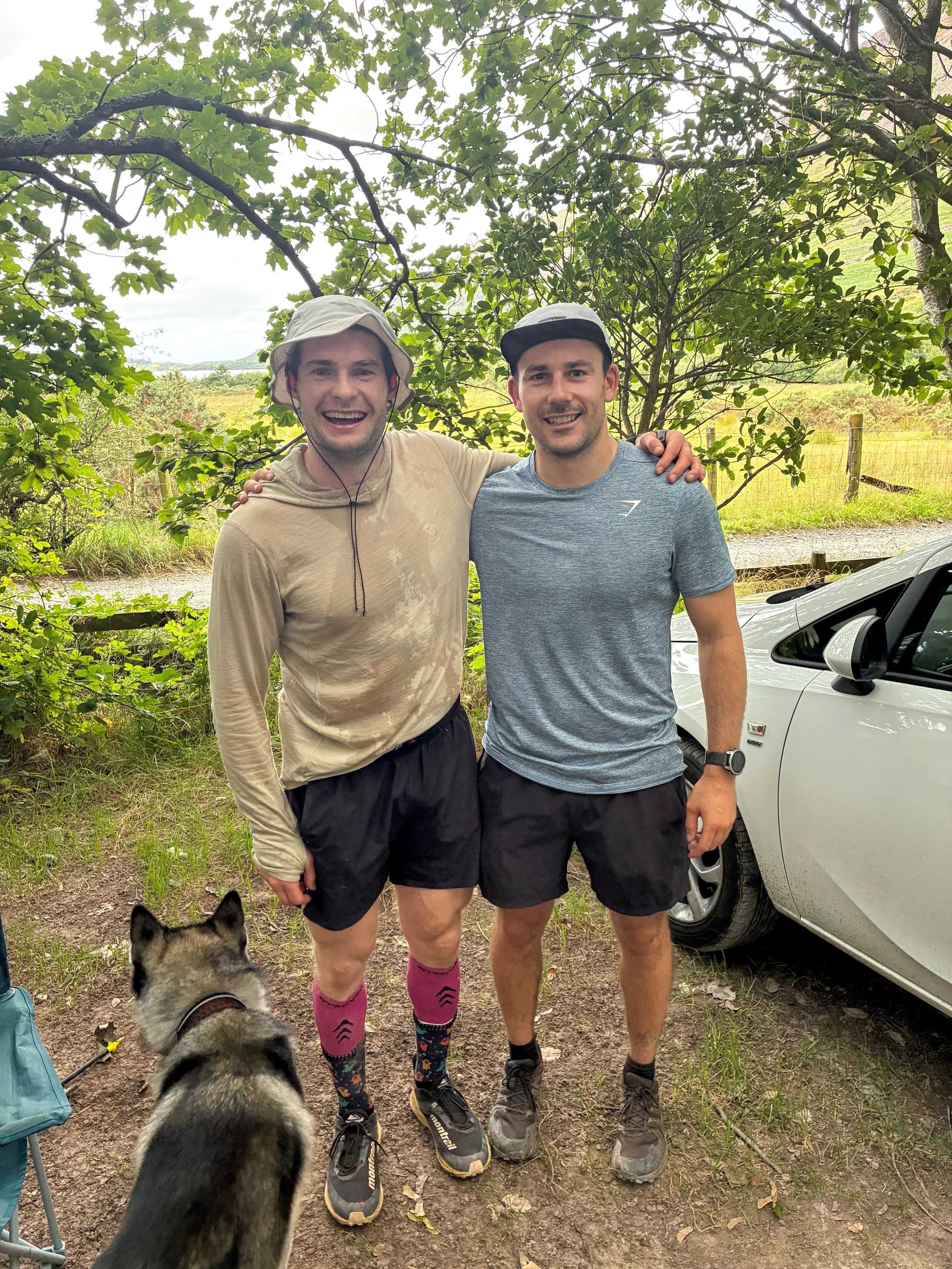
I used the extra time to frequent the toilet, change my socks, organise my food and thank the legend that was Brad for his support.
After a 21 minute stop, Ethan and I departed Wasdale and I tried to gobble down bacon sandwich whilst preparing myself for what would be the hardest leg of the entire Round…
Leg 4: Wasdale to Honister
Ethan was another person I had never met before the attempt, having reached out after seeing my post on social media. I had initially put him down for Leg 2, then moved him to Leg 3 before the increasingly chaotic support situation eventually landed him on Leg 4, yet despite all that he arrived enthusiastic and ready to help, even informing me that if things got really bad I could use him as a chair.
Fortunately, it never quite came to that, but it was reassuring to know the option was there.
Leg four starts you off with a kick to your nether regions.
After a 900m descent of Scafell, you begin with heinously steep 600m climb straight up Yewbarrow.
To make the climb even more enjoyable, the the cloud was clearing and the sun was creeping out.
Despite having already been moving for almost 14 hours, I was still feeling surprisingly good as we started grinding our way upwards. Buoyed by Ethans enthusiasm and energy, we settled into a steady rhythm and eventually reached the summit 23 minutes ahead of my schedule.
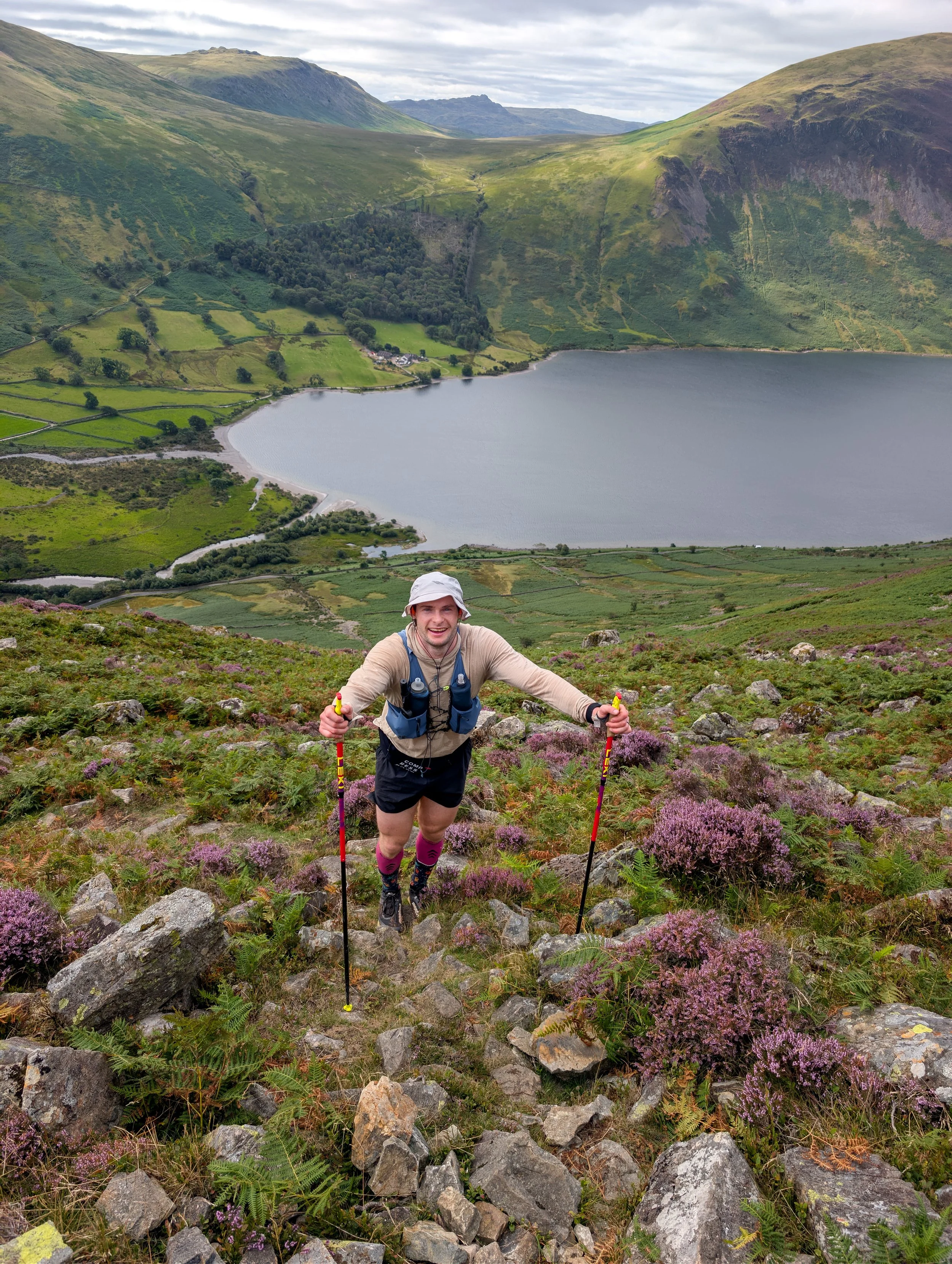
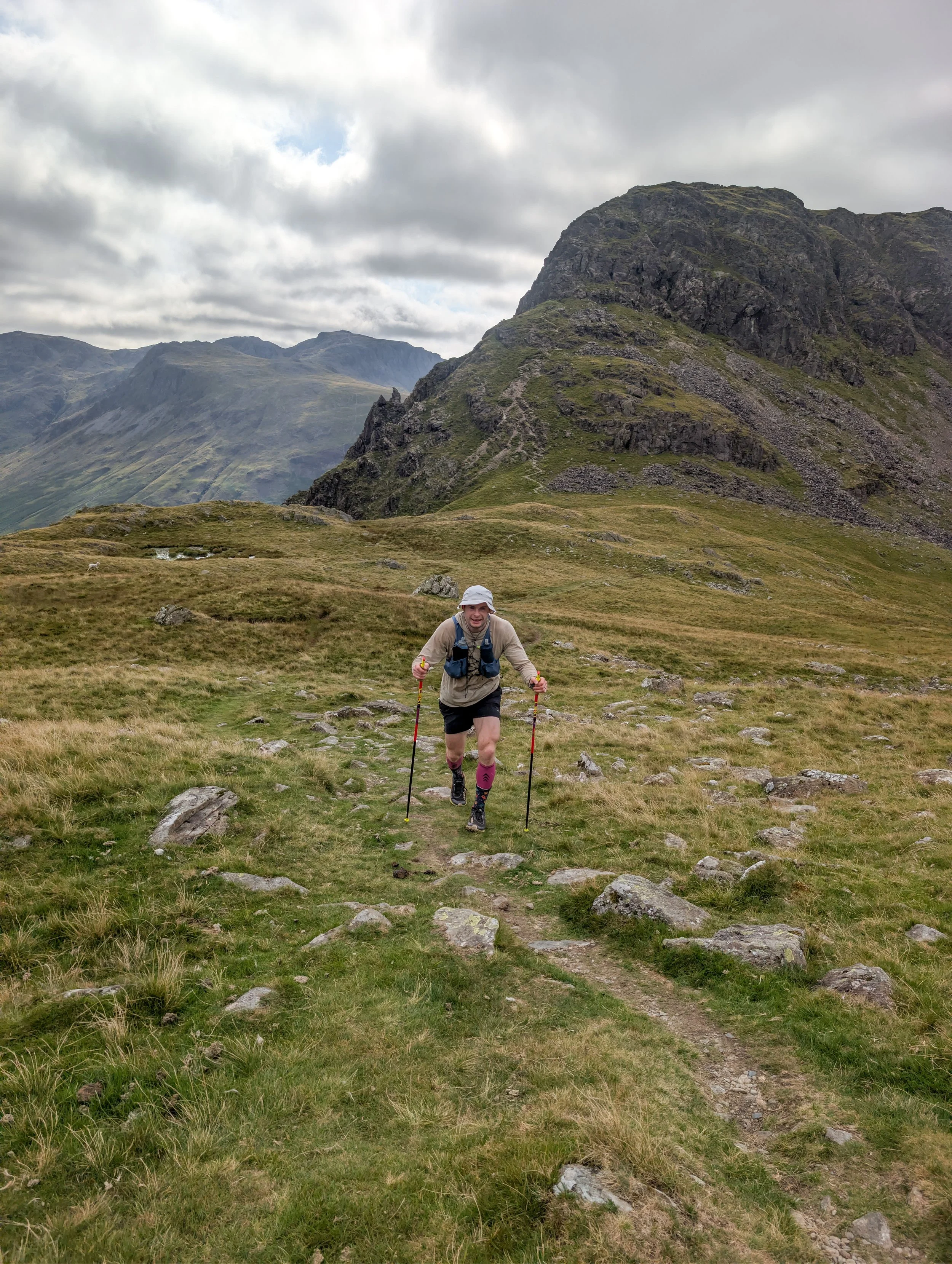
From there we continued to grind upwards towards Red Pike, and then towards Steeple.
Crossing the Wall we passed Pete and I greeted him with a Ronnie Coleman's famous "Lightweight baby, nothing but a peanut" quote and a first bump, which probably tells you everything you need to know about where my brain was at after around 75km in the mountains.
We kept the pace and reached Pillar at around 11:40am, still comfortably ahead of schedule.
Despite the sensational views the accumulated fatigue of nearly 17 hours in the mountains finally started to make itself known.
There was nothing drastically wrong , especially as I was still eating, drinking, and moving well. However my feet were beginning to hurt, the climbs felt considerable more energy sapping, and after spending most of the previous 17 hours chatting nonsense, I became noticeably quieter.
Nutrition was also becoming increasingly difficult.
I wasn't struggling to digest anything, I was simply completely sick of eating it. After consuming essentially the same 5 items for the best part of 18 hours palate fatigue had arrived with a vengeance. Even the Goated Rice Krispies Square bar was becoming difficult to get down.
After wearing them for the past 9 hours, I finally turned my Shokz headphones on, in order take my mind off the suffering I was about to endure…
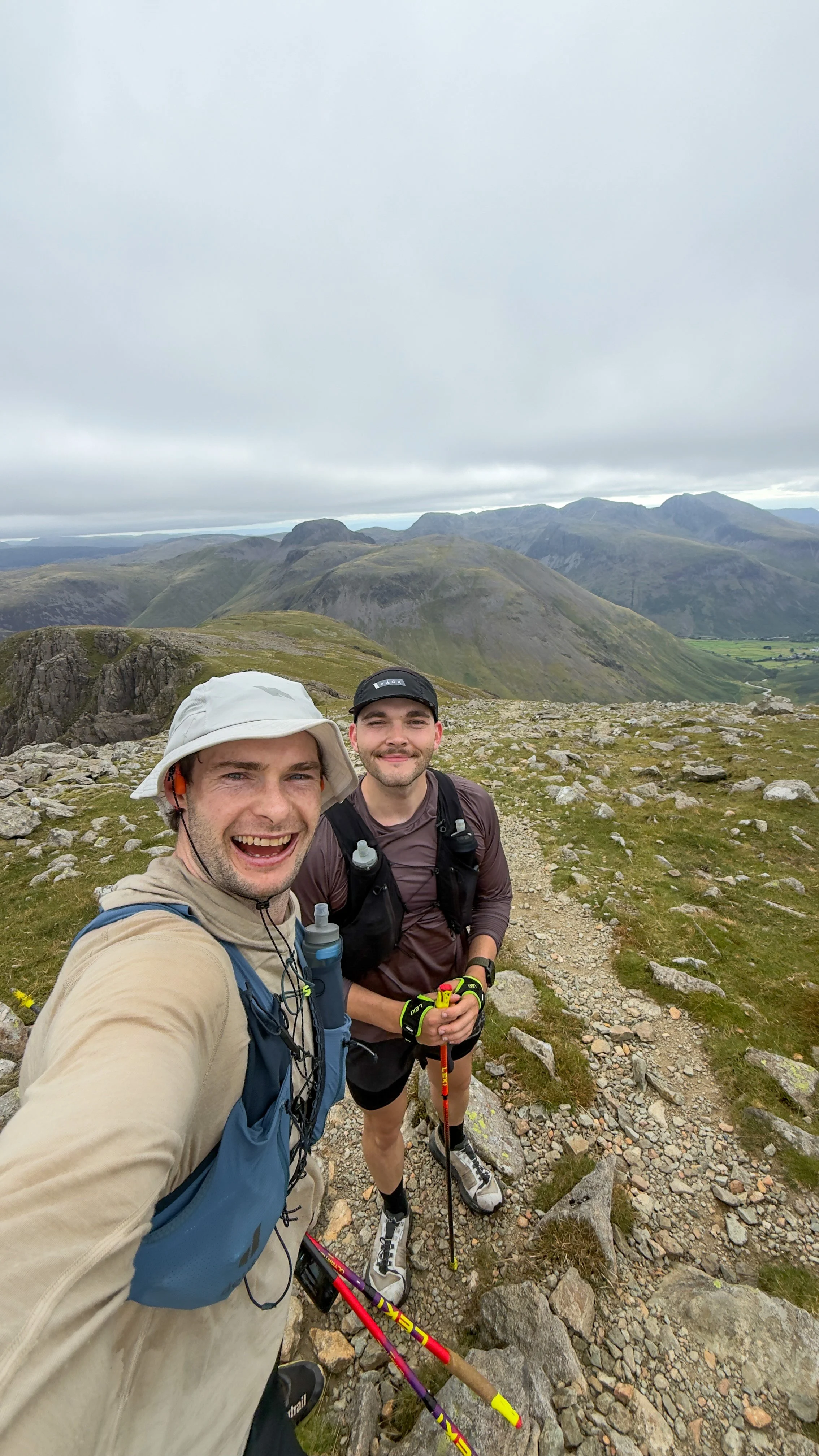
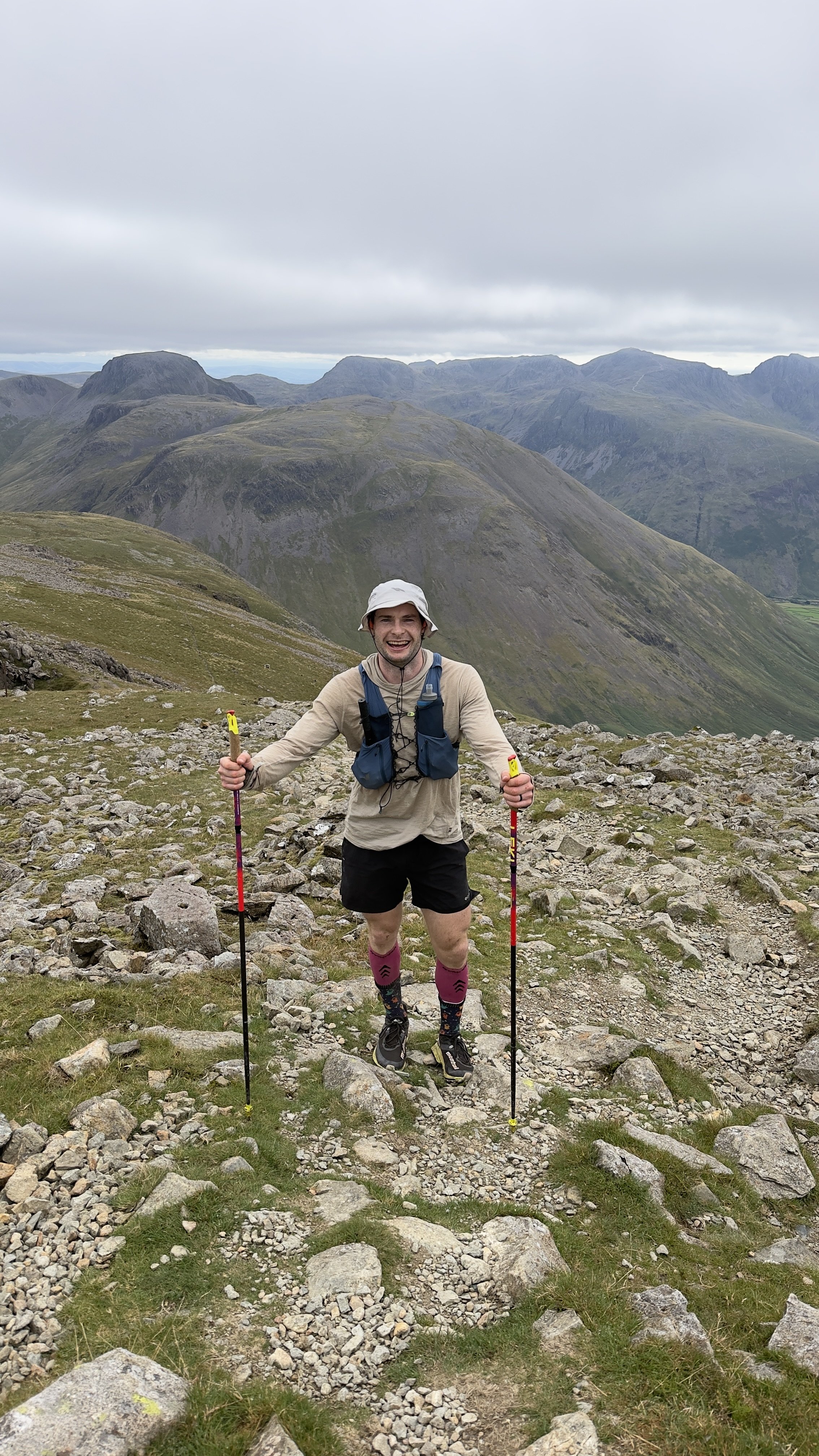
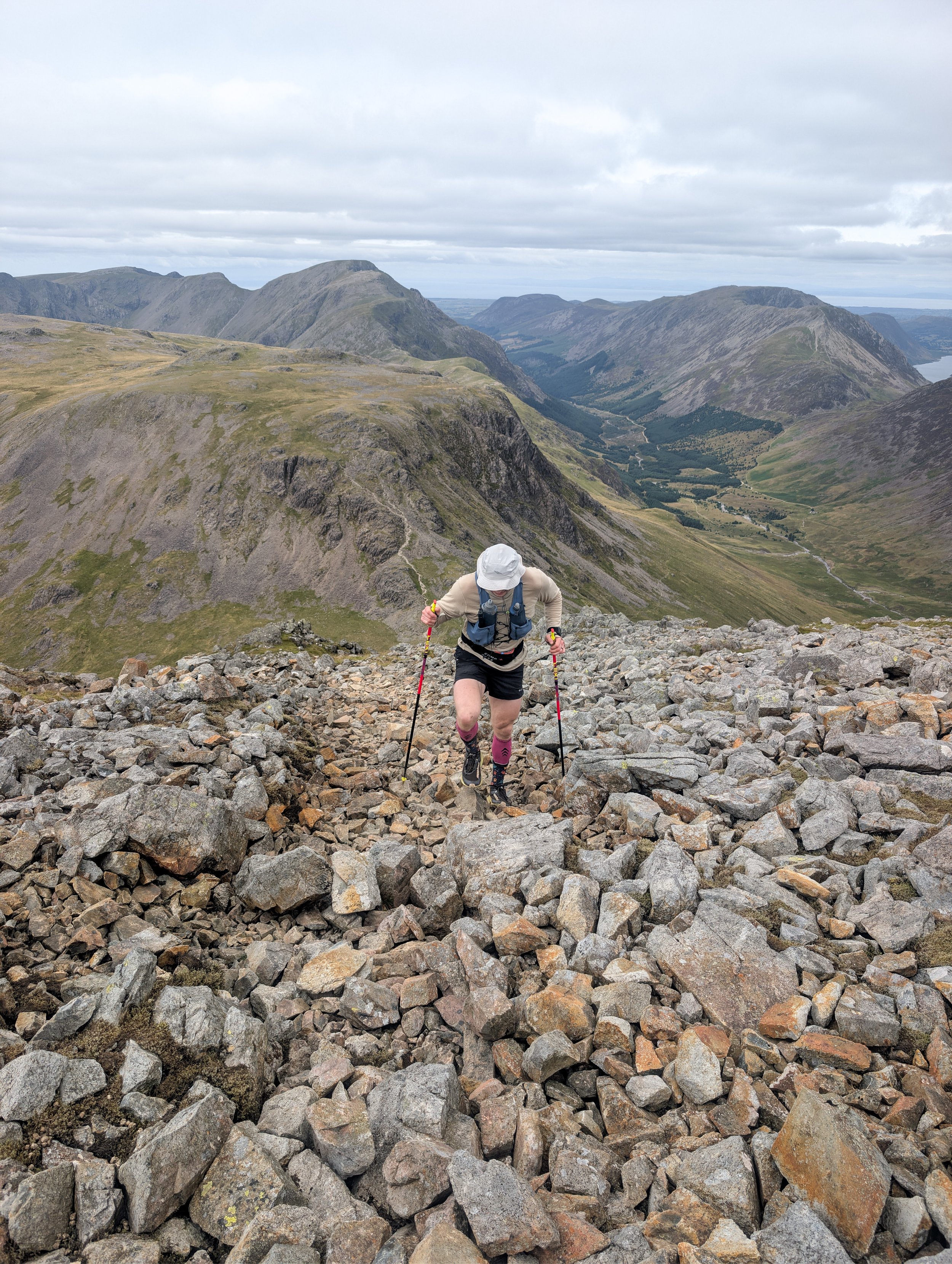
I dragged myself up Kirkfell, before setting my sights on the monolith that is Great Gable. Of all the climbs on the Bob Graham Round, this was unquestionably the hardest.
By this point 84km and 18 hours into the Round
I remember looking up at the unrelenting wall of rock and scree and telling myself that if I could get over this b*stard, I had essentially broken the back of the Bob, so I put my head down and started climbing.
Ethan was doing his best to keep spirits high as slugged my way to the summit. Somehow I knocked 7 minutes of my schedule and was now 40 minutes up.
Great Gable had been the psychological obstacle sitting in my head since leaving Wasdale. There was still a half marathon to go, but once it was behind me I knew barring some freak injury or complete catastrophe, I was going to finish.
I gave it the big Tyson Fury, laughed at a kid who had knocked his mothers expensive camera over, and hobbled my way off the rocky prick of a peak.
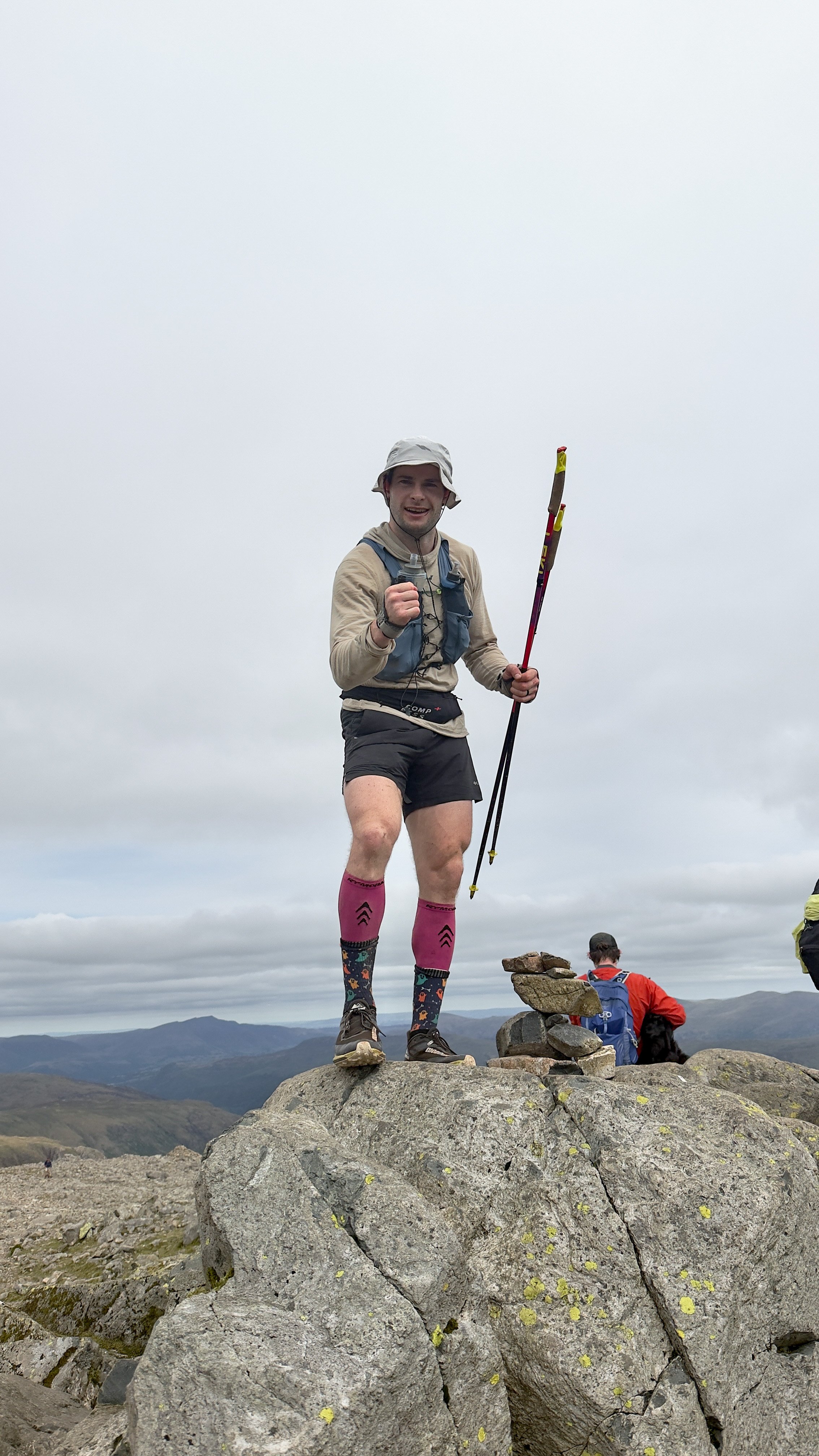
Green Gable came quickly, followed by Brandreth, and Grey Knotts.
By this point I wasn't taking any chances with exactly constituted the official summit, so I made a point of touching virtually every high-looking rock I passed.
After nearly 20 hours in the mountains, the last thing I wanted was to discover I had missed a summit because I had chosen to touch the wrong piece of Lakeland geology.
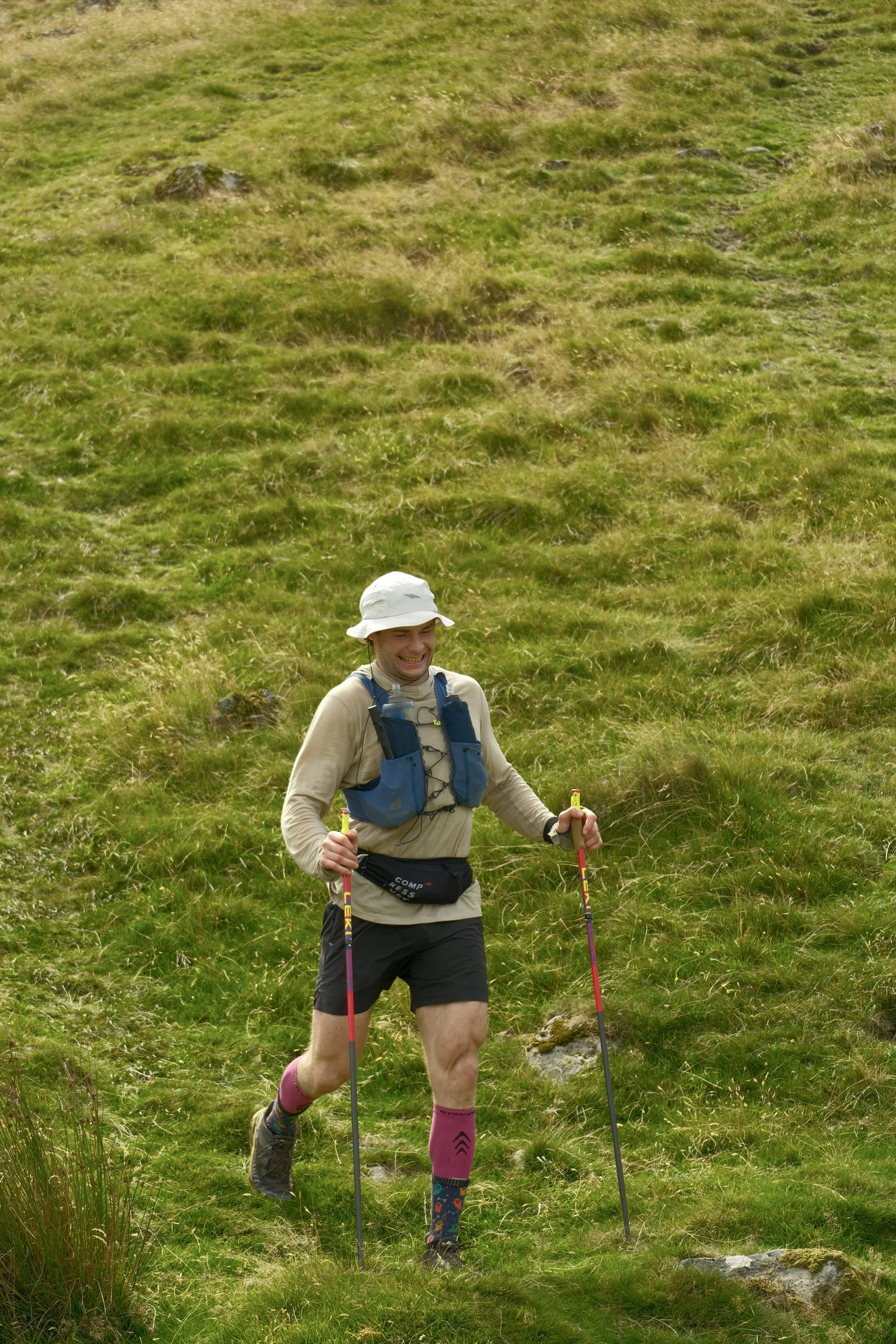
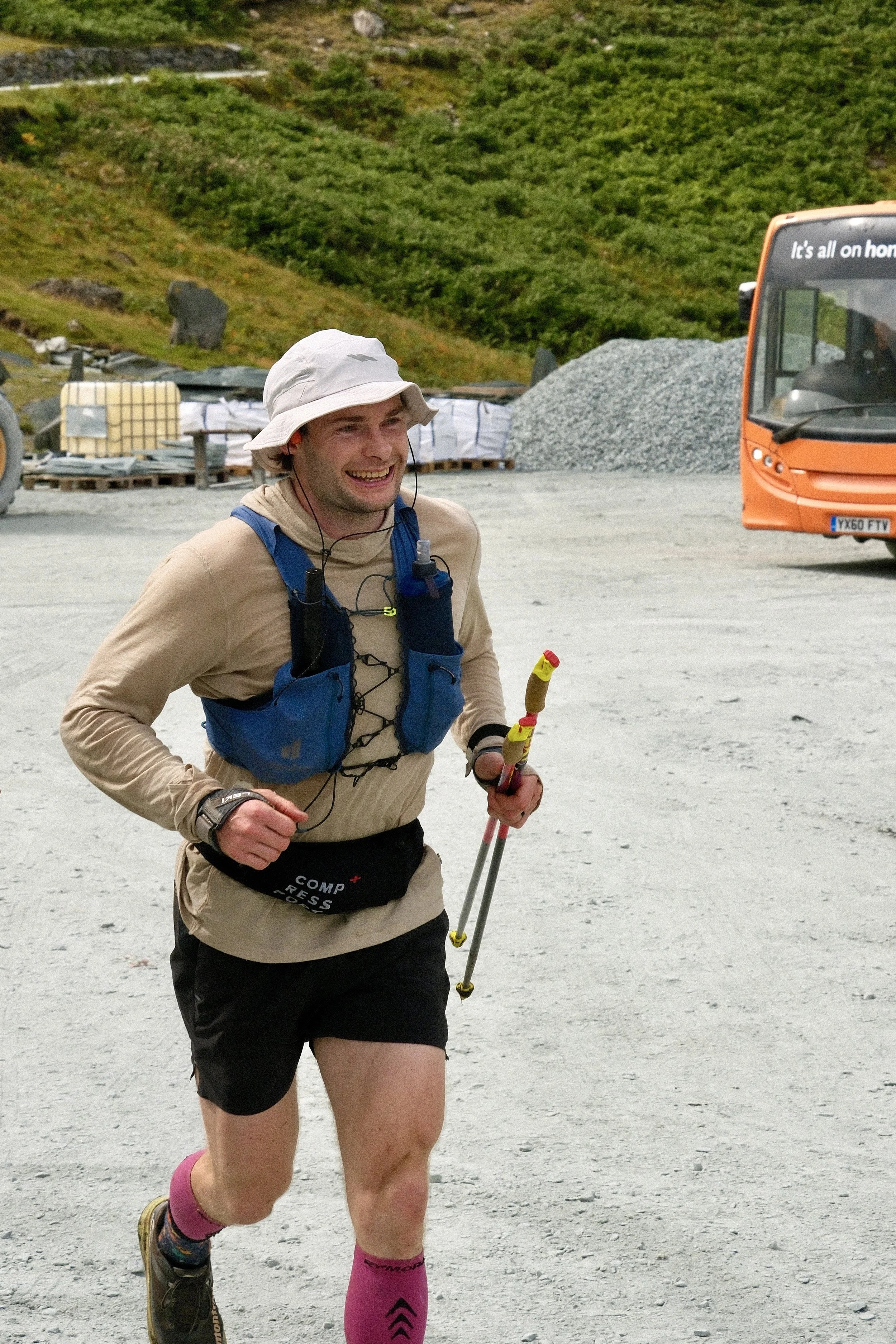
We dropped into Honister at around 2:07pm, where another collection of familiar faces were waiting, including my wonderful wife Becky. Rab and Rannoch, along with Heidi Rogers, Alex Staniforth and Rob Parsons, who had made the effort to support even after his flight had been delayed.
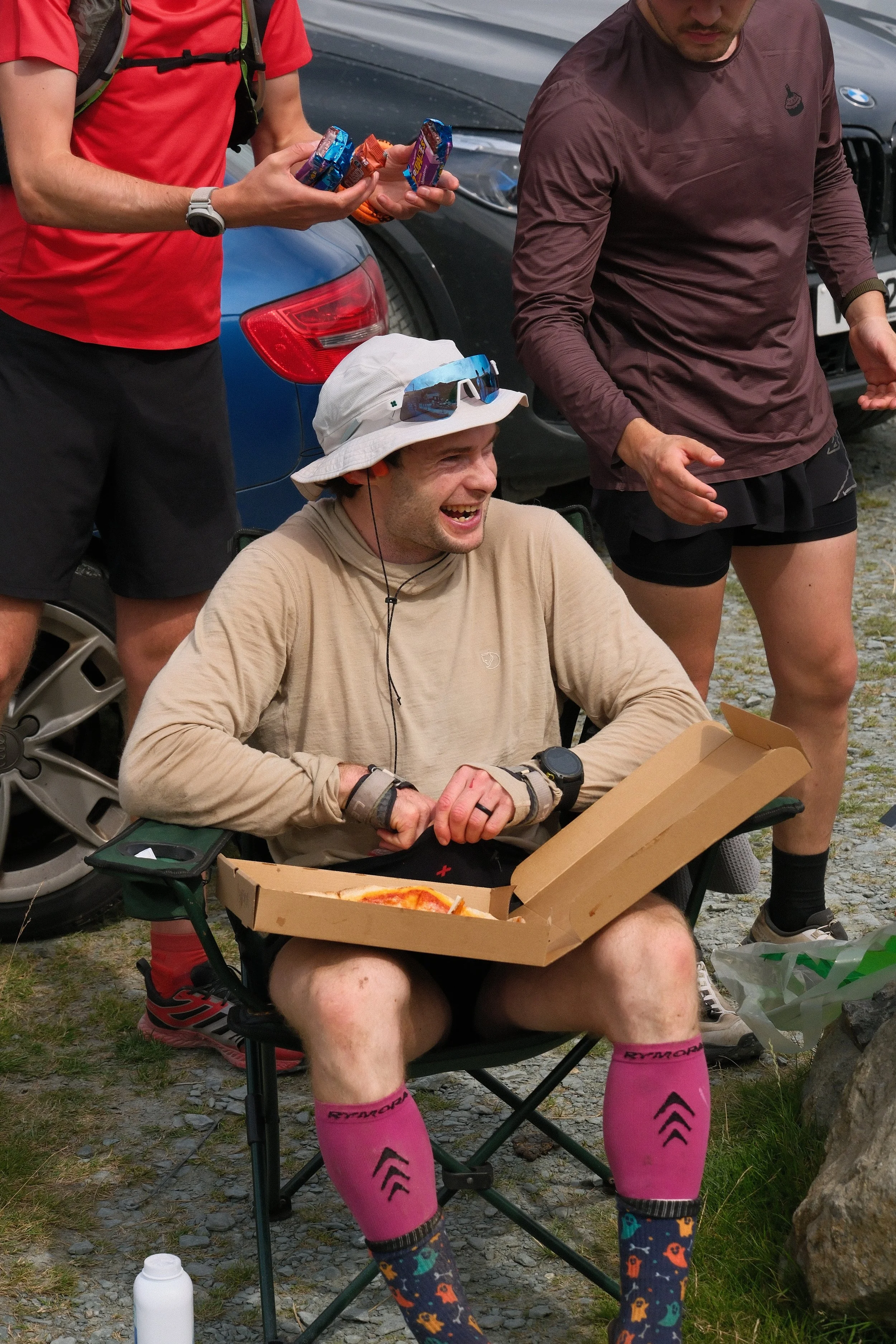
Mollie was also waiting with her camera to capture some great photos, and my mate Handsome James had brought pepperoni pizza.
After spending the previous 19 hours eating offensive quantities of sugar, that pizza might genuinely be one of the best things I have ever eaten.
I ditched my running vest, changed into my party shirt, once again thanksedmy wonderful wife and the hero that was Ethan, and prepared for the final leg.
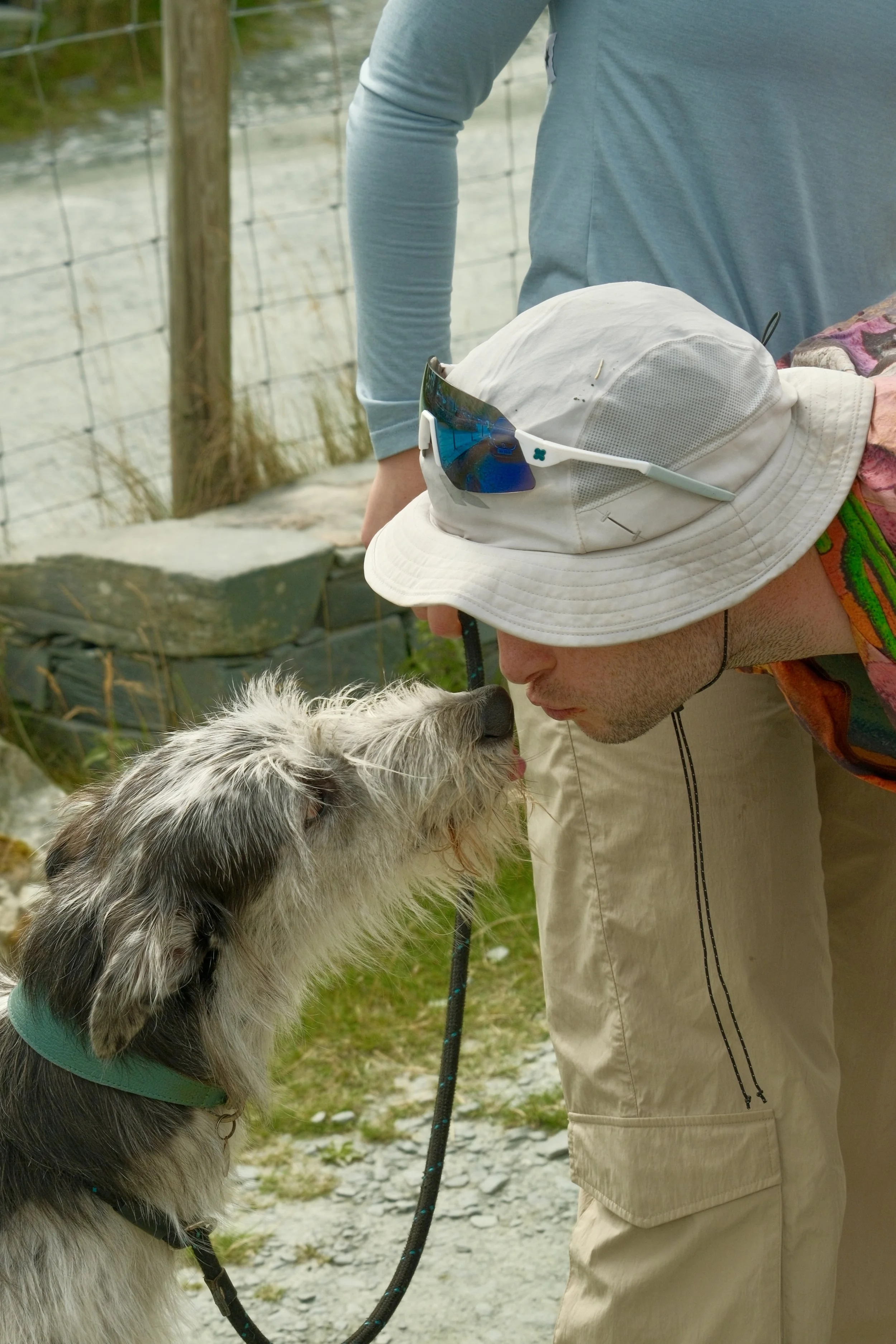
Leg 5: Honister to Keswick
A few minutes later we were climbing out of Honister towards Dale Head, with Heidi, Alex and Rob joining me for the final leg and Rab and Rannoch also tagging along for part of the climb.
Leg 5 is often described as the victory lap of the Bob Graham although calling 17km with 800m of climbing a victory lap feels slightly generous after you have already spent almost 20 hours in the mountains.
With a belly full of pizza, the sun shining, the company of familiar faces, and the worst of the climbing behind me, I was back on cloud nine and buzzing to seeing it home. Alex had even commented that he had never seen anyone looking so fresh heading onto Leg 5, which was a major pick me up.
Dale Head was the final substantial climb of the Round, and knowing that made the ascent considerably easier to stomach, Even if Heidi was setting a ferocious pace.
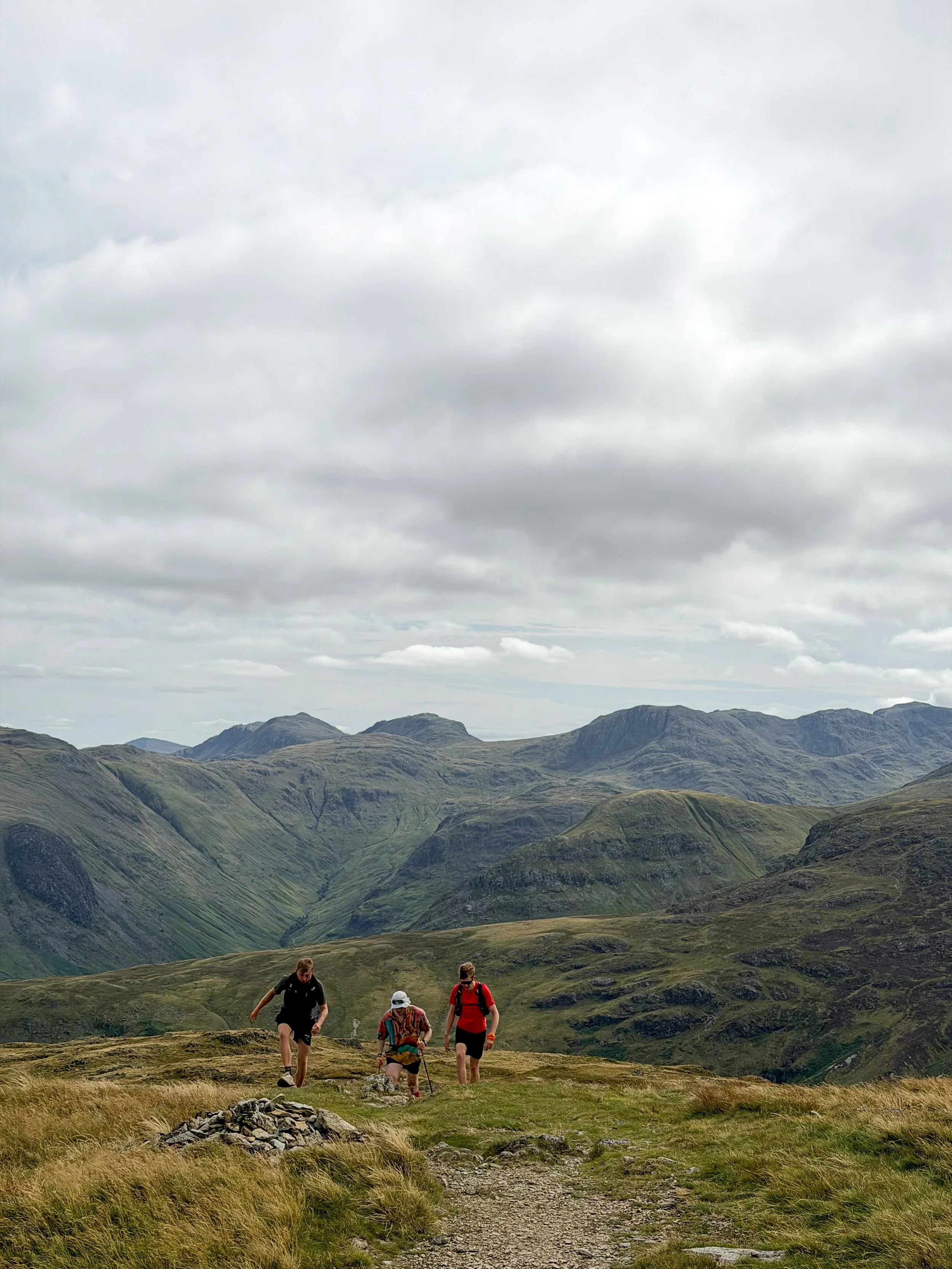
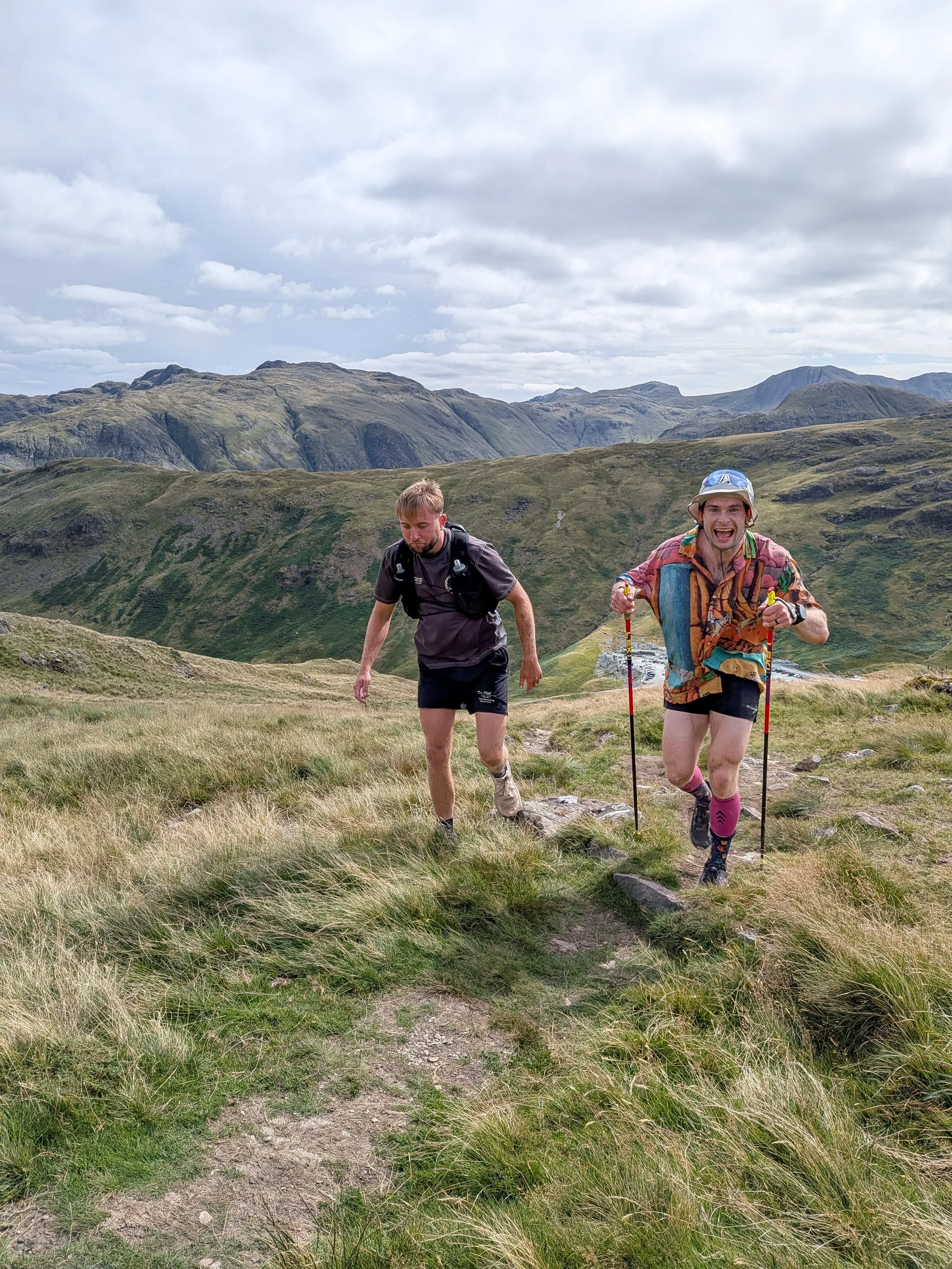
We reached the summit in good time and stopped for some photos. The tops were clear and with 360 degree Panoramic views stretching across the Lake District, I was able to look over many of the peaks I had summited over the previous 20 hours
Being able to look back and physically trace sections of the Bob was pretty profound:, particularly when I thought back to standing outside Moot Hall the previous evening, with such a daunting task ahead of me.
Those provoking thoughts didn’t last long upon the realisation I had left my tracker in my vest at Honister. It didnt affect the round, as my wife was heading straight to little town and heidi was updating the whatsapp group with my summit times.
However it cause some worry for those following the tracker, who now thought I had tapped out at Honister and was getting a lift back to Keswick…
“Its all the Drama Mick, I love it”….
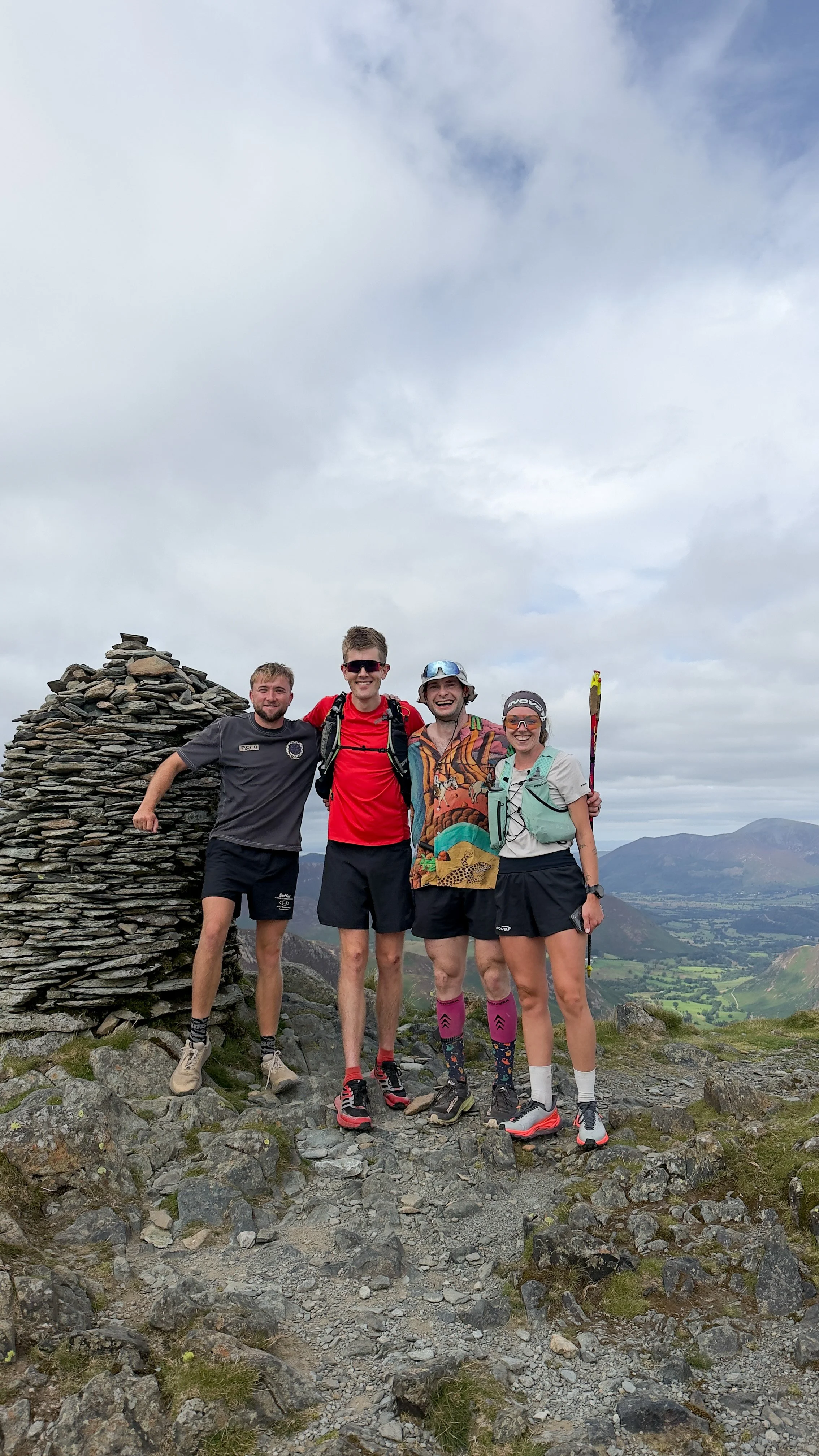
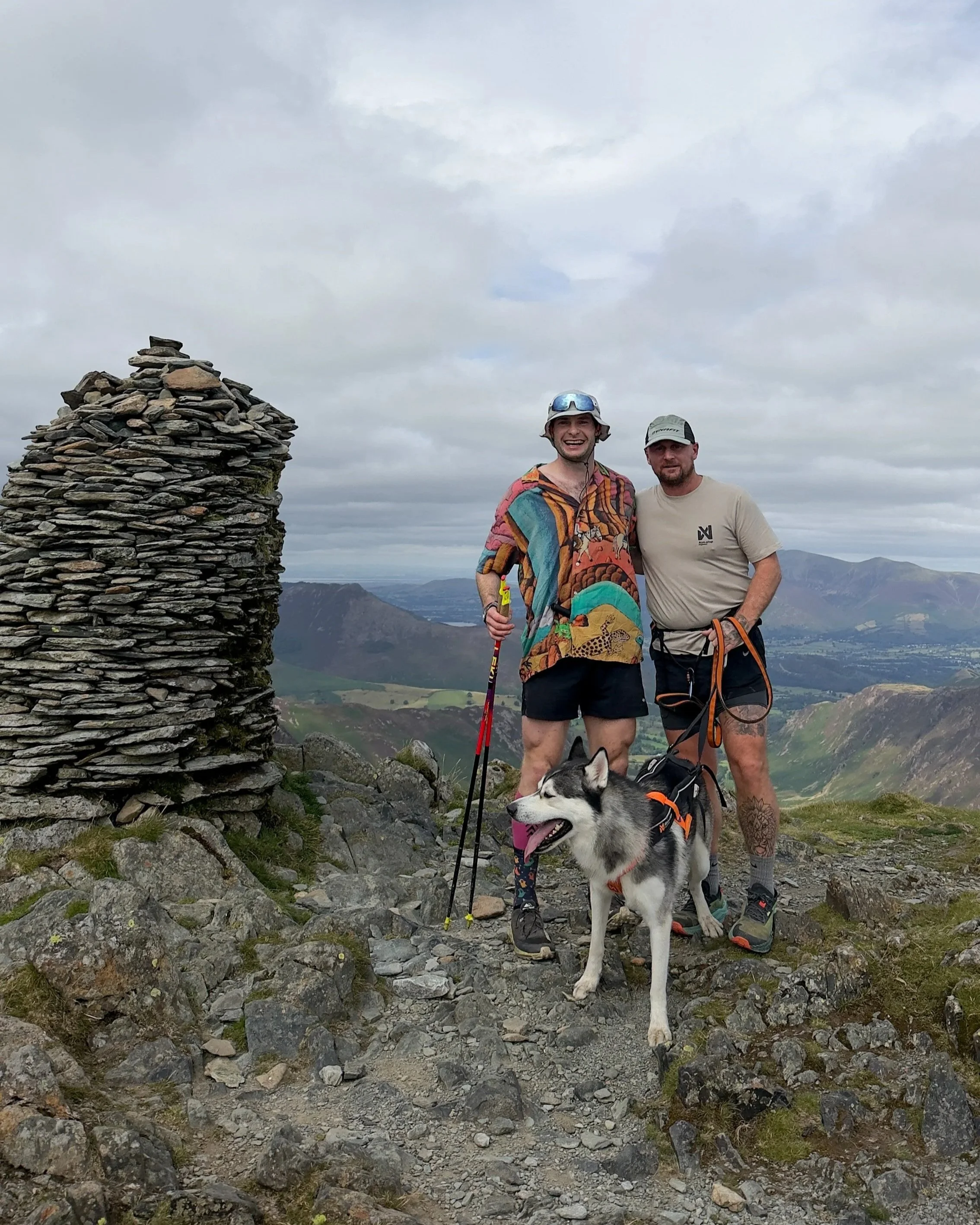
From Dale Head we continued across to Hindscarth before making our way towards Robinson. Upon reaching the 42nd and final summit, I sat down for a moment and tried to properly take everything in.
I obviously hadn't finished yet and there was still a decent distance between me and Moot Hall, but after months of training, recces, planning and questioning whether I was actually capable of completing the Round, I had now stood on all 42 summits and could finally allow myself a moment to appreciate it.
I was on cloud 9 and the energy levels can be summed up by the heel click which Heidi manage to capture as I made my way off Robinson (hello broken ankle)
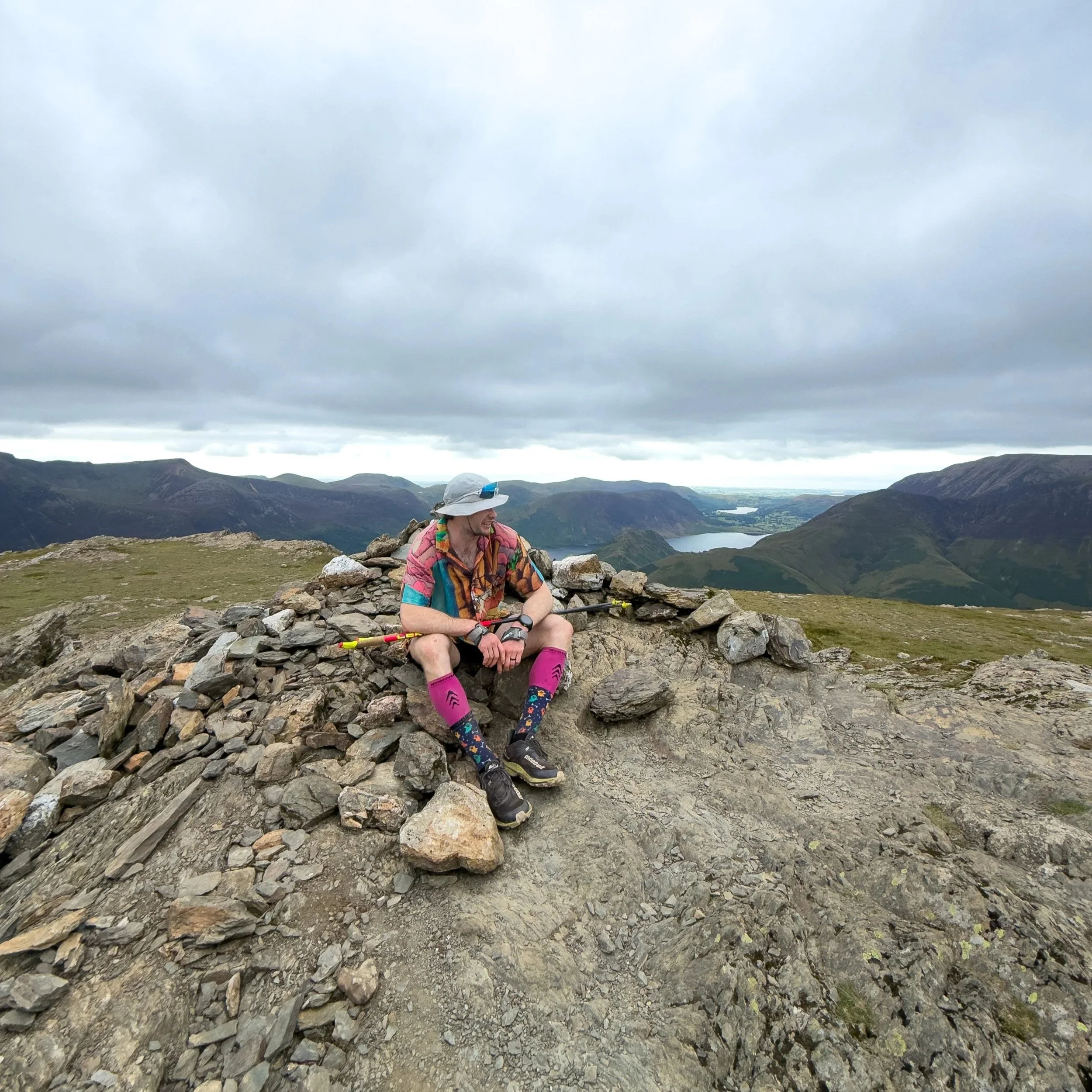
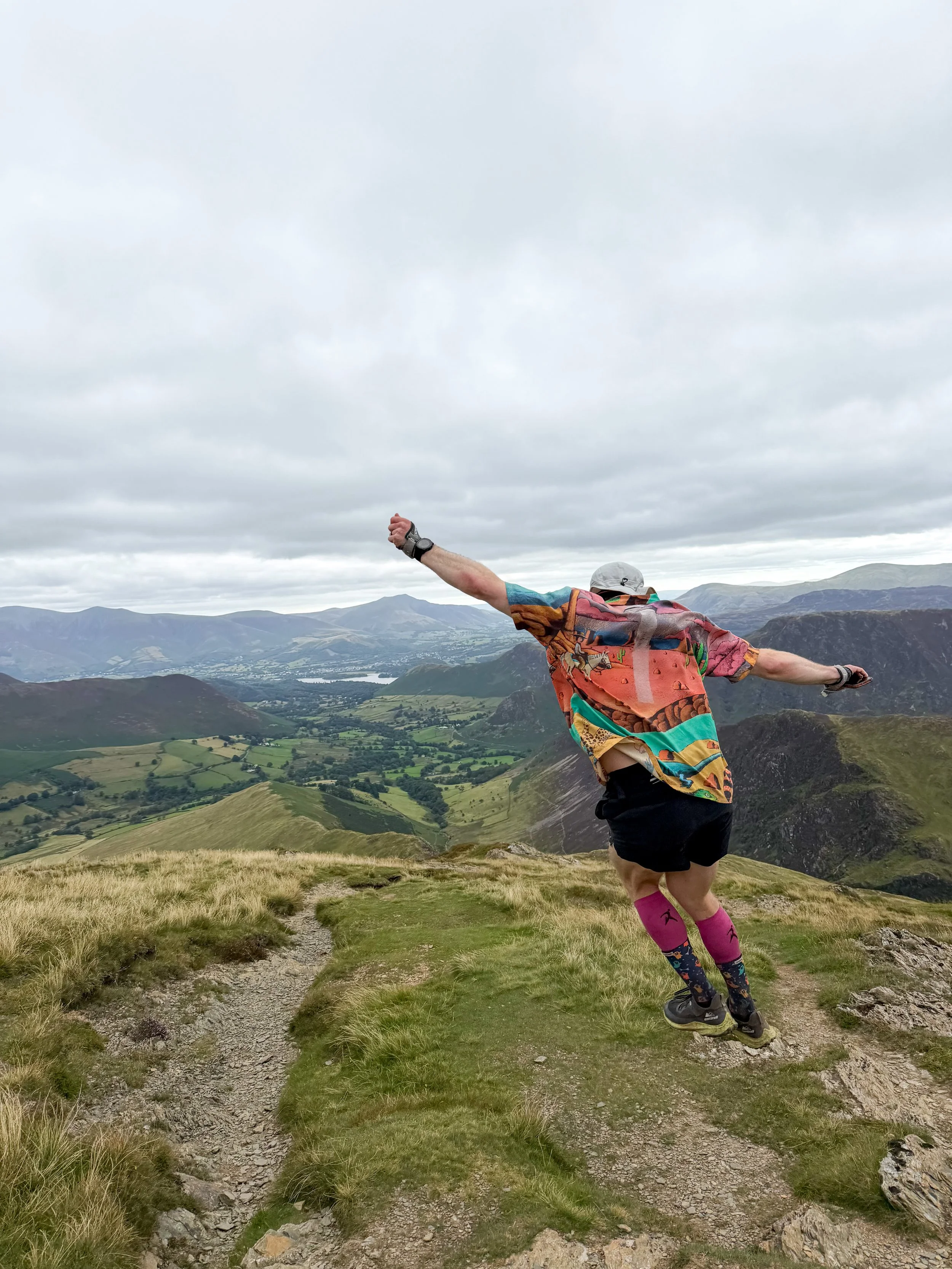
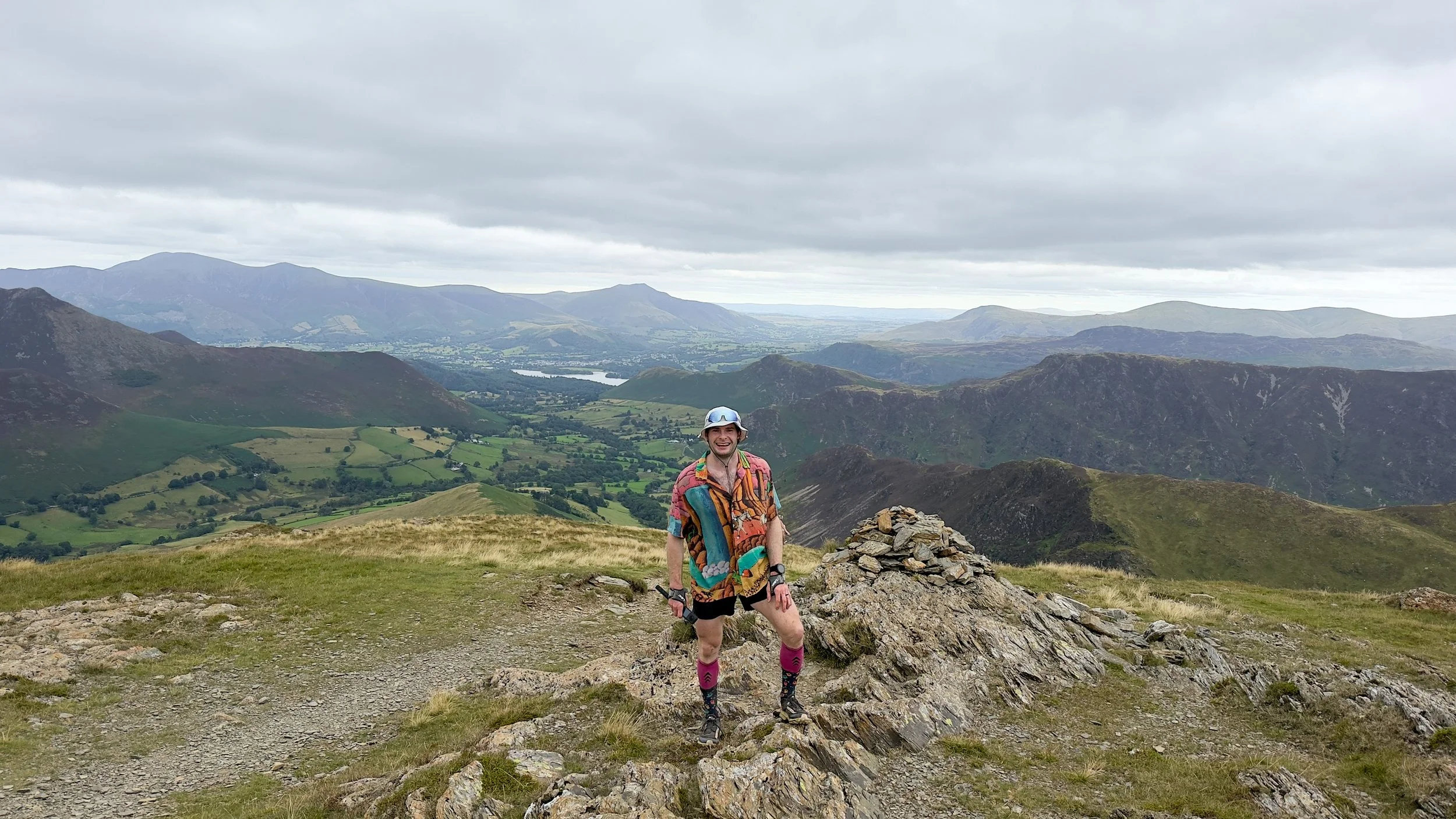
Despite my enthusiam and my legs feeling good, my toes and feet were in a bit of a pickle, making the steeper sections increasingly uncomfortable. So I was overjoyed to see Becky and Laszlo waiting for me at Little town with a camp chair and a pair of road shoes.
By this point my desire to consume anything sweet had almost completely disappeared, so I was surviving predominantly on gels and carbohydrate drink.
The final pick me up came through my headphones in the form of the Three Hunters from Lord of the Rings soundtrack.
If you're going to spend the final few km of a Bob Graham round running towards Keswick on battered toes, you might as well pretend you're chasing down a pack of Urak-hai.
Having spent the previous night and almost the entire day in the mountains, running back into a busy town at around 5pm on a Saturday afternoon felt incredibly surreal.
The market was still in full swing and the final few hundred metres involved weaving between people, stalls and cars as we made our way towards Moot Hall.
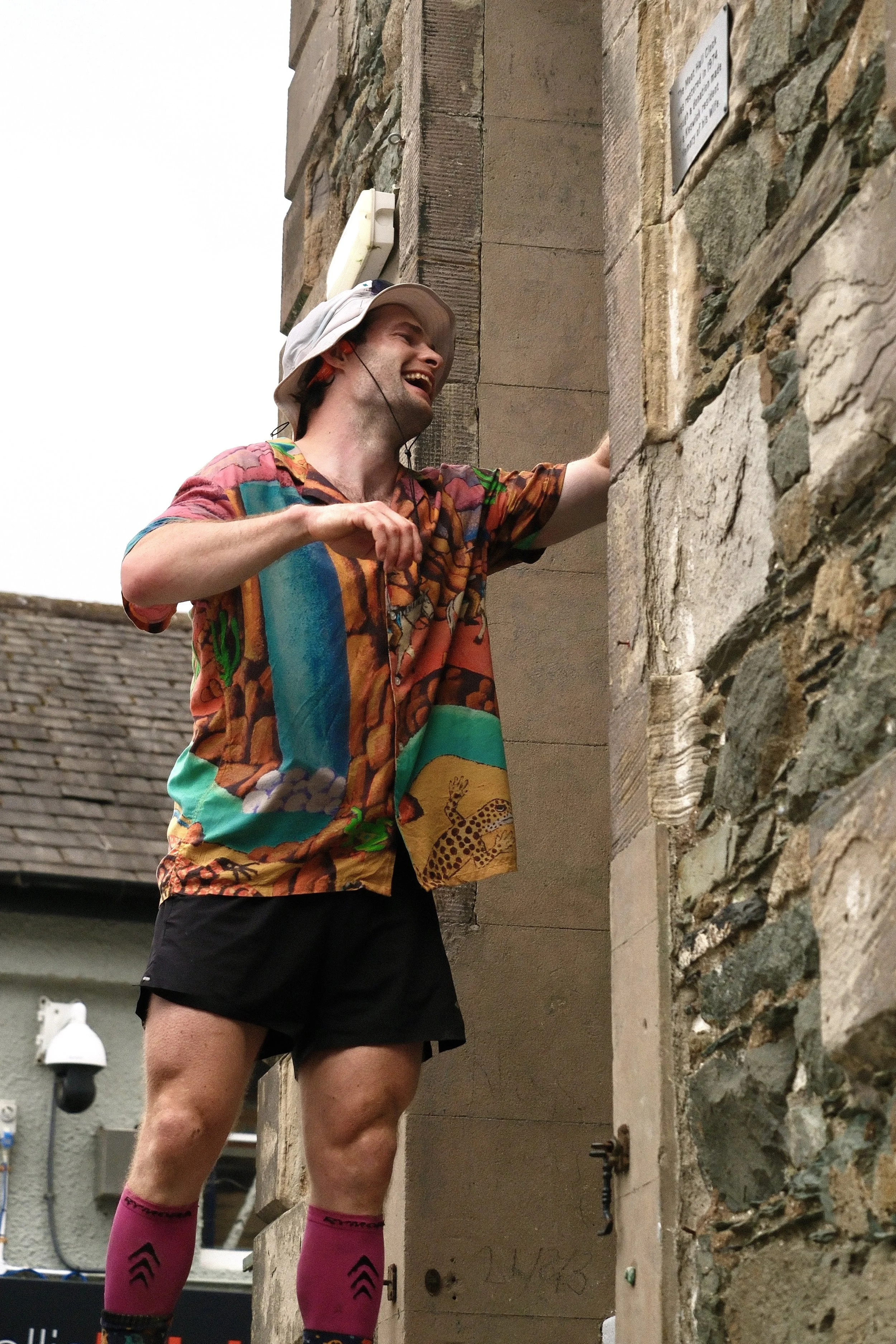
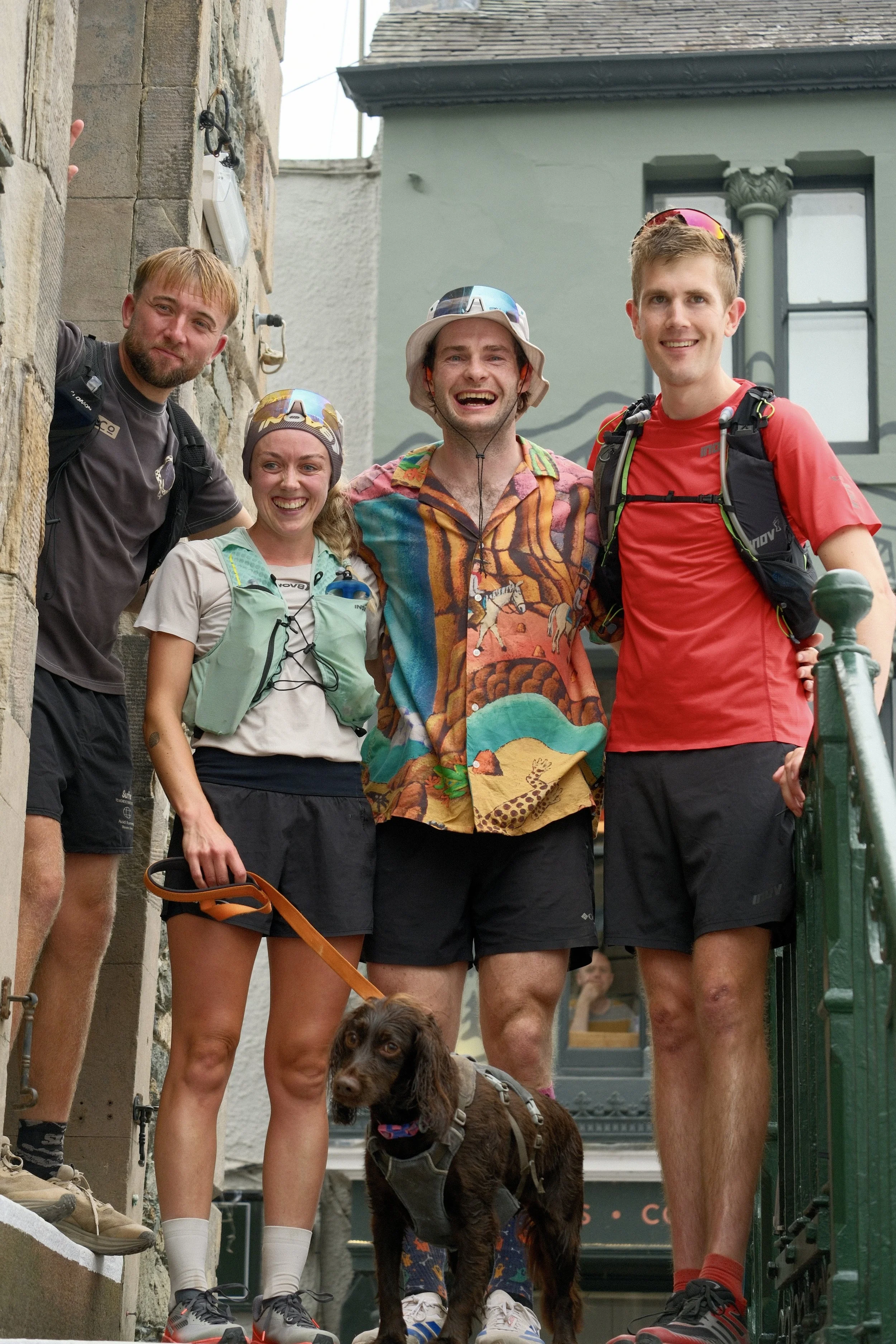
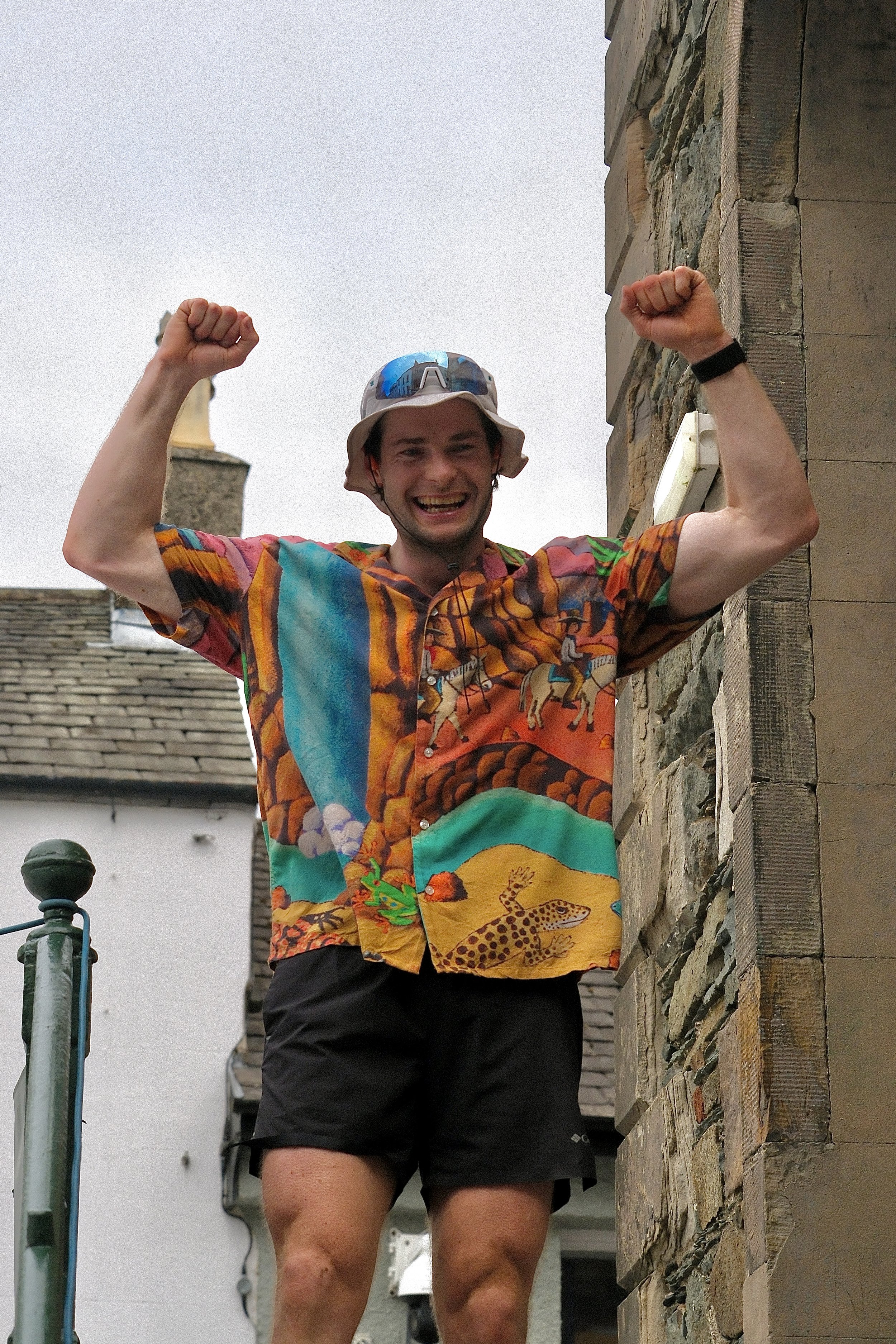
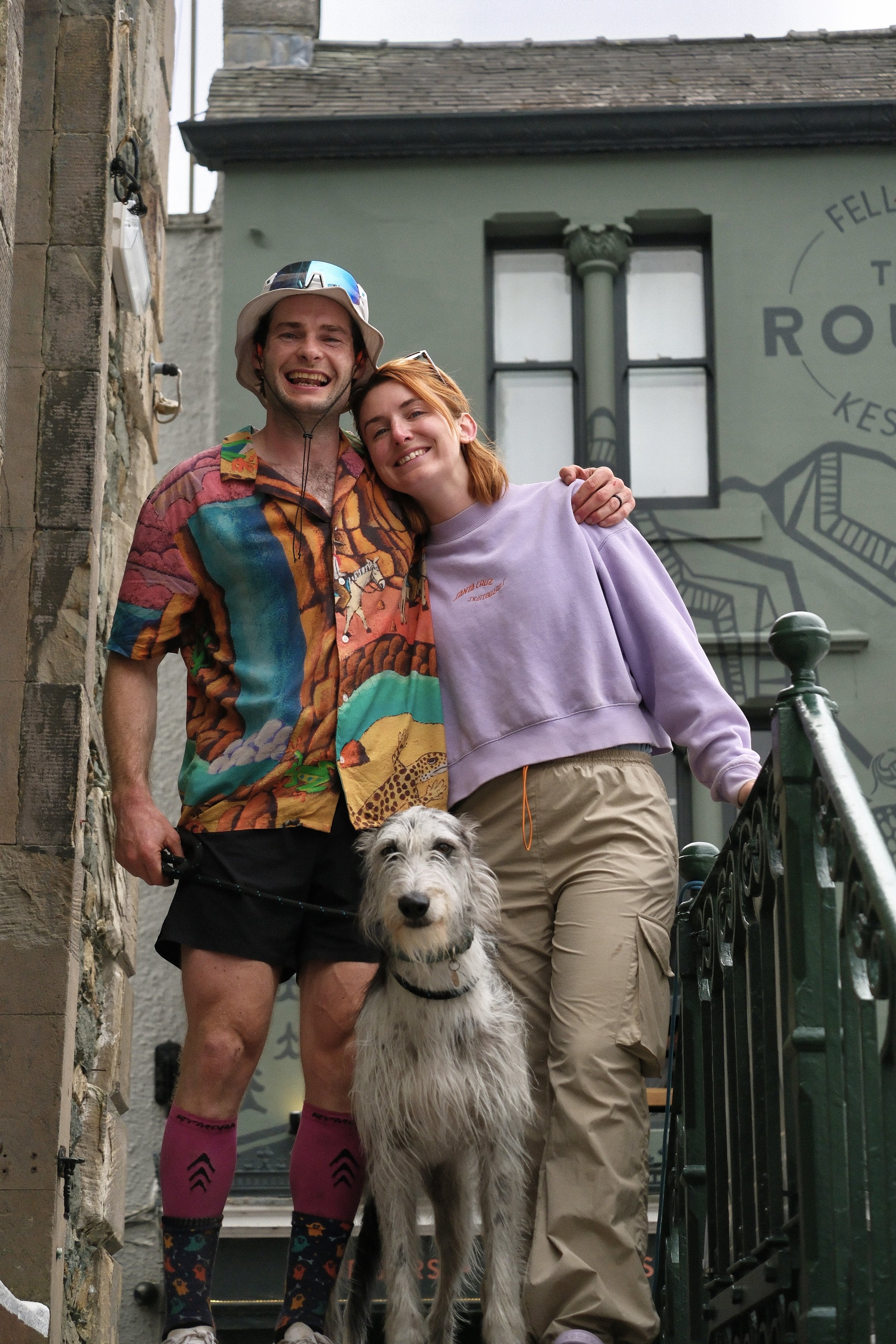
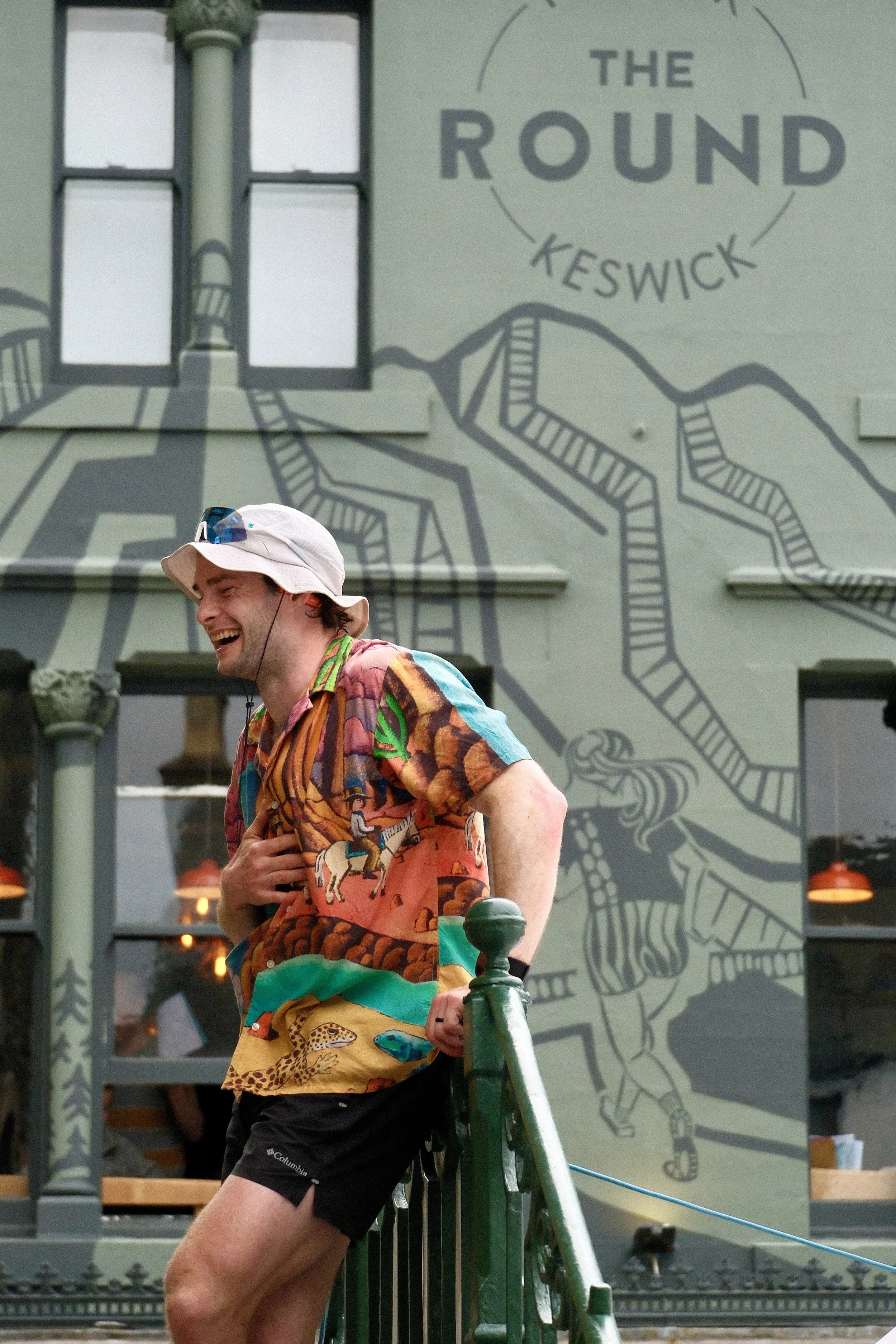
I climbed the fabled steps and after spending almost 22 hours marauding around the Lake District in order to touch a door, I actually forgot to touch the door (Thank you Heidi for reminding me)
I had completed the Bob Graham Round in 21 hours and 46 minutes.
My Garmin had recorded 107km with approximately 8,400m of ascent, meaning I had covered the equivalent of more than two and a half marathons while climbing almost the height of Mount Everest, all in less than a day.
For all the nerves beforehand, the logistical chaos, my increasingly battered toes, and the quite frankly unhealthy quantity of sugar I had consumed, I had done it.
More importantly I had spent the overwhelming majority of those 21 hours and 46 minutes smiling, laughing, and having one of the best days I have ever had in the mountains.
After the Round
Crossing the finish line of an organised race normally means medals, food, drinks and somewhere to collapse, whereas finishing a Bob Graham means touching a door in the middle of Keswick and then standing around wondering what you are supposed to do with yourself.
I had imagined finishing with a celebratory pint, but Keswick was absolutely heaving and there appeared to be about a 25-person queue just to get into the pub. With Becky also looking after Laszlo, that dream was quickly abandoned and instead
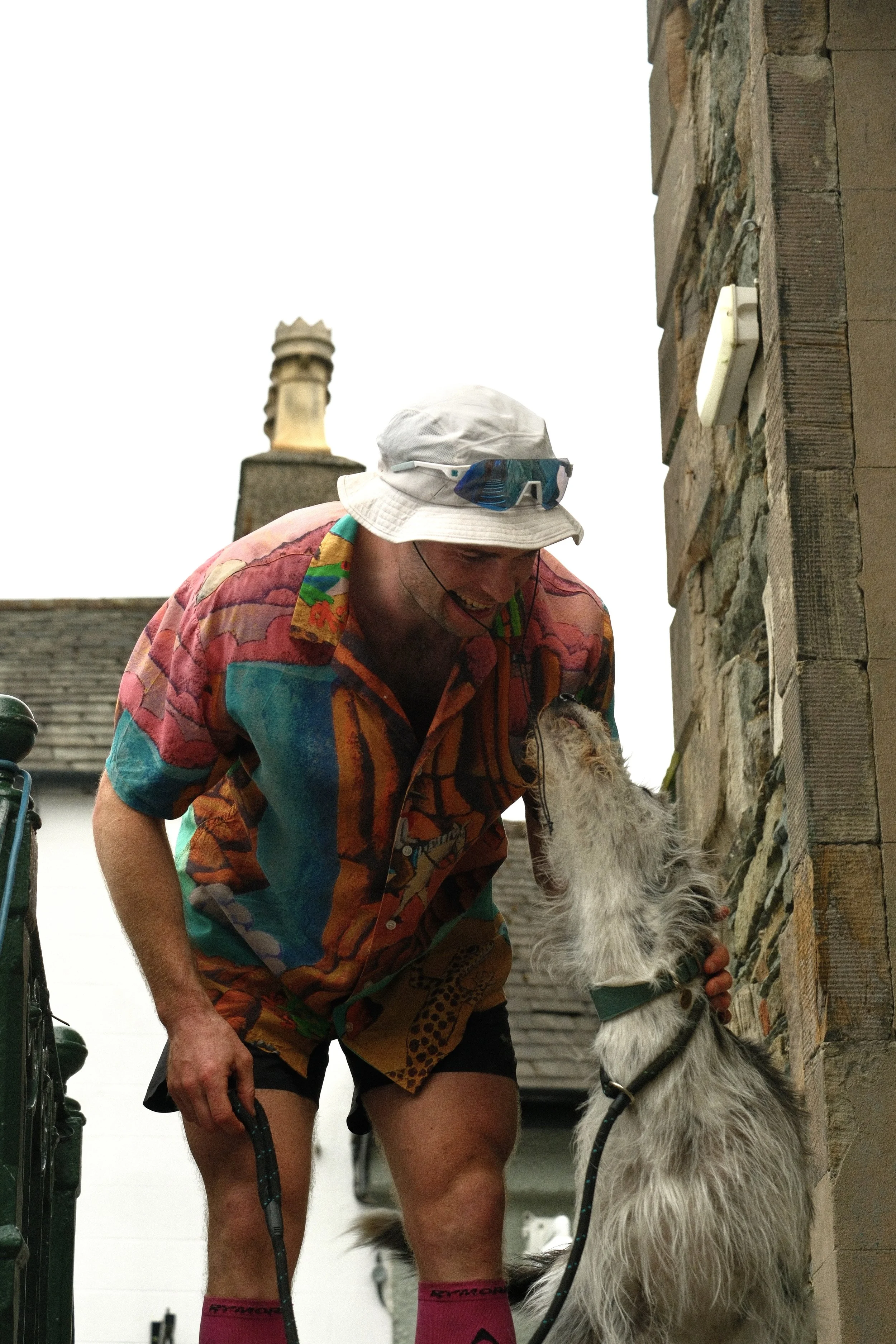
We took the obligatory photos outside Moot Hall, first with my wonderful wife and then with the glory hunters of Leg 5.
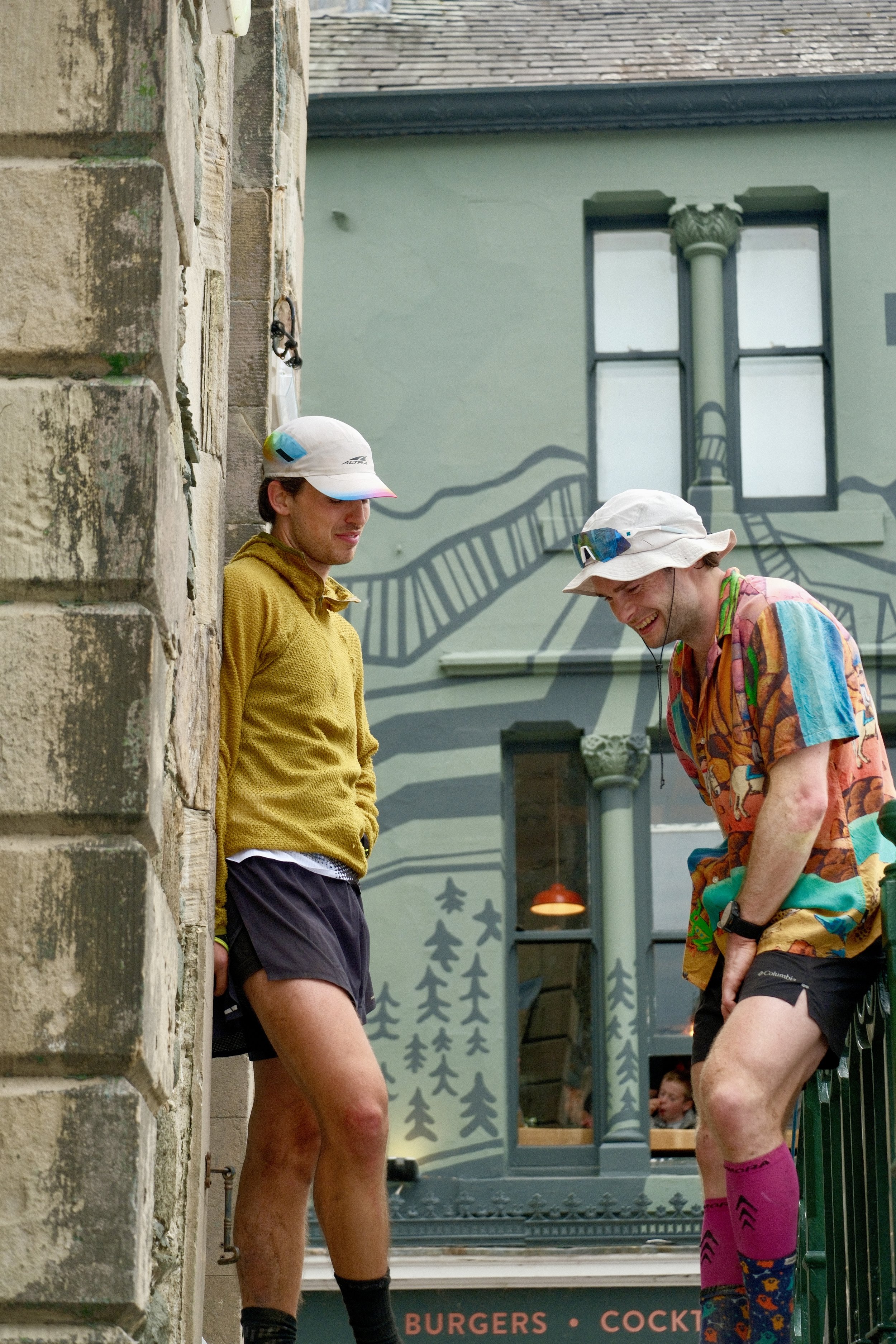
I then caught up with Pete, who was also sitting on the steps after finishing his Round around ten minutes before me. We compared our expereinces on the rest of our Rounds and laughed about some of the moments from Leg 3, which already felt strangely distant considering they had only happened a few hours earlier.
I then staggered the couple of hundred metres back to our hotel, which had cost an eye-watering amount because I had booked it at the last minute during the school holidays. The only consolation was that it was directly opposite Moot Hall, so at least after 107km I didn't have particularly far to walk.
Once the adrenaline started disappearing, everything caught up with me fairly quickly. I had been awake for around 34 hours, my toes were battered, one ankle had swollen up and I suddenly hit an enormous wall
I had a bath, managed around a 90-minute nap and awoke looking I had been transported from another dimension.
Thankfully, Becky kindly went out and returned with fish and chips and curry sauce, which I completely destroyed, before climbing into bed and having one of the best sleeps of my life.
How I felt afterwards
Considering I had just covered around 107km with 8,400m of ascent, I was genuinely surprised by how well my body recovered.
My toes were by far the biggest casualty and remained fairly fragile for the following week, while my ankle was also sore the next day, but muscularly I felt considerably better than I expected. My quads were slightly tender, my hips and hamstrings were fine and, fortunately, I don't really have calves, so they couldn't get sore.
The difference compared with UTS Snowdonia was enormous. After UTS I spent the best part of a week walking around like John Wayne, whereas after the Bob my legs seemed to recover surprisingly quickly and I was back doing some light training within a few days.
I think a huge part of that came down to how I paced the Round. Outside of the descents and flatter sections I wasn't really "running" particularly hard, I hiked almost every meaningful climb, kept my heart rate under control for the vast majority of the day and never reached the point where my legs completely fell apart.
It reinforced something I had started to realise during training, which is that the Bob isn't really about being an exceptionally fast runner, but about being incredibly efficient in the mountains for a ridiculously long period of time.
Final thoughts
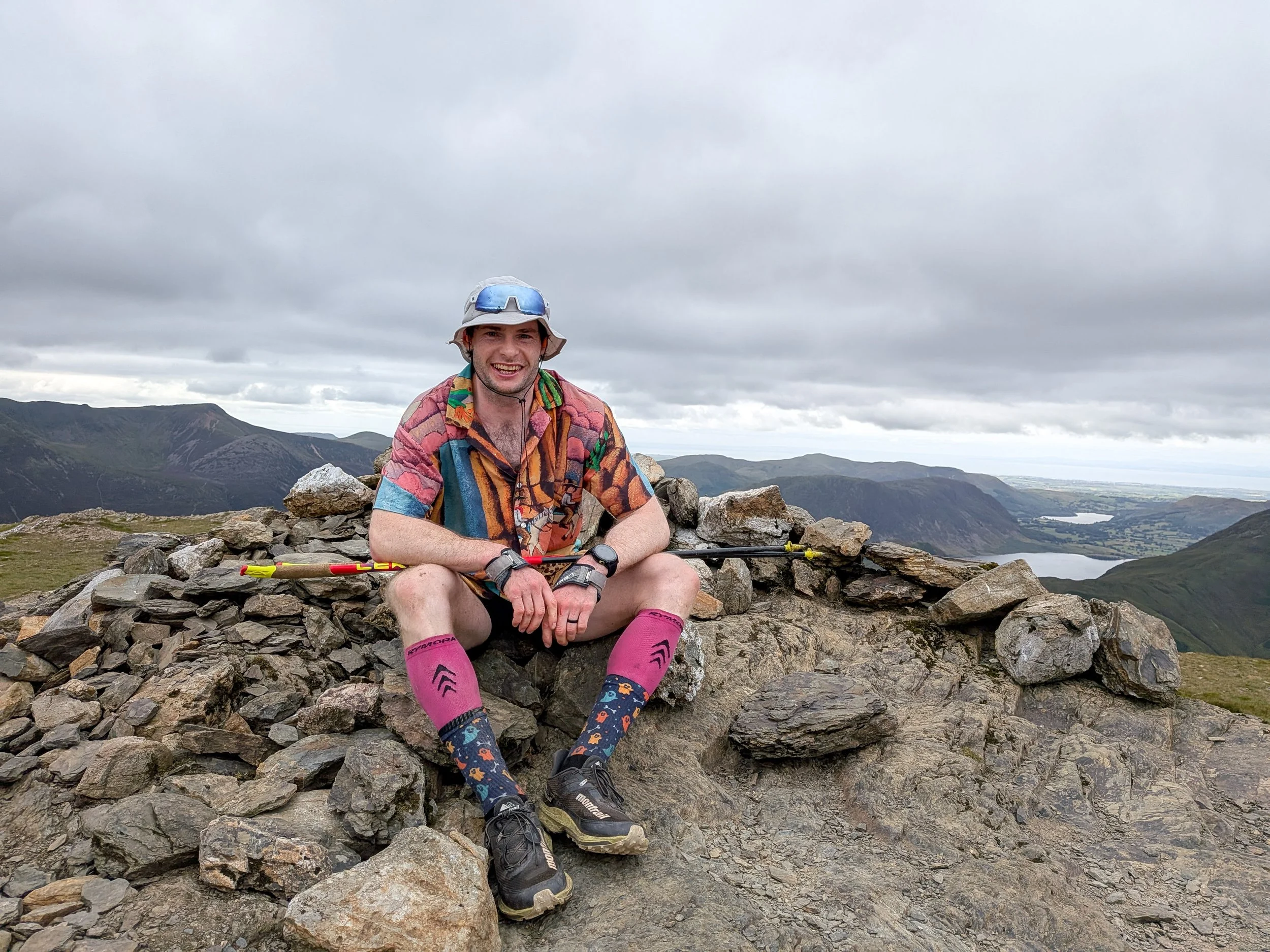
Looking back, the thing that stands out most isn't Great Gable, the distance, the 8,400m of climbing or even the 21-hour and 46-minute finish time, it is how much I genuinely enjoyed the experience.
There were obviously difficult moments, but they probably accounted for an hour or two of a day where I spent the vast majority of the time laughing, chatting nonsense, soaking in the Incredible views, whilst wondering how I had somehow persuaded this many people to give up their Friday night and Saturday to run around the Lake District with me.
The weather undoubtedly helped and made an enormous difference to my mood. During the daylight hours, whenever the legs started hurting, I could look around, see where I had come from and remind myself how lucky I was to be doing it.
More than anything, though, the Bob Graham reminded me how brilliant the outdoor and fell-running community can be.
Half of the people who supported me I had never met at all before the attempt, yet they willingly gave up hours of their time, and did everything possible to help me get back to Moot Hall.
Mark played a particularly big part in the whole thing, not only supporting Legs 1 and 2 but also being one of the reasons the idea of attempting a Bob entered my head in the first place after I watched the documentary about his own Round. Having previously supported him on the Paddy Buckley, it felt pretty special to then have him alongside me for the opening eight hours of mine.
Rab also deserves a huge mention, not only because he drove all the way down from Scotland to support but he crewed me at Wasdale, helped shuttle support runners, and then still joined me on Leg 5. Having him was not only a big pick me up, but took a massive amount of pressure off Becky and played a huge part in the support operating so smoothly.
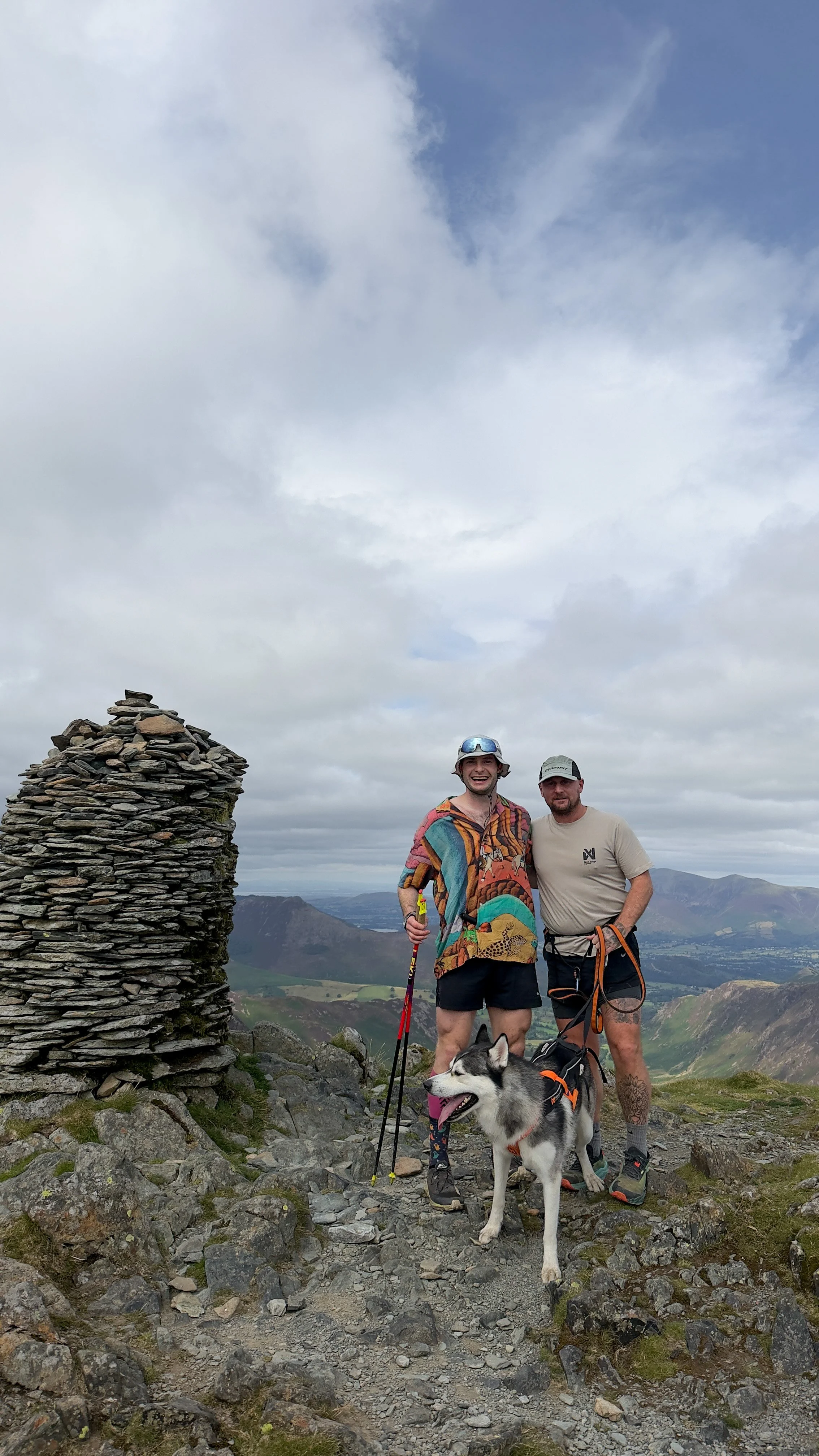
Tom, Stephen, Brad, Ethan, Heidi, Alex, a Rob were amazing support runners, while Pete and Dave were a massive help across Leg 3. James arriving at Honister with pepperoni pizza deserves a special category of recognition, and Mollie also deserves a huge thank you for coming out to capture some brilliant photos.
The biggest thank you, however, goes to Becky, who had to endure months of me talking about schedules, recces, nutrition, weather forecasts and increasingly obscure Lake District summits, before spending the entire attempt driving around the Lakes, preparing food, filling bottles, changing plans at short notice and somehow remaining supportive throughout the whole chaotic process.
Without her, and without everyone else who gave up their time to help, there is absolutely no chance I would have had the day I did.
I finished with battered toes, an unhealthy quantity of sugar inside me and absolutely no desire to look at another Rice Krispies Square for quite some time, but I also finished having smiled my way around the majority of the round and experienced one of the best days I have ever had in the mountains.
For something I had spent weeks worrying about, it turned out to be everything I hoped it would be.
Useful Bob Graham Round Resources
Bob Graham 24 Hour Club, the best place to start for official information on the Round, registration, rules and ratification.
Bob Graham Schedule Calculator, incredibly useful for building your schedule around your chosen start time, direction and expected pace.
Road Crossing and Parking Information, worth checking before your attempt, particularly for Wasdale where parking and road support can be awkward.
Bob Wightman's Bob Graham Resources, a brilliant collection of information covering the route, individual legs, schedules, training and general planning.
Mark Wilson's Bob Graham documentary, The Chase, which was actually one of the things that first planted the seed in my head that I might be able to take on the Round myself.
If you are planning an attempt, I would always use the Bob Graham 24 Hour Club website for the latest official information, particularly around registration, rules and road support, as some other resources online may be older.
Bob Graham Round FAQs
-
The traditional Bob Graham Round is approximately 66 miles or 106km, with around 27,000ft or 8,200m of climbing spread across 42 Lake District summits.
The exact numbers recorded on your watch will vary slightly depending on the lines you take between the summits. My Garmin recorded around 107km and 8,400m of elevation gain.
To put those numbers into perspective, you are effectively covering around two and a half marathons while climbing almost the height of Mount Everest from sea level.
Unfortunately, most of it isn't on a nice flat road either. You have bog, grass, scree, rocks, boulder fields and some absolutely heinous climbs thrown in for good measure.
-
Yes. There is no ballot, qualifying race or traditional entry process, and you don't need permission from the Bob Graham 24 Hour Club to go out and attempt the Round.
However, there is quite a large difference between being allowed to attempt the Bob Graham and being sufficiently prepared to attempt it safely.
This is a serious mountain challenge covering more than 100km across wild, rugged and remote terrain, with over 8,000m of climbing. You will almost certainly spend part of the Round in darkness, while Lake District weather can add another sizeable challenge on top.
You can't really just rock up and give it a crack in the same way you might attempt a long day hike. Ideally, you should have spent months preparing, becoming familiar with the route and building the mountain fitness, navigation skills and experience needed to move confidently across rough terrain for a very long time.
Registering your attempt with the Bob Graham 24 Hour Club is optional if you simply want to take on the challenge for yourself. Attempts are privately organised, so you can choose your own date and time, arrange your own support and head off from Moot Hall without registering.
However, I would still recommend registering. It helps the Club keep an accurate record of attempts, maintain the history and statistics surrounding the Round, and gives other contenders a better idea of how many people may be starting around a similar time.
Most importantly, if you want your successful Round officially ratified and to become a member of the Bob Graham 24 Hour Club, you should register your attempt beforehand and follow the Club's witnessing and ratification requirements
-
There is nothing stopping you from completing the Bob Graham Round in more than 24 hours, either as one continuous effort or spread across several days.
However, if you want your Round officially recognised and to qualify for membership of the Bob Graham 24 Hour Club, you need to complete all 42 summits and return to Moot Hall within 24 hours.
That 24-hour target is what defines the traditional challenge, but I certainly wouldn't dismiss anything outside it. Completing the entire route in one continuous push in 24, 26 or even 30 hours is still an absolutely enormous achievement, while splitting the Round across several days is also a brilliant way to experience the route without having a clock constantly hanging over you.
You can essentially take on the Bob Graham however you want. The 24-hour limit only becomes compulsory if you want the traditional qualifying completion and membership of the Bob Graham 24 Hour Club.
-
The Bob Graham isn't an organised race, so there isn't any race entry fee involved.
Its free to attempt, however it doesn't mean the challenge will cost you nothing.
Depending on where you live, you may need to factor in travel costs, accommodation, and food.
I had my pants pulled down for accommodation in Keswick the night after my round. I book the hotel late as I was waiting to see what the weather was doing before committing. It ended up being a Saturday during school holidays and the cheapest hotel was £250 a night. Thankfully it was in front of moot hall.
-
No. There is no fixed date or start time for the Bob Graham Round.
You choose your own date, start time and direction, which means you can plan your attempt around the weather, daylight, moon phase, your expected pace and the availability of your support team.
This is one of the things I really like about the Bob Graham. Unlike an organised race, you aren't tied to a particular weekend or forced to start at 6am with everyone else.
If you are registering your attempt with the Bob Graham 24 Hour Club, you simply register your chosen date and start time beforehand.
-
The Bob Graham is comfortably one of the hardest physical and mental challenges I have ever undertaken, although one thing that surprised me was how much I enjoyed it. With the right preparation, good pacing, favourable weather and an incredible support team, it wasn't 22 hours of relentless suffering.
The difficulty comes from combining the distance, enormous amount of climbing, rough terrain, navigation, darkness, Possible sleep deprivation and the need to continue eating and drinking for almost an entire day.
You also have the added pressure of the 24-hour clock constantly ticking away in the background.
The Bob Graham Club's latest complete figures are from 2025, when there were 238 registered attempts and 112 successful qualifying rounds, giving a headline success rate of 47.06%. The Club points out that because some successful contenders needed multiple attempts, the actual likelihood of succeeding on any individual attempt is closer to 40%.
So even among people who are fit and confident enough to actually stand outside Moot Hall and give it a crack, a lot don't make it around within 24 hours.
-
You need to be very fit, but you don't necessarily need to be an exceptionally fast runner.
Moving efficiently across mountainous terrain for a very long time is far more important than your 5K or marathon PB. You need a strong aerobic base, excellent climbing endurance, robust and conditioned legs that can tolerate thousands of metres of climbing and descending, and the confidence to move efficiently across rough mountain terrain.
You also need to be comfortable spending a very long time on your feet. Depending on your schedule, you could still be climbing mountains 20 or even 23 hours after leaving Keswick.
I would argue that time on feet in the mountains is more valuable than simply doing lots of long trail runs. Most of my running in training was relatively short, but I spent a lot of time hiking consecutive long days in the mountains, building elevation, learning to use poles efficiently and becoming more confident descending.
I go into much more detail on exactly how I trained for the Bob Graham Round later in this guide.
-
The Bob Graham Round starts and finishes at Moot Hall in Keswick, right in the centre of town.
You touch the door below the steps, disappear into the Lake District for the best part of a day, climb 42 mountains and then return to touch the steps above the door.
It is a wonderfully understated finish line considering what you have just done.
One of the things I loved about Moot Hall was the atmosphere. You're not starting from a lonely trailhead somewhere in the mountains, you're setting off from the middle of Keswick surrounded by pubs, restaurants, shops and people going about their day.
When I left at 7:14pm on a Friday evening, strangers clapped as I set off. When I returned at 5pm on Saturday, the market was still going and I had to weave through shoppers and stalls to get to the steps.
After spending 107km marauding around the Lake District in pursuit of a wooden door, I then almost forgot to actually touch it.
-
Don't simply look at somebody else's successful Round and copy their start time.
You need to consider your expected pace, the time of year, sunrise and sunset, twilight, moon phase, weather forecast, where you want darkness to fall and how well you cope with sleep deprivation.
For most people on a sensible sub-24-hour schedule, getting through the first three legs from Keswick to Wasdale will take somewhere around 13 to 16 hours, including road crossings, so this is a useful figure to work backwards from.
I started at 7:15pm, around 90 minutes before sunset, and my first three legs took 13 hours and 50 minutes, with me reaching Wasdale at 09:04 the following morning.
That worked brilliantly for me. I started Leg 1 in daylight and got some beautiful evening light heading towards Skiddaw, spent Leg 2 and the early stages of Leg 3 under a headtorch, then had daylight returning before the rougher and more technical terrain towards Bowfell and the Scafells.
Another big reason for the evening start was sleep. I didn't have an early alarm hanging over me and actually had my best night's sleep of the entire week before the Round. Finishing at 5pm also meant I didn't have to spend the rest of the day desperately trying to stay awake, and I was able to get back into a fairly normal sleep routine that evening.
The downside was that I had been awake for around 34 hours by the time I finished, and I'd be lying if I said that didn't affect me. I would happily choose a similar start time again, but I can completely understand the argument for starting earlier in the morning and reducing your total time awake. I just wouldn't start so early that you sacrifice a good night's sleep beforehand.
An earlier start may mean completing some or all of Leg 4 in darkness, but personally I don't think that would worry me too much. Leg 4 is incredibly tough because of where it comes in the Round and the amount of climbing involved, but I wouldn't describe it as particularly difficult to navigate if you have recced it and are confident moving over mountain terrain at night.
Some people also deliberately time their Round so that sunrise arrives during Leg 3, using the return of daylight and morning views as a mental boost after several hours under a headtorch.
The time of year and moon phase can make a huge difference too. Around the summer solstice, particularly with clear skies and a bright moon, you may have usable natural light for almost the entire Round. The same start time later in the year could leave you relying on your headtorch for several additional hours.
There is no perfect start time. Work out roughly where you expect to be after 13 to 16 hours, decide which sections you are happiest covering in darkness, factor in how much sleep you are likely to get beforehand, then choose a start time that suits your own strengths.
-
Both directions are possible, although clockwise is overwhelmingly more common.
In 2025, 109 of the 112 successful qualifying rounds were clockwise, with only three completed anticlockwise.
I went clockwise and would choose the same direction again.
One of the biggest attractions is finishing with Leg 5. Although I wouldn't describe it as easy after 90-odd kilometres and 7500m of ascent, it contains the least mountainous terrain of the five legs and eventually spits you out onto the road for the final 5 miles back into Keswick.
Going anticlockwise completely changes the character of the Round, the climbs and descents you do and also changes where darkness is likely to fall, so there are perfectly legitimate reasons for choosing it.
-
Choosing the right schedule is a bit of a balancing act.
You want something ambitious enough to give yourself some contingency underneath the 24-hour limit, but not so quick that you're working at an unsustainable pace from the moment you leave Keswick.
I based my attempt around a 22.5-hour schedule, which gave me around 90 minutes of contingency while still being a pace I genuinely believed I could sustain based on my training and recces.
I think having some time in the bank is important. If you plan around exactly 24 hours, a navigation mistake, bad weather, stomach problems, an unexpectedly long road stop or even an urgent toilet visit can suddenly leave you chasing the clock.
However, the answer isn't simply choosing a 20-hour schedule and trying to bank loads of time early on.
Going too fast on the first couple of legs can come back to haunt you later. Saving ten minutes charging up Skiddaw doesn't mean much if you then lose an hour because you've completely cooked yourself by Great Gable.
Use your recce times and previous long mountain days to work out what you can realistically sustain, rather than choosing the finishing time you would simply like to achieve.
The Bob Graham Club schedule calculator is extremely useful for building a starting schedule, but I would then adjust it around your own strengths, weaknesses and how quickly you move over different types of terrain.
Most importantly, once you have a realistic schedule, stick to it. The aim isn't to win Leg 1. The aim is to still be moving well when you're 80km deep into the Round.
-
You can physically complete the route solo, but a solo or partly solo Round will not qualify you for Bob Graham Club membership.
The Club is very clear that arrival at every summit needs to be witnessed and that solo or partly solo rounds aren't recognised for membership. The reasoning is also rooted in safety, given the length and seriousness of the challenge.
GPS tracking doesn't replace the witnessing requirement.
Personally, I think doing it entirely alone would also remove one of the things that made my Bob so special.
Friends, experienced fell runners, and complete strangers gave up their time to join me across the five legs, and the conversations, encouragement and general nonsense were a huge part of the experience.
-
If you want a qualifying Round, you need appropriate witnesses with you on the summits.
The Club says a support team of up to two people per leg is perfectly adequate and specifically asks contenders to think about the environmental impact of taking unnecessarily large groups onto the fells.
Beyond witnessing, good support runners make the challenge considerably easier.
Mine helped navigate, carried fluids and additional kit, reminded me to eat and drink, took photos and generally kept morale high.
I would prioritise quality over quantity. One experienced fell runner who knows a leg extremely well is considerably more useful than several mates who are all staring at the same GPX file wondering which pile of rocks is Grey Knotts.
You also want your most experienced runners on the legs which you ill be in the dark, as these are the toughest to navigate.
I think two is the ideal number, as one can focus on naviarion and the other on you. It also allows you to split your fluids across three people and have two people to chat to. A small and particular detail, I also like that the two support runners can also have a conversation which you don’t have to be a part of, sometimes its nice just to have that company and listen into a conversation to distract you
-
You could theoretically organise the Round without conventional road support, but for a normal supported attempt I think a good road crew is essential.
The four main road crossings at Threlkeld, Dunmail Raise, Wasdale and Honister give you the opportunity to refill food and fluids, change clothes, deal with your feet, swap shoes or socks and sort out any problems before heading back into the mountains.
Road support can also be one of the hardest jobs of the entire weekend.
Wasdale is particularly awkward because of the driving involved, especially if your schedule puts those journeys in the middle of the night. On my Round we used a second road crew specifically for Wasdale, which took a huge amount of pressure off my wife and also helped with transporting support runners.
Preparation is everything.
Having a detailed list of exactly what you want ready at each road crossing, alongside what you need to take onto the next leg, makes life considerably easier for everyone involved.
I packaged and labelled all my nutrition by leg, worked out exactly how many soft flasks I needed at each crossing and used different coloured bottles for carbohydrate drink and water.
I also had a list of spare kit I might need, what food I wanted to eat while I was stopped, who was supporting each leg, what time they needed to arrive and what I wanted each support runner to carry.
The aim was to remove as much thinking as possible.
When your road crew has barely slept and you suddenly arrive asking for food, seven bottles, dry socks, a different pair of shoes and somewhere to perform an urgent number two, you will be extremely glad your crew knows where everything is.
-
You earn membership by successfully completing a qualifying Bob Graham Round.
You should register your attempt beforehand, complete the traditional 42 summits within 24 hours and ensure your arrival at the required summits is properly witnessed. After successfully completing the Round, you submit the necessary information for ratification.
-
For me, it was Leg 4 from Wasdale to Honister.
Leg 3 is longer and contains some of the roughest and most technical terrain on the Round, particularly towards Bowfell and the Scafells, but Leg 4 comes when you already have a huge amount of distance and climbing in your legs.
You leave Wasdale and immediately have to climb the brutally steep Yewbarrow, followed by Red Pike, Steeple and Pillar, before eventually facing Kirk Fell and Great Gable.
Great Gable was comfortably the hardest individual climb of my Round. By that point I was around 84km and 18 hours deep, and its steep mixture of rocks and scree wasn't particularly welcome.
The section around Kirk Fell and Great Gable was probably my lowest point of the entire Round, although I was never in a particularly dark place mentally and still felt confident I was going to finish.
There are a few climbs across the Round that deserve a special mention:
Clough Head: Heinously steep. You hit it immediately after Threlkeld and it feels like a very abrupt welcome to Leg 2.
Fairfield: Not necessarily the biggest climb, but one I really didn't enjoy. It is a steep out and back on loose ground, which somehow makes it feel even more pointless when you have to turn around and come straight back down.
Steel Fell: Another steep climb straight out of a road crossing, this time after Dunmail Raise. It isn't especially long, but it is a fairly rude introduction to Leg 3.
Bowfell: This is one people regularly warn you about Strangely, I found it fine, Daylight had finally arrived, the cloud had cleared and the views back down towards the Langdales were incredible, so it never became the monster I had been expecting.
Yewbarrow: Probably one of the most brutally steep climbs on the whole Round and a rather aggressive way to begin Leg 4. I didn’t find it that bad, especially if you turn around and look at the view
Great Gable: For me, the toughest climb of them all. It isn't the biggest in terms of elevation, but after around 80km of mountains, the steep rocks and scree are relentless.
Dale Head: On fresh legs it wouldn't be intimidating, but it hots differently after 90km. Thankfully you know you are tantalisingly close to finishing and have eager glory hunters supporting you on leg 5, so it won’t feel as bad.
I would also separate physical difficulty from navigational difficulty. Leg 4 is brutally hard because of the climbing and where it comes in the Round, but I don't think it is particularly difficult to navigate if you know the lines and have recced it.
-
I would say the back end of Leg 3, particularly the terrain around Bowfell, Esk Pike, Great End, Scafell Pike and Scafell.
There is significantly more rocky terrain and route choice than on many other parts of the Round, and the section between Scafell Pike and Scafell needs particular consideration.
That doesn't mean it is impossibly difficult in darkness if you are experienced on that type of terrain.
During one of my recces I climbed Scafell Pike and then crossed to Scafell via Lord's Rake after sunset before descending Scafell in darkness. It was my first time doing both and I didn't have too much trouble.
So again, this comes back to knowing your own abilities.
Someone uncomfortable scrambling over rocky terrain under a headtorch might deliberately schedule this section for daylight. Somebody accustomed to technical mountain terrain may be considerably less bothered.
-
For a clockwise Round, Leg 5 from Honister to Keswick is definitely the easiest on paper.
To give you an idea of how the five legs compare, these were the distances I actually recorded during my Round:
Leg 1, Keswick to Threlkeld: 20.76km, around 1,600m of ascent, 3 summits
Leg 2, Threlkeld to Dunmail Raise: 22.65km, around 1,800m of ascent, 12 summits
Leg 3, Dunmail Raise to Wasdale: 26.85km, around 2,000m of ascent, 15 summits
Leg 4, Wasdale to Honister: 18.84km, around 1,800m of ascent, 9 summits
Leg 5, Honister to Keswick: 17.28km, around 800m of ascent, 3 summits
Your exact distance will vary depending on the lines you take, but the figures show why Leg 5 is considered the easiest. It has significantly less climbing than any of the other four legs and only contains three summits, Dale Head, Hindscarth and Robinson, before dropping into the Newlands Valley for the final road section back into Keswick.
Obviously, "easy" becomes quite a flexible term when you have already travelled roughly 90km.
-
There is no rule requiring you to recce the Bob Graham Round, but I would strongly recommend becoming familiar with as much of the route as reasonably possible.
A recce isn't simply about memorising the navigation. It lets you understand the terrain, learn how the different sections link together, practise the climbs and descents, and get a much better idea of how quickly you personally move across different parts of the Round.
It is also fantastic BGR-specific training.
If you live locally, then recces are arguably some of the best training you can do. However, I don't think you need to obsessively recce every section, especially if you live a significant distance from the Lake District.
Once is enough, twice is great, three times is elite.
I didn't actually recce the whole of Leg 3 between Dunmail and Great End before my Round, although I had previously hiked around the Langdales and knew sections of the terrain. I also hadn't recced every metre of Leg 4, but I knew enough of the route and was confident that the navigation would be relatively straightforward in daylight.
My own recces looked something like this:
Legs 1 and 2 together: Keswick to Dunmail Raise.
Most of Leg 4 and the back end of Leg 3: I started from Wasdale, covered Leg 4 as far as Great Gable, then linked back across towards Great End, Scafell Pike and Scafell.
Leg 5: I did an out and back from Honister towards Robinson, then drove the final road section back into Keswick so I knew exactly where I would be going on the day.
If you are starting from scratch, I would initially try to cover all five legs either across one longer trip or split across two visits.
Having two cars obviously makes life considerably easier, but the Lake District also has a good bus network, which means you can plan some of the recces without needing somebody to shuttle you around all weekend.
A practical way of breaking it down could look something like this:
Leg 1: Keswick to Threlkeld.
Leg 2: Park around Dunmail Raise and use public transport to get back towards the start, or organise a vehicle at either end.
Leg 3: Go from Dunmail as far as Great End, then drop into Seathwaite rather than continuing all the way into Wasdale. I would personally park around Seathwaite first, then get the awkward public transport journey out of the way before starting the recce (that way you aren't relying on catching the final bus after a long mountain day).
Back end of Leg 3 and most of Leg 4: Use Wasdale as a base and turn it into a loop.
End of Leg 4 and start of Leg 5: Honister works well for an out and back in either direction.
As your fitness improves, you can then start combining legs.
Completing Legs 1 and 2 together, then eventually Legs 3 and 4, is a brilliant way of testing yourself against your planned schedule. If you can complete those bigger sections on tired legs, particularly across consecutive days, then you know you're getting into a very good place.
You don't need to know the location of every rock and sheep on the route, but you should be familiar enough with the terrain that nothing on the day comes as a complete surprise.
-
For most people, late spring and summer offer the best combination of long daylight hours, warmer temperatures and potentially more favourable mountain conditions.
The period around the summer solstice is particularly attractive because you have so much daylight available, and if that lines up with a bright moon and clear conditions you can potentially have usable natural light for a huge amount of the Round.
However, there isn't one perfect month.
Weather, moon phase, temperature, your support team's availability and your own schedule all need to be considered.
I attempted mine on 14 August, mainly because that was the weather window that worked for me
-
If you have enough flexibility, I absolutely would.
The Bob is difficult enough without the weather making it even harder.
Poor weather doesn't just make the Round less enjoyable, it can make navigation more difficult, slow you down and add another layer of risk to an already enormous mountain challenge.
For me, though, the biggest reason for choosing a good weather window is simply enjoyment.
I go into the mountains and take on these challenges for lots of reasons, but one of the biggest motivations is the experience, the scenery and the views that come with them.
Although looking across the fells can occasionally be intimidating when you can physically see the enormous climb waiting for you, being able to soak in the scenery also made my Round significantly easier.
It gives your brain something else to focus on.
Being able to look back across the Lake District and see how far I had already travelled was a massive source of motivation.
Take all of that away and you potentially turn the Bob into 106km of suffering in the clag (and I am not about that life).
If possible, I would pencil in two or three potential dates and remain as flexible as you reasonably can.
I appreciate that isn't realistic for everyone. People have jobs, families and limited annual leave, while finding and organising enough support runners is difficult enough when everyone knows the date months in advance (trying to reorganise them all at the last minute is another challenge entirely).
No Lake District forecast is guaranteed and conditions can change incredibly quickly, but if the forecast is genuinely horrific and you have the option to move your attempt, I would.
-
Alongside making sure you are properly prepared and almost painfully organised beforehand, my biggest piece of advice is simple: look up and actually enjoy it.
Enjoy the views, talk absolute nonsense with your support runners, laugh when things go slightly wrong, thank the amazing people who have given up their time to help you, and every now and again take a moment to grab a photo and appreciate what you are actually doing.
There will probably be parts where it hurts and moments where you question your own use of free will, particularly when Great Gable appears after 80-odd kilometres.
But you only get to complete your first Bob Graham once.
Mine lasted 21 hours and 46 minutes and, despite the tiredness, battered toes, logistical chaos and an unhealthy amount of sugar, it was easily one of the best days I have ever had in the mountains.
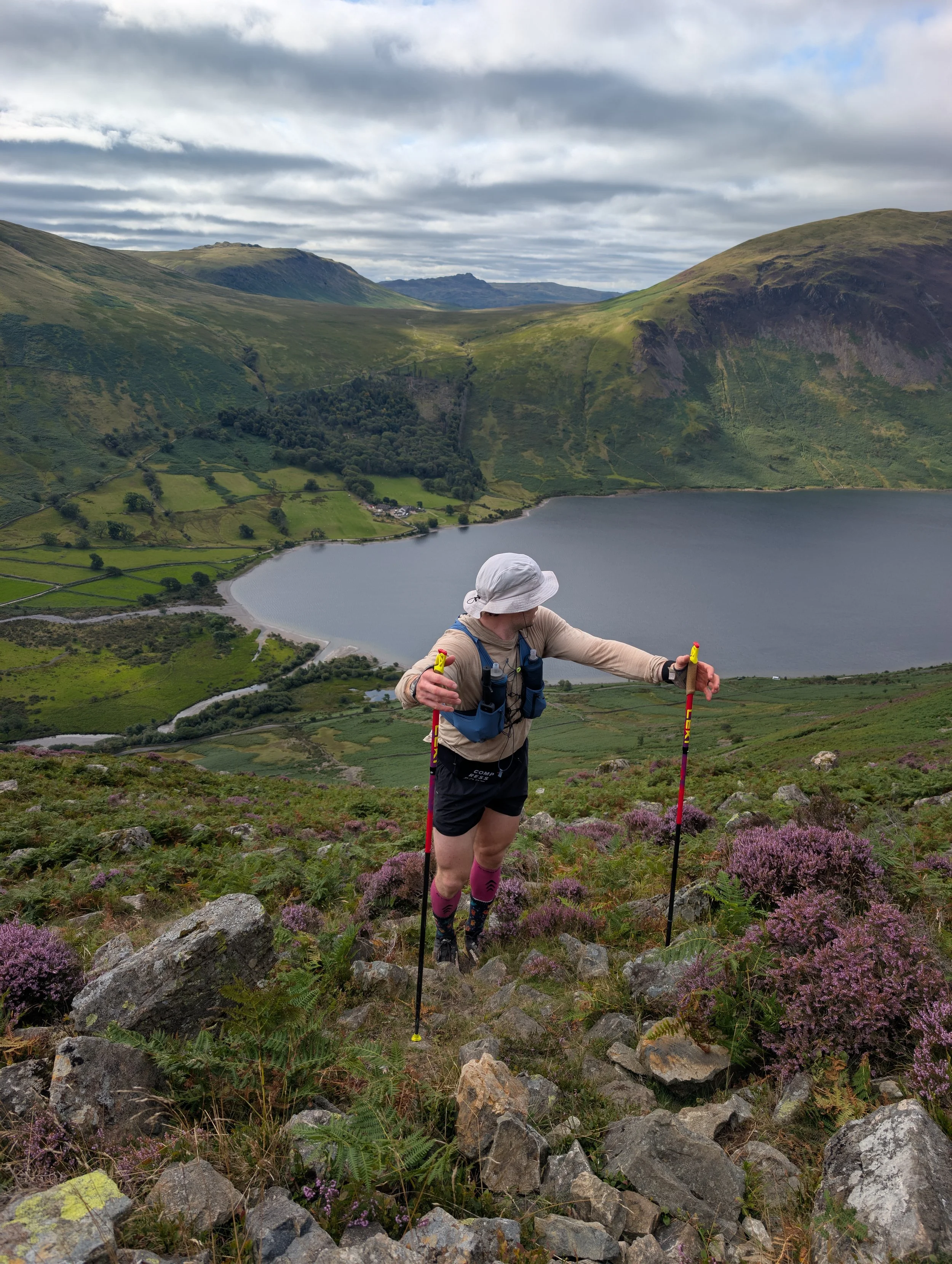
Help support what I do
I created and I run this website in order to help inform, amaze, inspire people (for free) to get outside and explore the adventurous side of the UK and beyond.
Although I do run some google ads, I have limited them in order to make your experience on this website far more enjoyable.
If you’d like to support this website, you can use the affiliate links below to book your accommodation or transport. These come at no extra cost to you, but help keep this site running.
If you are felling generous you can also buy me a coffee to say thank you, and give me a follow on social media.
Book your car using Discover Cars
Book your accommodation using Booking.com
Thank you, and if you have any questions, leave them in the comments below or drop me an email!
